
Maths: How Compound Interest Drives Exponential Growth
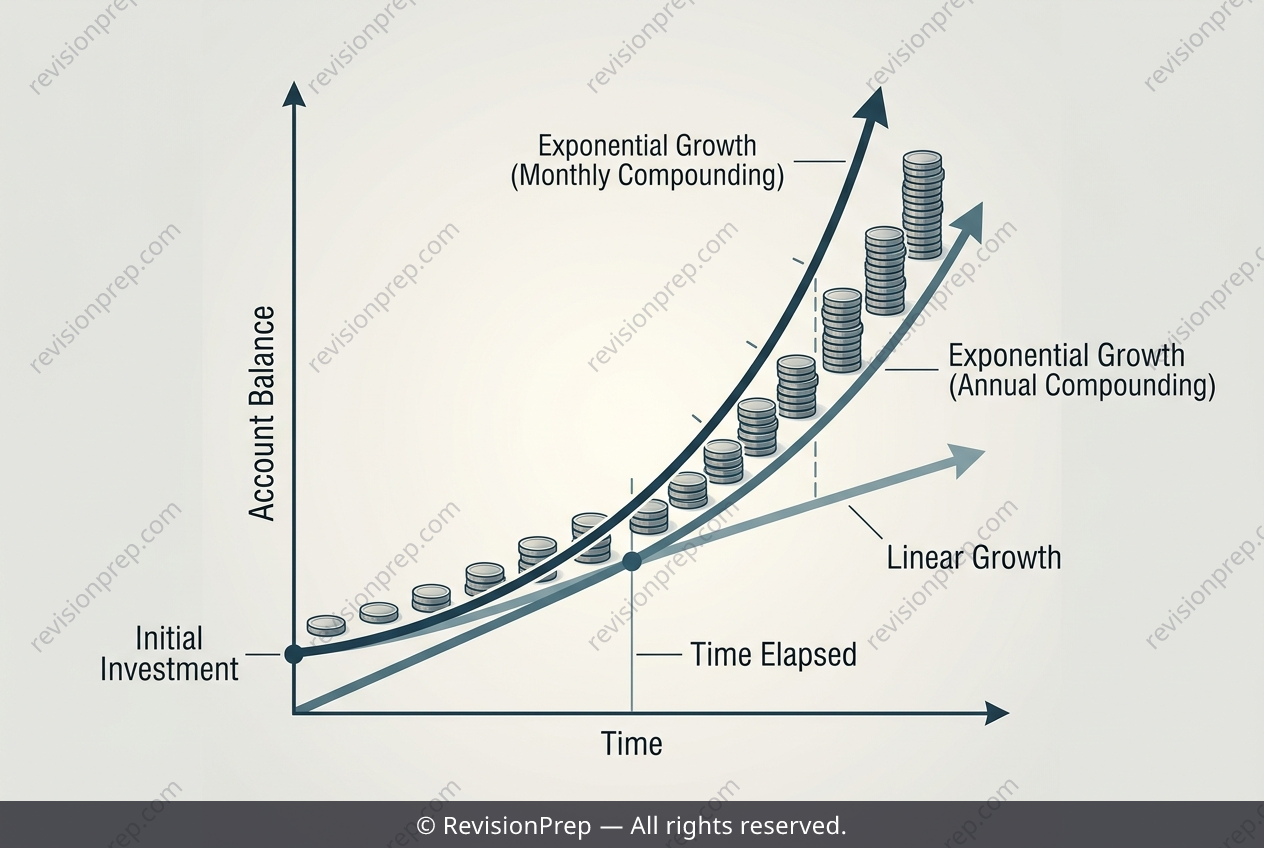
Compound interest is the engine behind long-term saving and debt, where a balance grows not by a fixed amount each period but by a fixed percentage of whatever is already there. This produces exponential growth: because each year's interest is calculated on a larger principal, the curve steepens over time, and the annual increase itself keeps rising. The core relationship is A = P(1 + r)^n, where P is the principal, r the rate per period, and n the number of periods. Compounding frequency changes how that formula is applied: interest paid more often means the rate is divided across more periods, as in A = P(1 + r/k)^(kt), so the effective growth is slightly larger. Understanding this connection between rate, frequency, and time lets you judge whether a change in compounding terms genuinely matters for a given investment.
Start practising IB questions today
150,000+ IB-styled questions, criteria-mapped and instantly accessible.