
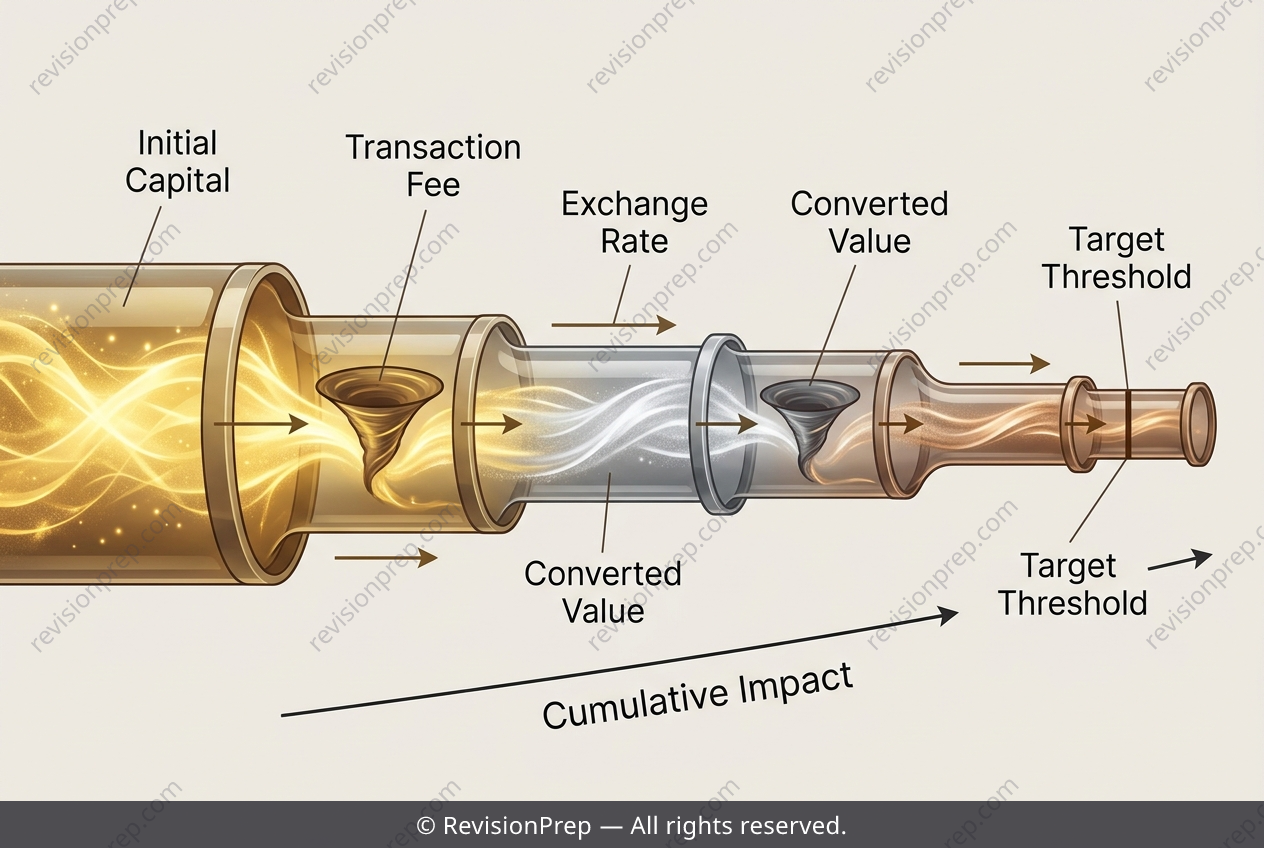
Maths: How Sequential Fees Reduce Currency Value
Sequential financial transformations reveal how money behaves when it passes through several currencies, each step quietly eroding value through fees. The core idea is simple: at every stage, deduct the transaction cost first, then apply the exchange rate. So a conversion becomes (amount − fee) × rate, repeated as many times as there are currencies in the chain. This matters because exchange rates alone rarely tell the full story. Fees compound sequentially, meaning an early deduction shrinks the base on which every later rate operates, so small charges can quietly accumulate into a meaningful loss. Understanding the order of operations — subtract, then multiply — is what separates an accurate calculation from a misleading one. The parts connect through a single thread: each output becomes the next input. Working backwards from a target amount then reveals the maximum fee a traveller can tolerate, turning a straightforward conversion into a practical constraint on cost.
Start practising IB questions today
150,000+ IB-styled questions, criteria-mapped and instantly accessible.