
Maths: Purchasing Power Parity and Currency Misalignment
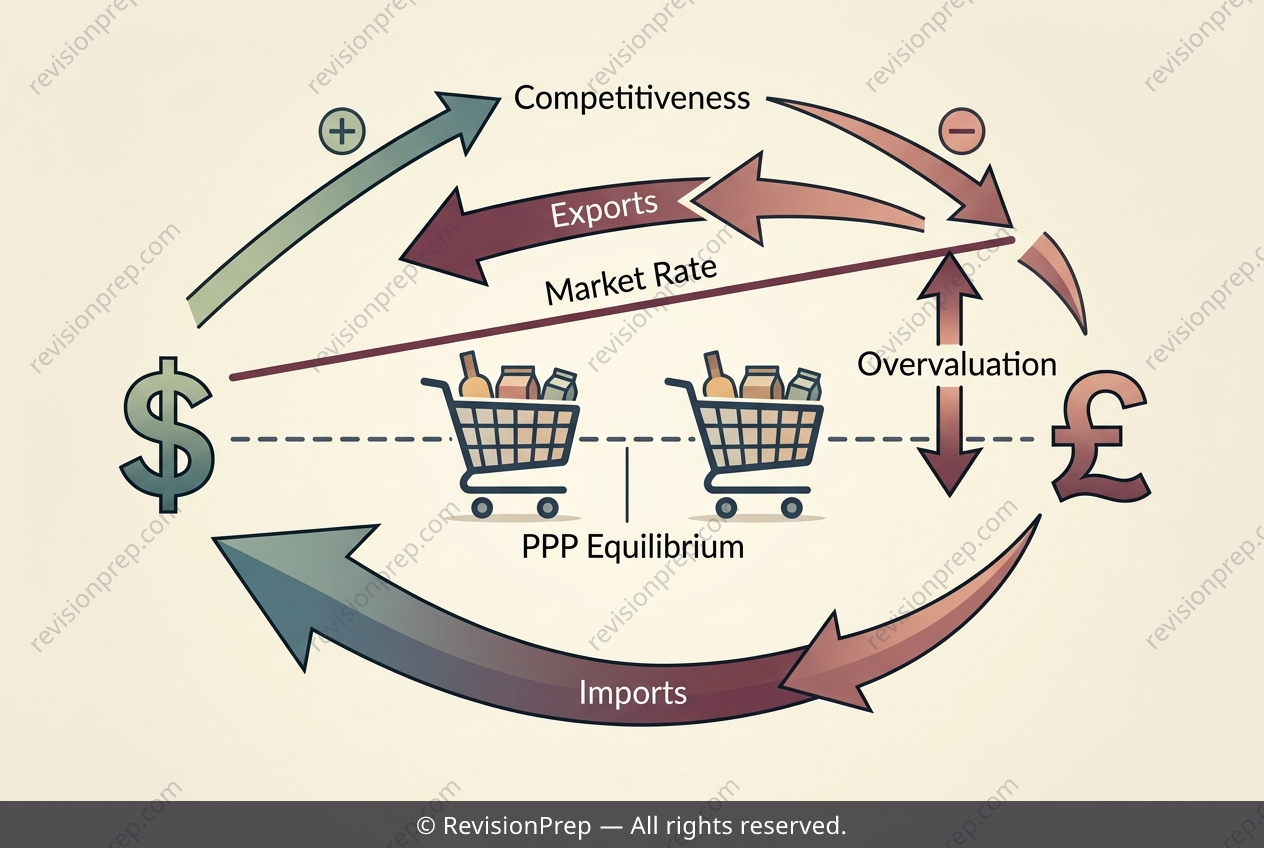
Purchasing Power Parity (PPP) is the idea that, in the long run, exchange rates should adjust so that identical goods cost the same across countries. Plotting exchange rate against a price index, the PPP equilibrium line marks where a currency is fairly valued — the point where the plotted curve and the equilibrium line intersect. This matters because real market rates rarely sit at that equilibrium. When they diverge, a currency is described as overvalued or undervalued, and the size of that gap is measured as a percentage: (actual rate − PPP rate) ÷ PPP rate × 100. That single figure connects the graph to the real economy, since an overvalued currency makes a country's exports more expensive abroad, weakening demand and competitiveness. Understanding this link between equilibrium rates, misalignment, and trade flows is central to financial mathematics.
Start practising IB questions today
150,000+ IB-styled questions, criteria-mapped and instantly accessible.