
Maths: Recipe Scaling and the Limits of Proportion
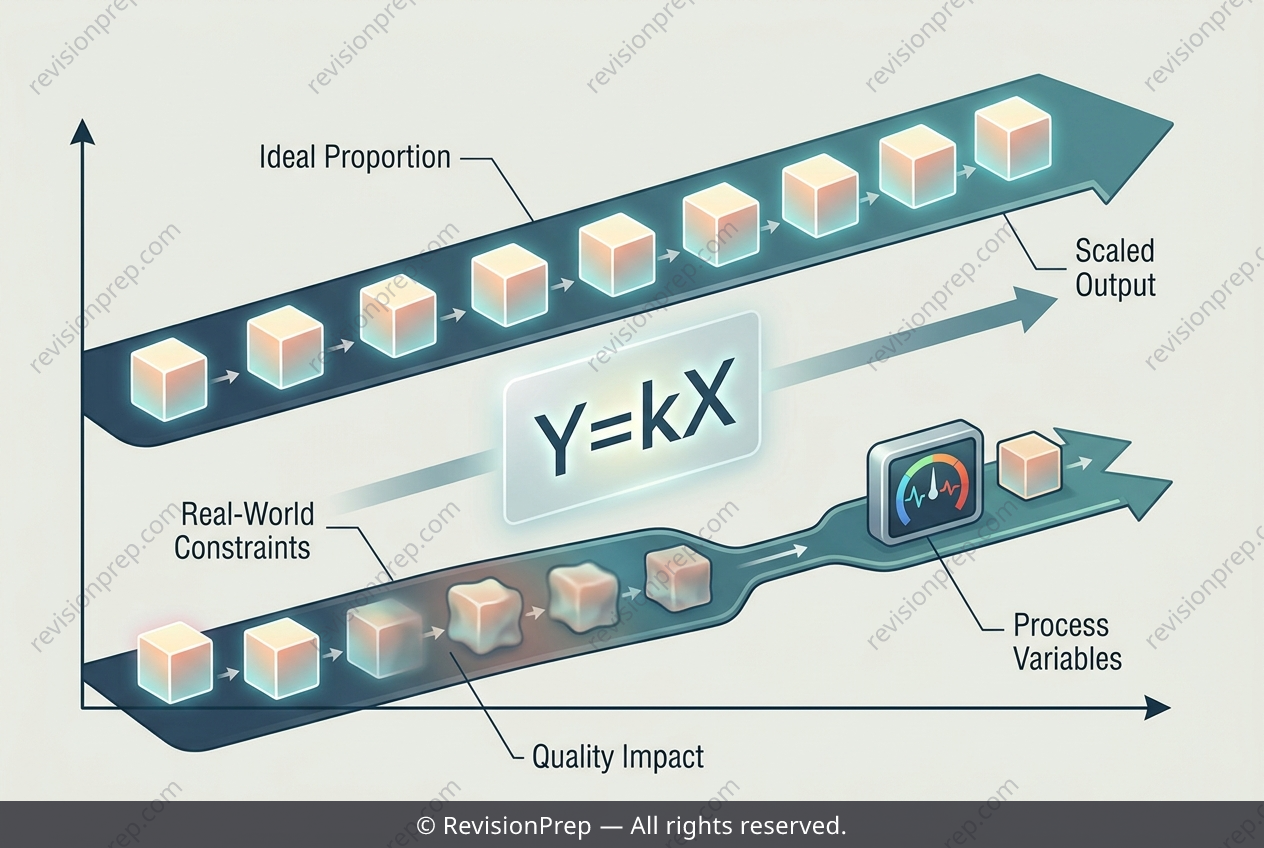
Scaling a recipe is one of the simplest examples of mathematical modelling — and one of the most revealing. At its core, direct proportion assumes that every quantity grows by the same multiplier, so a scaling factor such as 120 ÷ 24 lets us multiply each ingredient by an identical value and preserve the recipe's internal ratios. Flour, sugar and butter all rise together, keeping the flavour balance intact. Yet real-world applicability is where the model becomes interesting. Not everything scales linearly: leavening agents depend on non-linear chemical reactions, and mixing ever-larger batches strains ordinary equipment, so texture and rise can suffer. Time behaves differently again — batches are baked sequentially, so total baking time is the number of batches multiplied by the time per batch, while batter waiting to be baked is exposed to premature activation of leavening agents. Understanding where proportion holds, and where it breaks down, is the heart of this topic.
Start practising IB questions today
150,000+ IB-styled questions, criteria-mapped and instantly accessible.