
Physics: Mass vs Weight and the Meaning of W = mg
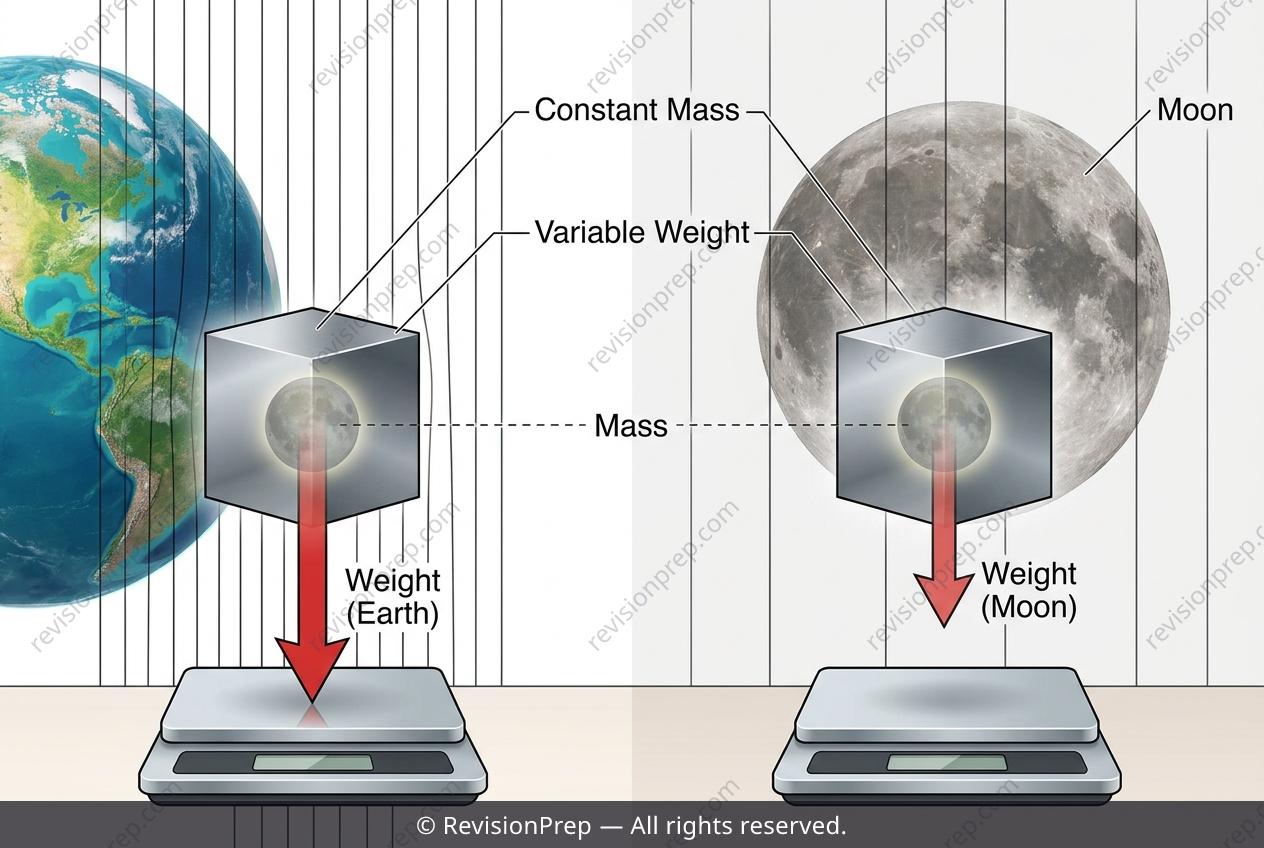
Mass and weight are often used interchangeably in everyday language, yet physics treats them as fundamentally different quantities. Mass measures the amount of matter contained in an object and is expressed in kilograms, while weight is the gravitational force acting on that mass, given by W = mg, where g is the gravitational field strength of the surrounding environment. This distinction matters because it shapes how we describe motion, forces and equilibrium in different locations. An object's mass stays constant whether it sits on Earth or the Moon, but its weight changes with g, which is roughly 9.8 N kg⁻¹ on Earth and only 1.6 N kg⁻¹ on the Moon. Because mass is intrinsic and location-independent, it is the more fundamental property; weight, being a force, depends on the external gravitational field. Understanding how these quantities connect through W = mg is essential for analysing free body diagrams and forces correctly.
Start practising IB questions today
150,000+ IB-styled questions, criteria-mapped and instantly accessible.