
Physics: Free Fall, Air Resistance, and Net Force
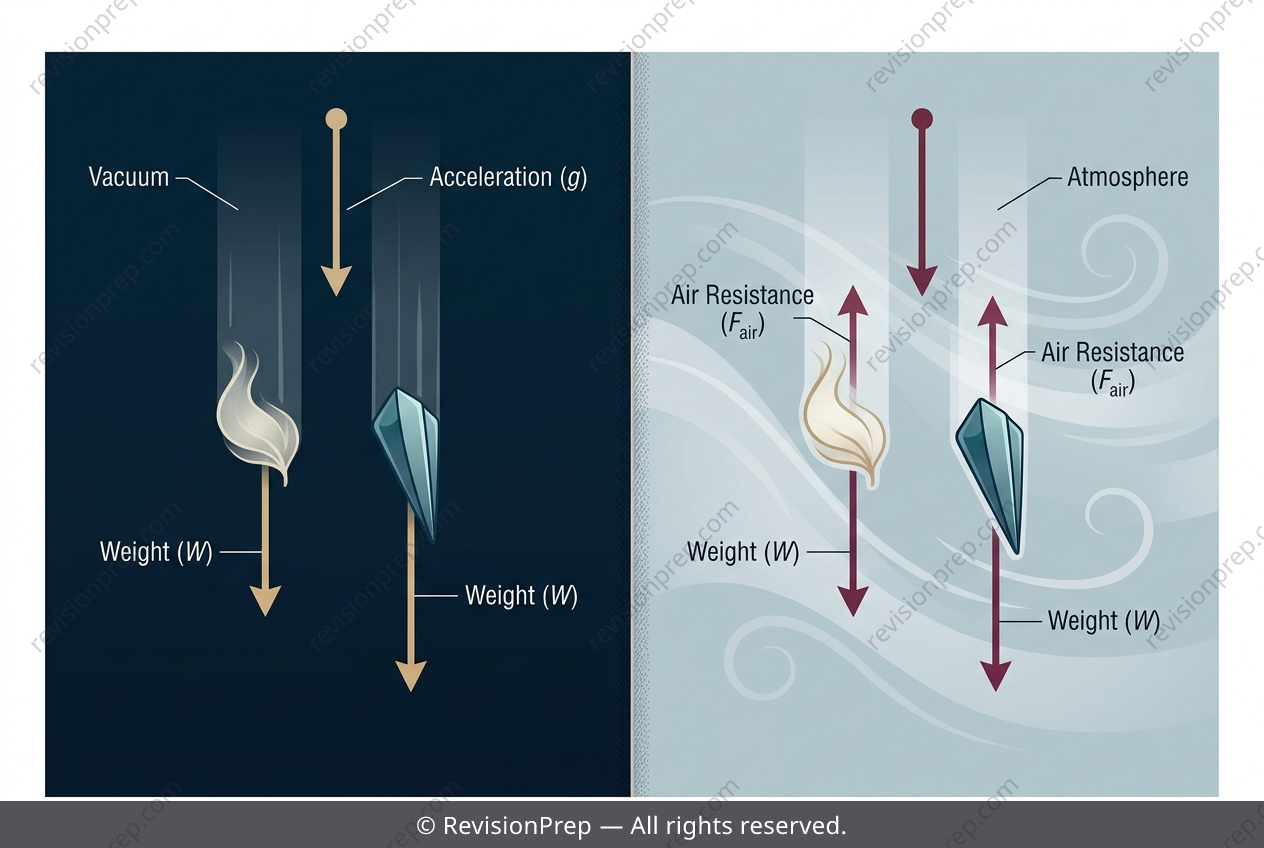
Why does a feather drift lazily to the ground while a steel ball thuds down almost instantly? The answer lies in free fall, air resistance, and net force. In a vacuum, gravity is the only force acting on a falling object, so its weight W = mg is also the net force. Newton's second law then gives acceleration a = W/m = mg/m = g. The mass cancels, meaning every object — feather or steel ball — accelerates at the same rate when nothing else interferes. That elegant result matters because it separates gravity's true behaviour from the effects of the world around us. In everyday air, a drag force acts upward alongside weight, reducing the net downward force and therefore the acceleration. Because the feather's weight is tiny, drag affects it dramatically, while a heavy steel ball barely notices. Understanding this connection between weight, net force, and acceleration explains why vacuum demonstrations look so different from ordinary experience.
Start practising IB questions today
150,000+ IB-styled questions, criteria-mapped and instantly accessible.