
Maths: The Hidden Impact of Rounding Errors
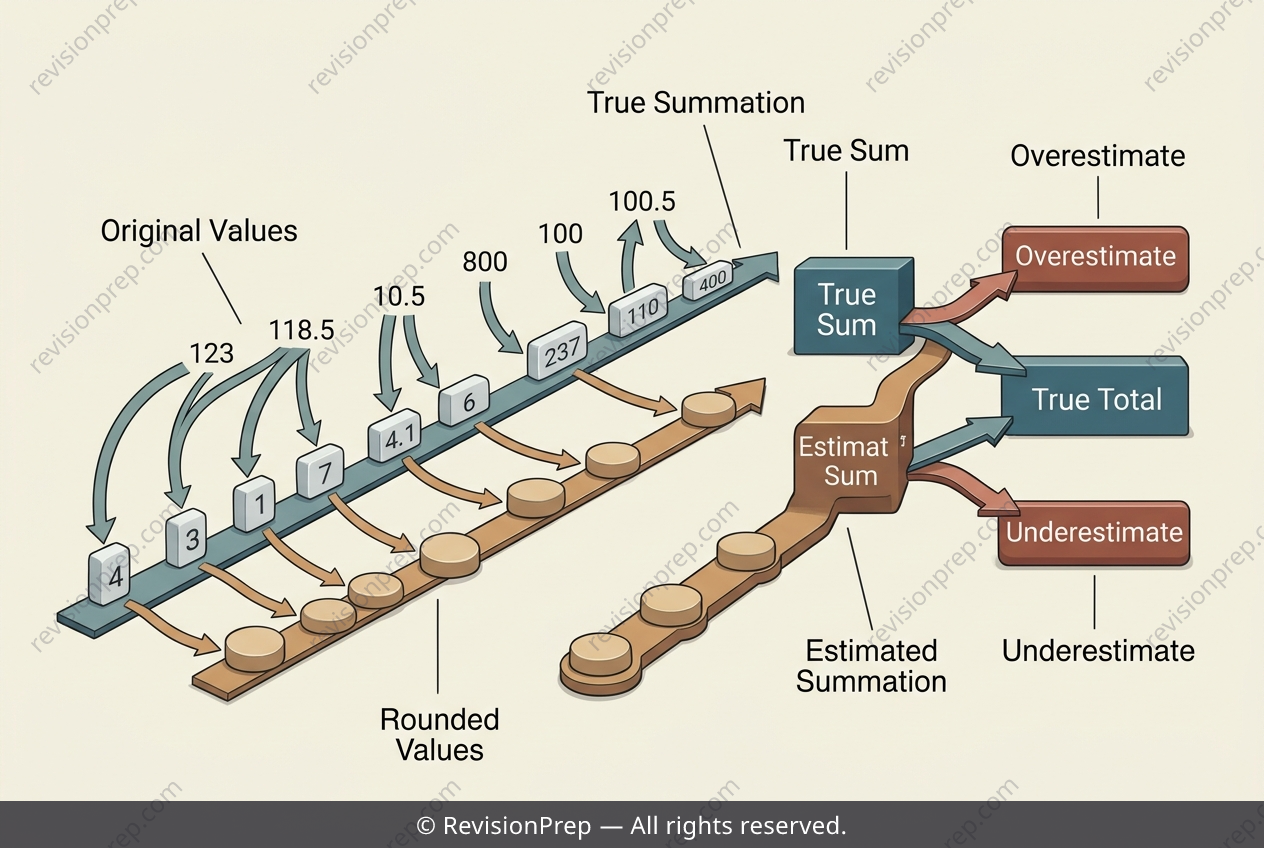
Rounding each item price to the nearest £100 before summing is a practical estimation technique, but it introduces a subtle complication: the rounded total may not match the true total. Every price whose last two digits fall between £50 and £99 rounds upward, adding a small surplus, while every price ending in £01 to £49 rounds downward, creating a small deficit. Whether the final estimate overshoots or undershoots the true sum therefore depends entirely on which rounding direction dominates across all the items. This matters because estimation is rarely just about speed — it shapes real decisions. In a construction budget, the direction of the error carries genuine financial consequences. An overestimate guarantees enough money is set aside to cover actual costs, whereas an underestimate risks a shortfall, forcing delays or emergency funding. Understanding how individual rounding errors accumulate into a net bias, rather than cancelling neatly, is the key insight: the sum of many small rounded values can drift systematically above or below the exact total, and recognising that drift is what makes an estimate genuinely useful.
Start practising IB questions today
150,000+ IB-styled questions, criteria-mapped and instantly accessible.