
Maths: Using Exponents to Calculate Volume
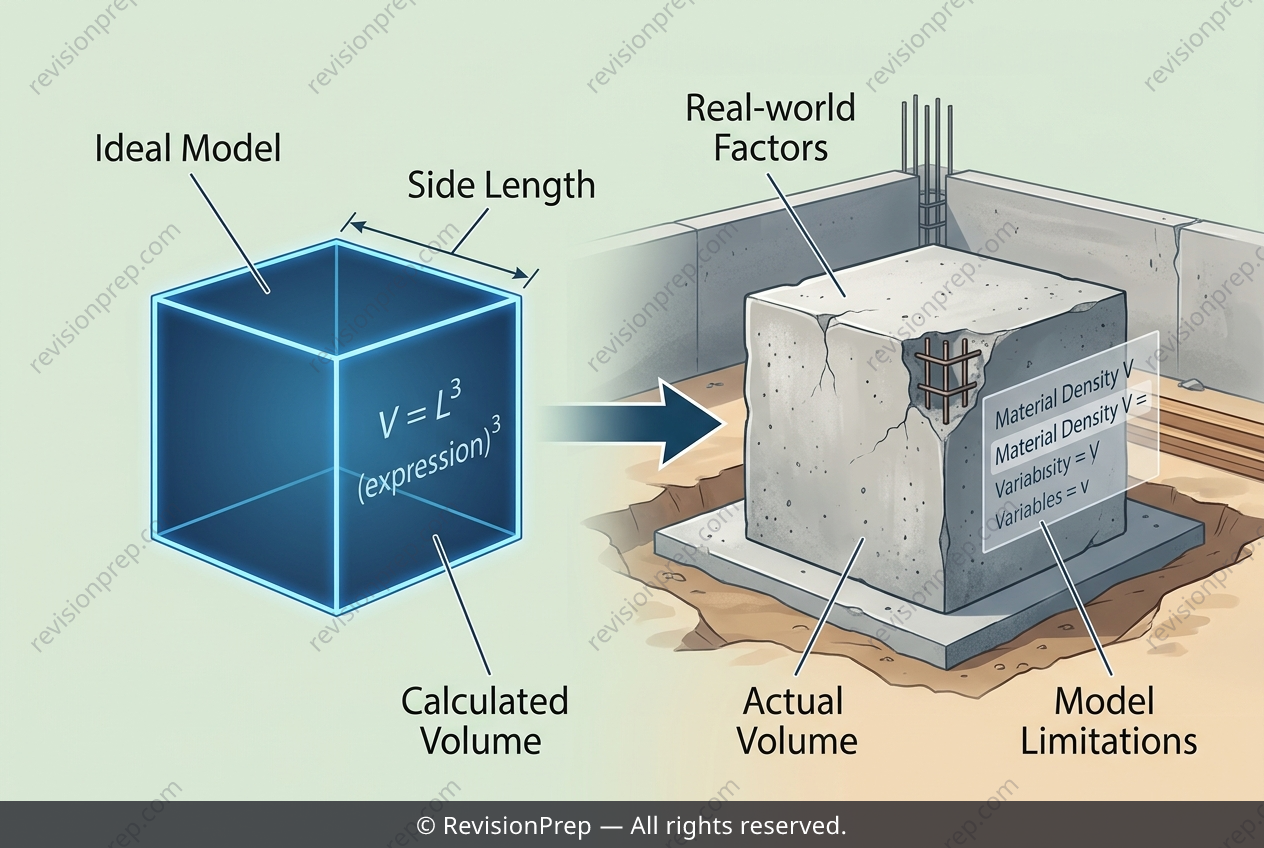
Exponents and roots are not just abstract algebraic rules — they are the language engineers use to model real physical quantities. When a solid's dimensions are expressed as powers, its volume follows directly through the power of a product rule: cubing a side length such as 3x² means cubing both the coefficient and the variable part, so (3x²)³ expands as 3³ · (x²)³, combining numerical and algebraic exponents into a single expression. This matters because such models let us predict how volume scales as dimensions change, which is central to estimating materials like concrete. Yet every model rests on assumptions. Treating a block as a perfect cube with exact, uniform sides ignores construction tolerances, formwork thickness, measurement uncertainty in the scaling factor, and surface irregularities or voids. Understanding both the algebraic structure and its real-world limits is what turns a formula into genuine mathematical modelling.
Start practising IB questions today
150,000+ IB-styled questions, criteria-mapped and instantly accessible.