
Physics: Conservation of Momentum in Rocket Propulsion
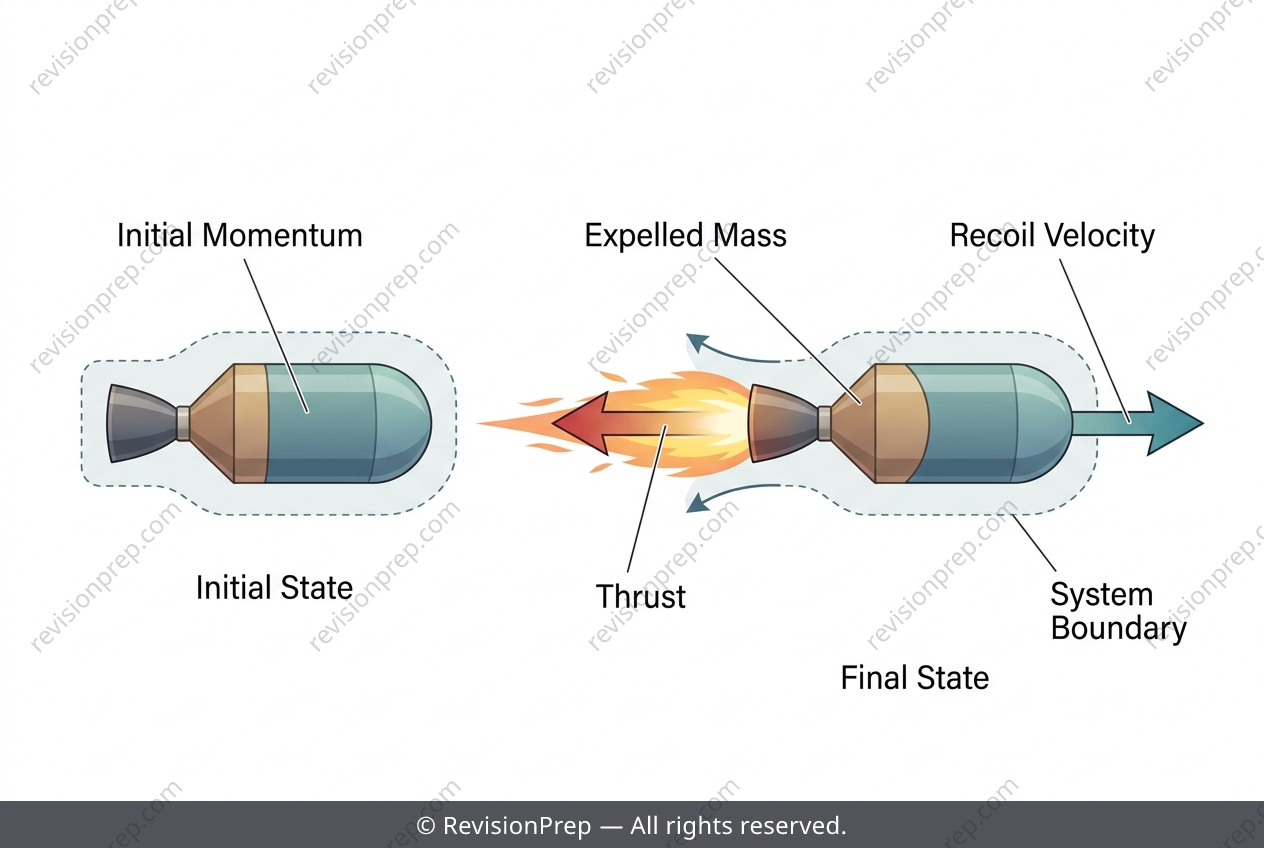
Conservation of linear momentum states that, absent external forces, the total momentum of an isolated system remains constant. This principle governs everything from collisions to rocket launches, and it underpins much of Newtonian mechanics. In deep space, where no external forces act, a spacecraft and its expelled propellant form just such an isolated system, so their combined momentum before and after firing must be equal. Momentum is the product of mass and velocity, p = mv, and conservation means the total before equals the total after. For rockets, this connects directly to Newton's third law: expelling propellant backward pushes the spacecraft forward. Because the propellant leaves at a velocity relative to the spacecraft, its speed in the rest frame is the spacecraft's velocity minus the exhaust speed. Tracking these velocities carefully reveals how mass and velocity trade off, and why carrying all propellant from the start places fundamental limits on achievable velocity change.
Start practising IB questions today
150,000+ IB-styled questions, criteria-mapped and instantly accessible.