
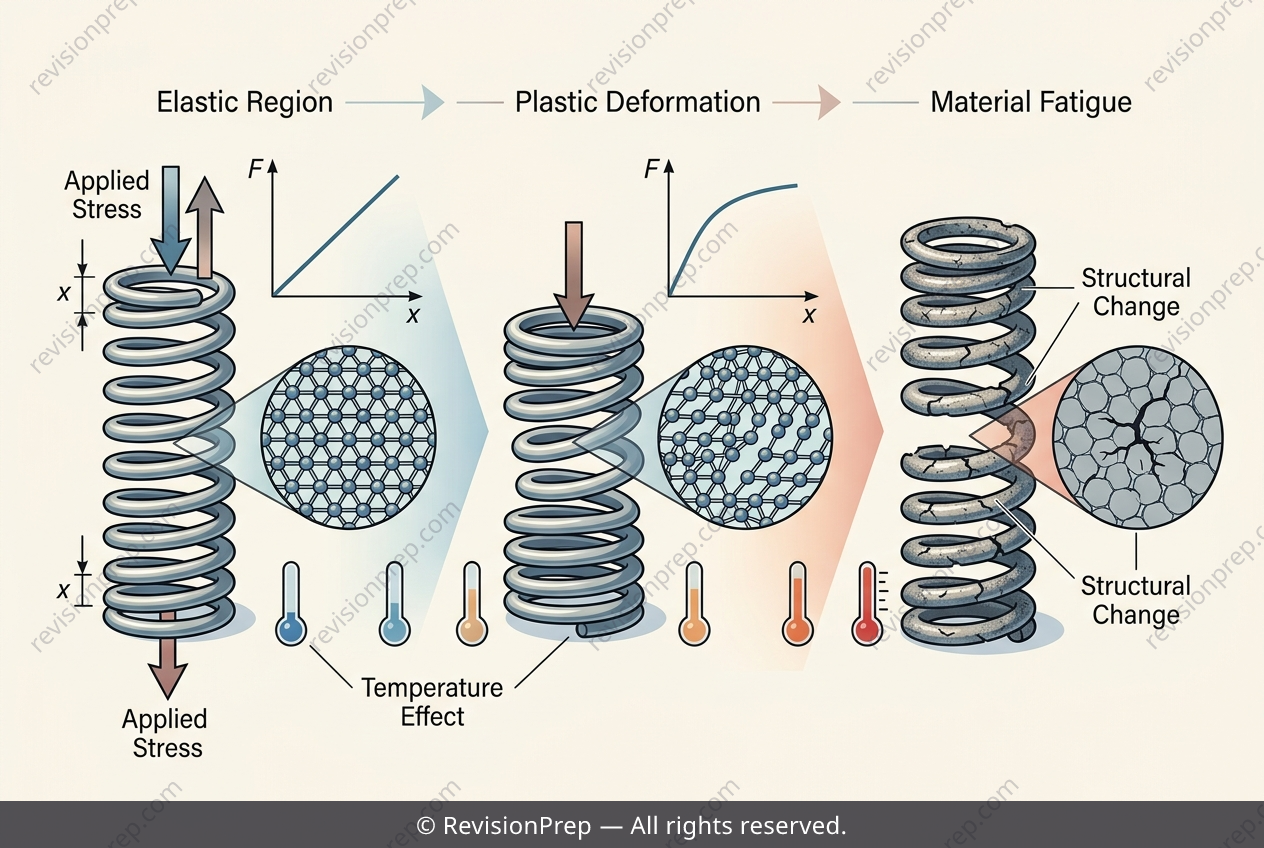
Physics: Hooke's Law, Elastic Limits, and Spring Fatigue
Hooke's Law describes an ideal spring through F = kx, where the spring constant k measures stiffness and the extension x stays proportional to the applied force. Real materials, however, only obey this linear relationship within their elastic limit. Temperature shifts the picture further: heating weakens interatomic bond stiffness and lowers k, while cooling stiffens the bonds and raises k, so the spring drifts away from ideal behaviour. Beyond the elastic limit, the force–extension graph turns non-linear and plastic deformation becomes permanent, leaving the spring unable to return to its original length. Repeated compression cycles add another dimension, gradually accumulating microscopic cracks and dislocations within the steel's crystal structure. This fatigue steadily reduces k and the spring's shock-absorbing capacity, and in extreme cases causes sudden fracture. Understanding how stiffness, temperature, and material degradation interact explains why suspension springs are engineered with safety margins well inside their elastic limits.
Start practising IB questions today
150,000+ IB-styled questions, criteria-mapped and instantly accessible.