
Chemistry: Catalysis, Emissions and Hidden Costs
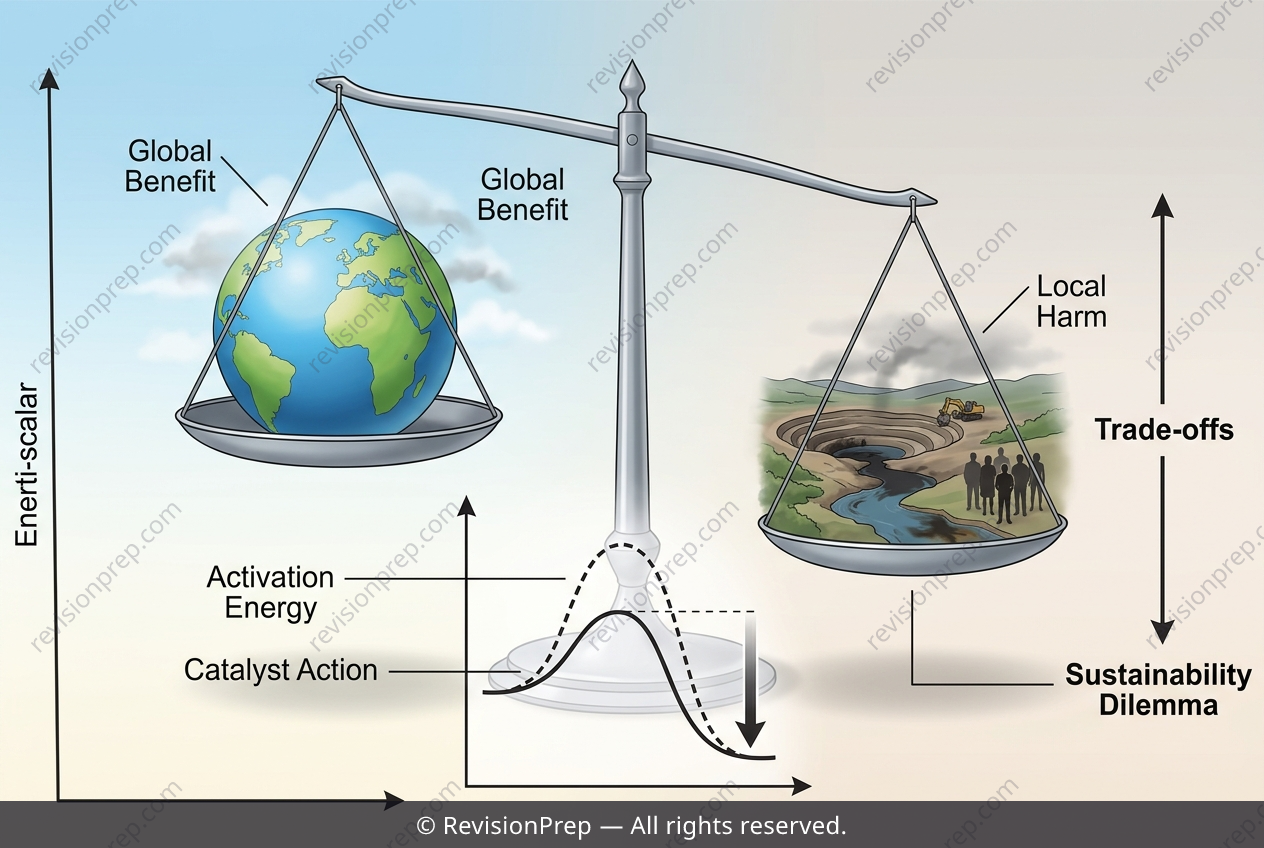
Collision theory and activation energy sit at the heart of why chemical reactions happen at all — and how fast. In essence, for particles to react, they must collide with enough kinetic energy to overcome an energy barrier, the activation energy (Eₐ). Only those collisions meeting or exceeding this threshold are “successful.” A catalyst works by offering an alternative reaction pathway with a lower Eₐ, meaning a far greater proportion of colliding molecules now clear the barrier. This single shift multiplies the frequency of effective collisions, dramatically raising the reaction rate without altering the equilibrium position or the overall energy change of the reaction. Why does this matter beyond the lab? Because lowering Eₐ directly translates into lower energy demand. In an industrial process like the Haber-Bosch synthesis of ammonia, a catalyst that cuts Eₐ by a given amount allows the reaction to run at a reduced temperature. Less thermal energy required means less fuel burned — and fewer CO₂ emissions. But this technological win is not free. The new catalyst’s rare-earth component is mined under conditions that generate toxic waste, contaminating local water and harming nearby communities. The benefit (a global, diffuse reduction in greenhouse gases) and the cost (a concentrated, local health and environmental burden) are not evenly distributed. Understanding this trade-off — where the mechanism of catalysis meets the socio-scientific reality of resource extraction — is the core of evaluating real-world chemistry.
Start practising IB questions today
150,000+ IB-styled questions, criteria-mapped and instantly accessible.