
Pure Substances, Mixtures and Separation
Classify matter by melting behaviour, particle size and solubility — then justify how you'd separate it.
Quick facts
Every MYP 5 chemistry paper eventually asks you to look at a melting point, a cloudy liquid, or a solubility curve and decide: pure or mixture, and how would you separate it? This topic gives you the toolkit. You'll learn why a sharp melting point proves purity but not identity, how solutions, colloids and suspensions differ by particle size, what actually changes solubility, and why every separation technique choice comes down to one question — which physical property is different between the components? These are exactly the skills examiners test in classify-and-justify data tasks, where a bare label with no evidence scores zero. This teaser covers the five ideas worth the most marks; the full revision note walks through every definition, worked example and common trap in detail.
What you’ll be able to do
Pure Substances vs Mixtures
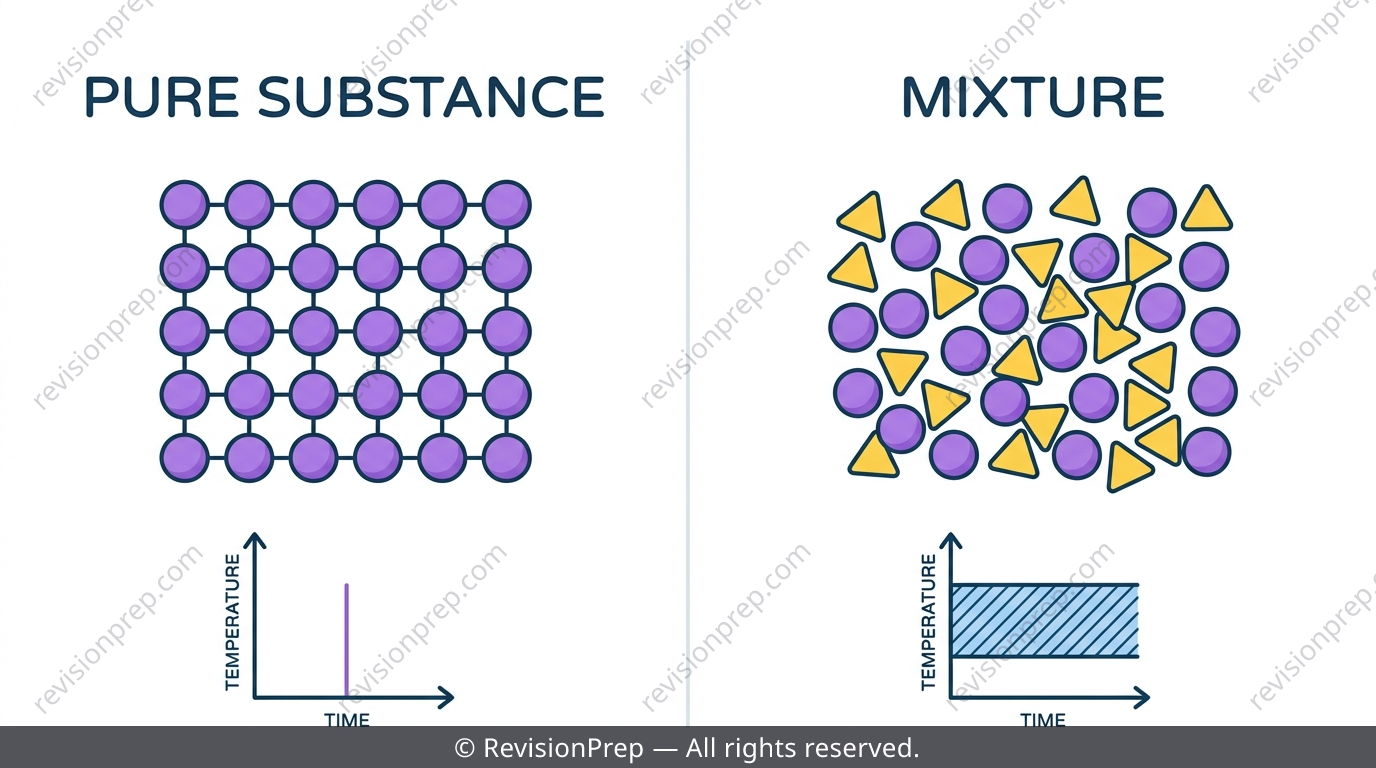
A pure substance — an element or a compound — contains only one type of particle in a fixed composition, so its physical properties are constant and reproducible. A mixture combines two or more pure substances in a ratio that can vary, and each component keeps its own properties. Compounds like NaCl contain two elements chemically bonded, but that still counts as pure — don't confuse 'made of two elements' with 'is a mixture'.
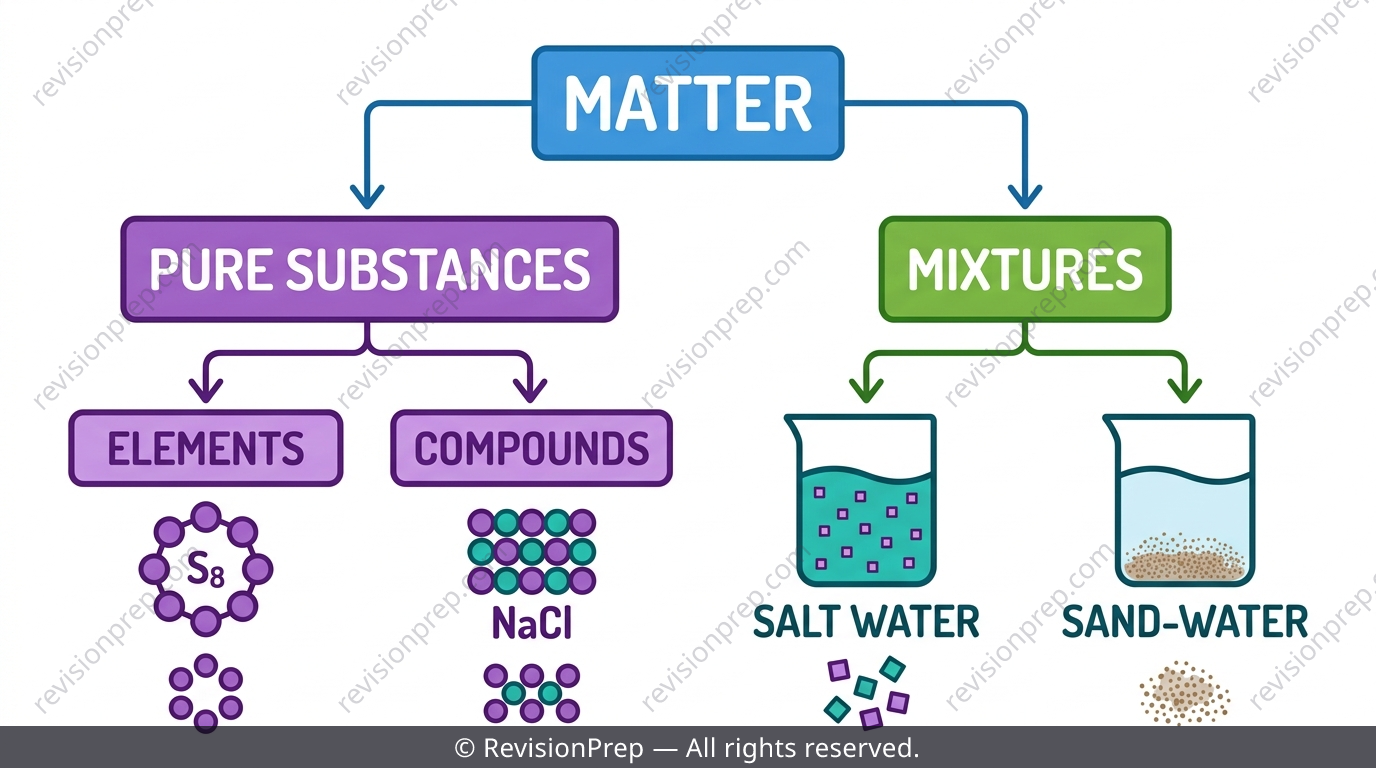
| Feature | Pure substance | Mixture |
|---|---|---|
| Particle types | One | Two or more |
| Composition | Fixed | Variable |
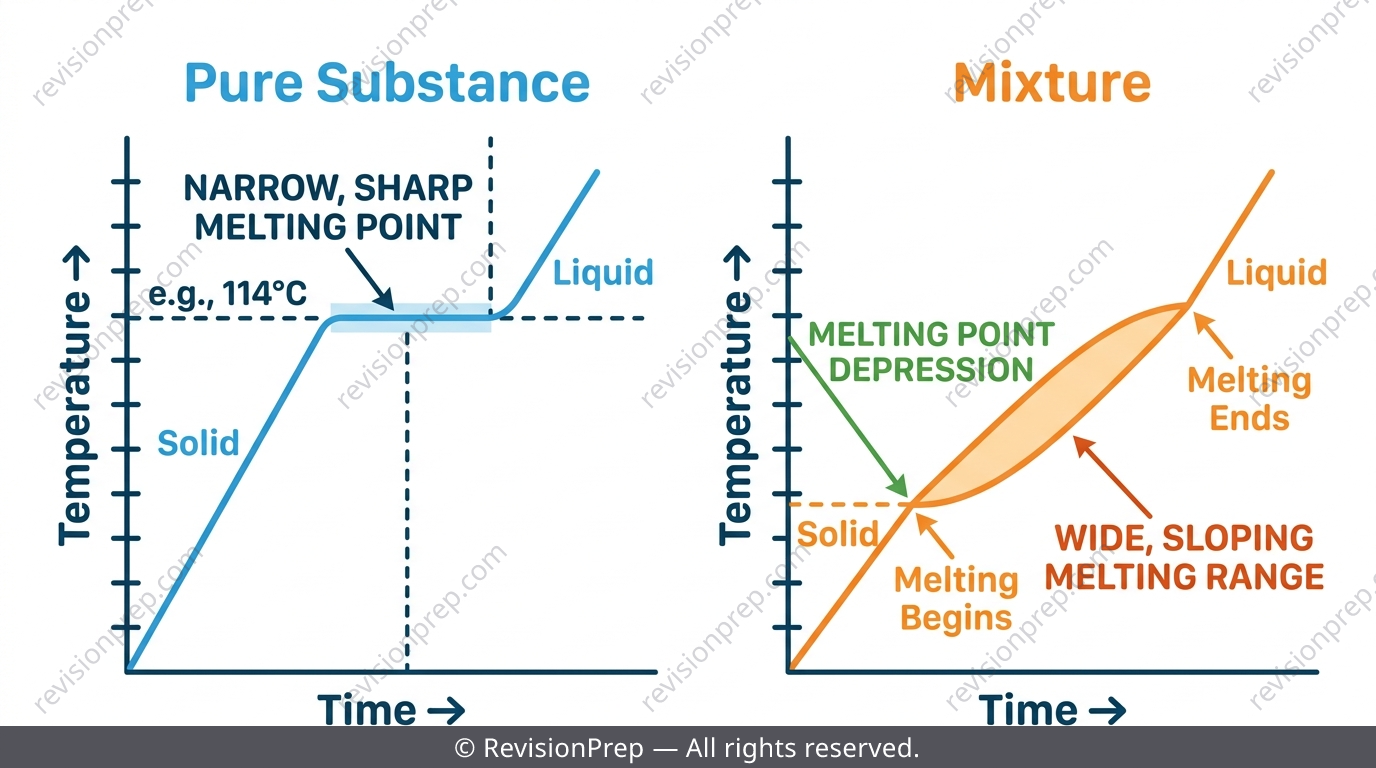
| Melting point | Sharp value | Range, often depressed |
Exam tip
If a question shows a substance with two elements, check whether they're chemically bonded (compound = pure) or physically combined (mixture) before you classify it.
Common mistake
Calling NaCl 'a mixture' or 'impure' just because it contains two elements — that's confusing compound with mixture.
Mini summary
One type of particle + fixed composition = pure; variable combination of substances = mixture.
Melting Point as a Purity Test
A sharp, narrow melting range (often within about 1 °C) is strong evidence of purity, while a wide range that sits below the true value signals a mixture — foreign particles disrupt the regular lattice packing. Crucially, a sharp range only proves purity; to claim identity, you must match the value against a known literature melting point for that exact substance. A range close to but not exactly matching one reference value usually means an impure sample of that substance, not a brand-new pure compound.
Exam tip
Always separate your answer into two claims: 'sharp range → pure' and 'matches reference X → likely identity of X'. Never merge them into one sentence.
Common mistake
Concluding a substance is a completely new pure compound just because its range doesn't exactly equal any literature value.
Mini summary
Sharp range = pure; matching a literature value = identity. You need both pieces of evidence, not one.
Solutions, Colloids and Suspensions
Not all mixtures disperse the same way — particle size decides the category. Solutions disperse down to individual ions or molecules, never settle, and don't scatter light. Suspensions have visibly large particles that settle out and are removed by ordinary filter paper. Colloids sit in between: too small to settle, but big enough to scatter a light beam, producing the Tyndall effect.
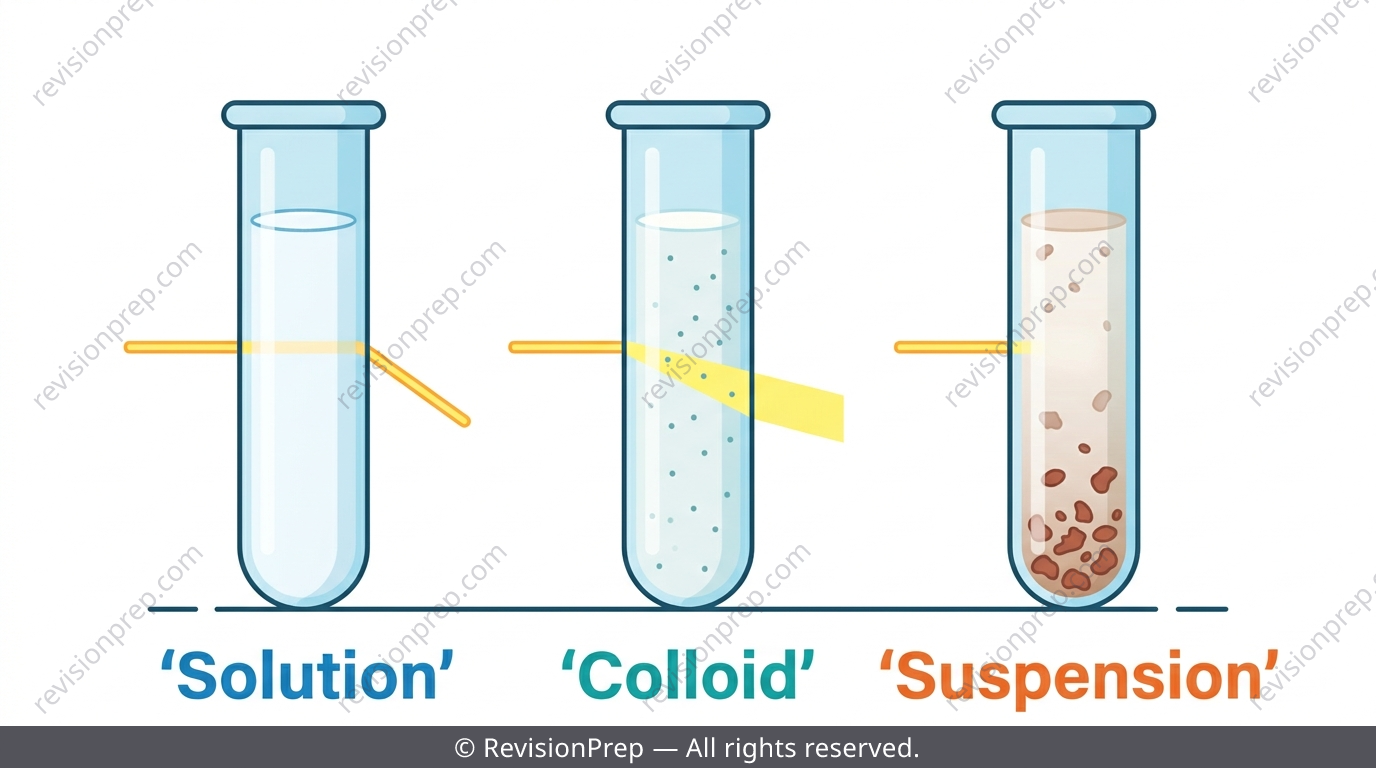
| Property | Solution | Colloid | Suspension |
|---|---|---|---|
| Settles on standing? | No | No | Yes |
| Filterable? | No | No | Yes |
| Scatters light (Tyndall)? | No | Yes | Usually cloudy |
Exam tip
Never classify by appearance alone — run the settling, filtration and Tyndall tests in that order before you commit to a label.
Common mistake
Calling a cloudy sample a suspension just because it looks cloudy, when only the settling/filtration/Tyndall tests can actually distinguish it from a colloid.
Mini summary
Particle size order: solution < colloid < suspension — use three diagnostic tests, not appearance, to classify.
Solubility, Saturation and What Changes It
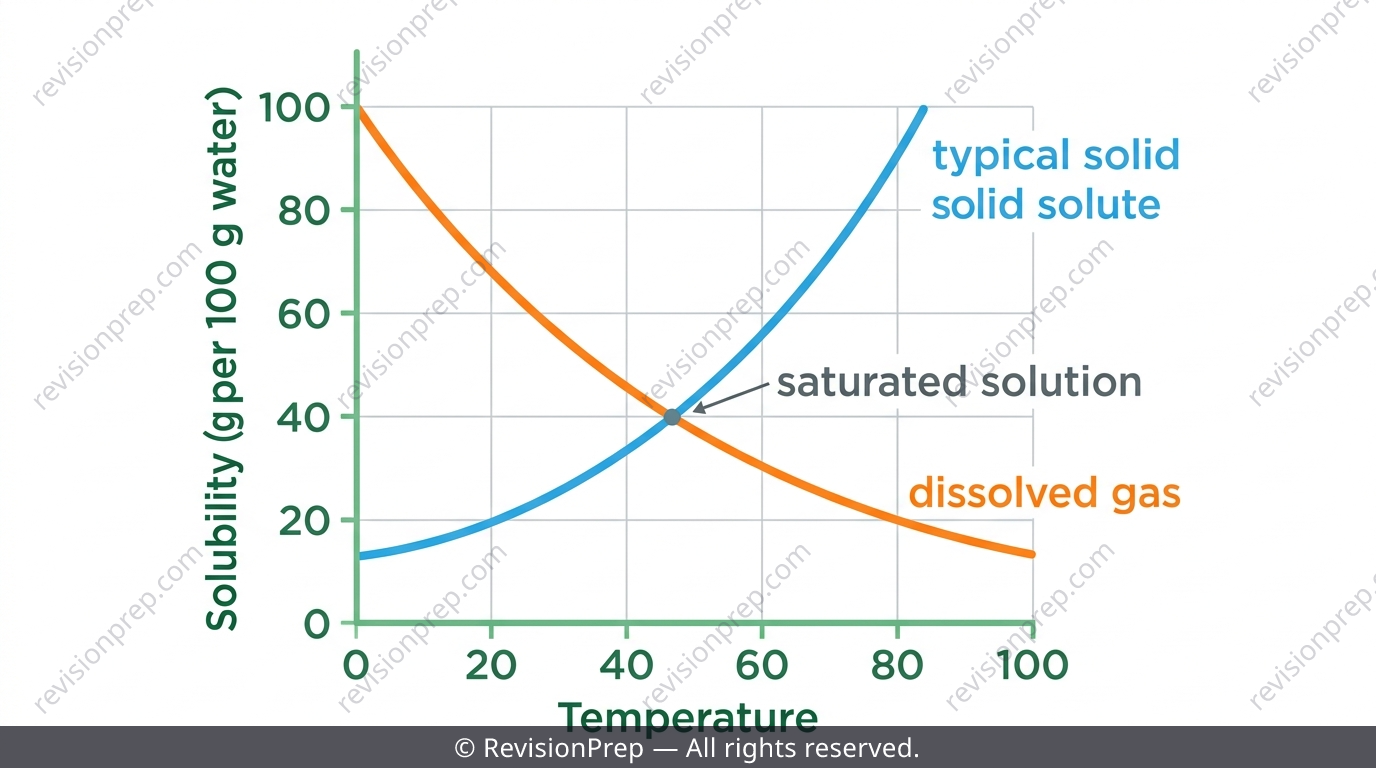
Solubility is the maximum mass of solute that dissolves in a fixed mass of solvent (usually 100 g water) at a given temperature, forming a saturated solution. Below that maximum the solution is unsaturated; carefully cooling a hot saturated solution can trap more solute than the equilibrium amount, creating an unstable supersaturated solution. For most solids, solubility rises with temperature, but for gases it falls as temperature rises (and rises with pressure) — which is exactly why a warm fizzy drink goes flat faster.
Exam tip
Stirring, crushing, and heating change how fast the maximum dissolves, not the maximum itself — never say they 'increase solubility'.
Common mistake
Saying stirring or crushing a solid 'increases its solubility' — these only speed up the rate of dissolving, not the actual solubility value.
Mini summary
Solid solubility ↑ with temperature; gas solubility ↓ with temperature and ↑ with pressure; rate factors ≠ solubility itself.
Choosing a Separation Method
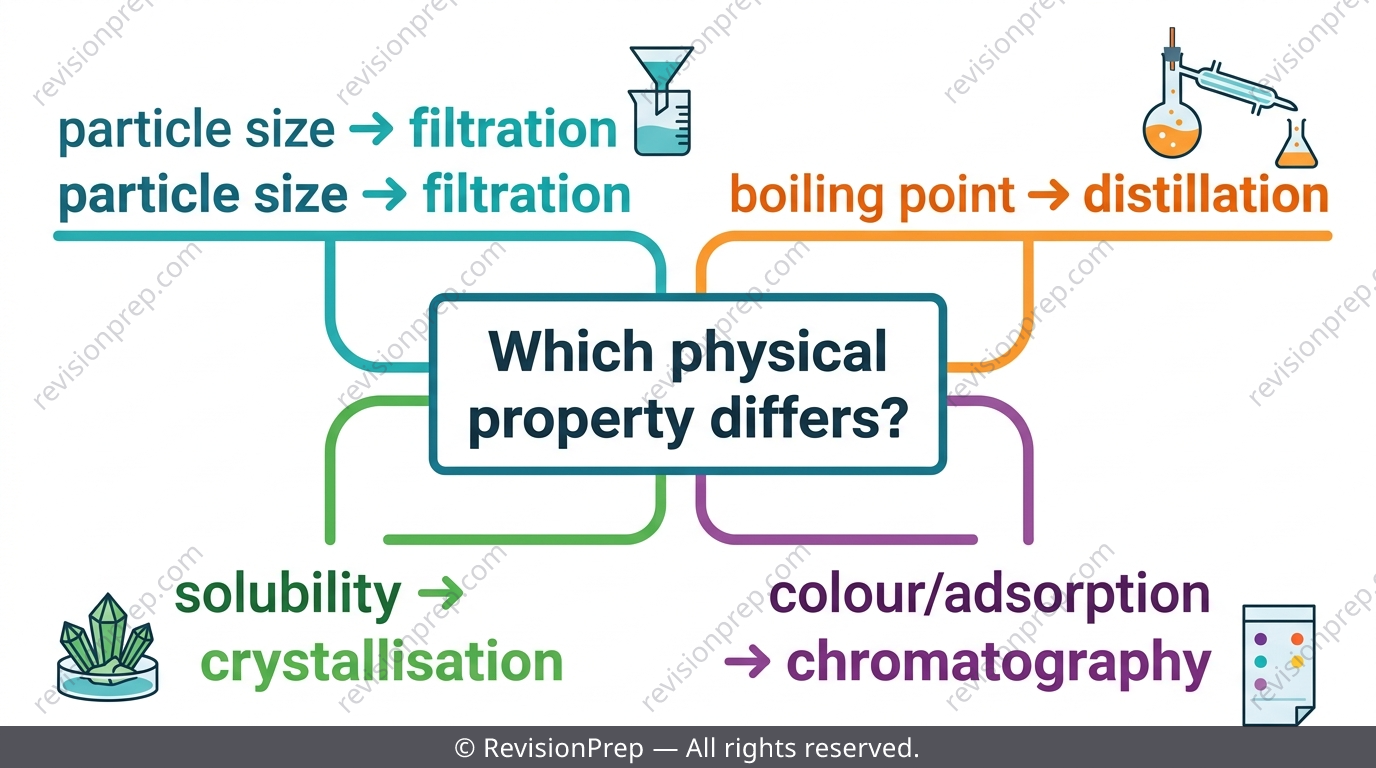
Every separation technique — filtration, distillation, chromatography and more — works because one physical property differs between the components: particle size, magnetism, boiling point, solubility, or colour/adsorption. MYP data tasks reward you for naming that specific property, not just naming the technique. A justification like 'use filtration' with no reasoning tied to the data scores zero for the justification mark.
Exam tip
Structure separation answers as: name the technique → name the physical property that differs → explain how that property lets the components split apart.
Common mistake
Naming a separation technique without stating which physical property justifies the choice — this loses the justification mark even if the technique is correct.
Mini summary
Technique choice = physical property difference; always state the property, not just the method name.
Quick formula sheet
Practice questions
- State whether an element is always a pure substance and explain why.
- Define 'saturated solution' in your own words.
- Give one physical property that filtration relies on to separate components.
- A sample melts over the range 145-150 °C. Explain what this tells you about its purity, and what extra information you'd need to confirm its identity.
- Explain why gas solubility decreases as temperature rises, using particle behaviour.
- A cloudy liquid scatters a laser beam but does not settle after 24 hours. Classify it and justify your answer using two tests.
- The mass of oxygen combining with 1.00 g of nitrogen is 0.571 g, 1.14 g and 2.28 g in three compounds. Deduce the pattern and predict the mass of oxygen combining with 1.00 g nitrogen in a compound with twice the highest ratio shown.
- Design a two-step separation process for a mixture of sand, salt and water, naming the physical property exploited at each step.
- A student claims 99.9% pure copper is 'chemically pure'. Evaluate this claim using the definitions of purity covered in this topic.
Frequently asked questions
What's the difference between a pure substance and a mixture?+
A pure substance (element or compound) has one type of particle and fixed composition, giving constant properties like a sharp melting point. A mixture combines substances in a variable ratio, so properties like melting point smear into a range.
Does a sharp melting point prove what a substance is?+
No — a sharp, narrow range only proves the sample is pure. To claim its identity, you must compare that value to a known literature melting point for the specific substance.
How do I tell a colloid from a suspension?+
Don't rely on appearance. Check if it settles (suspensions do), if it's filterable (suspensions are), and if it scatters light in the Tyndall effect (colloids do, solutions don't).
Why does solubility behave differently for solids and gases?+
Heating helps break apart a solid's lattice, so solid solubility usually rises with temperature. Heating gives dissolved gas molecules enough energy to escape the liquid, so gas solubility falls as temperature rises.
How do I justify a separation technique in an exam answer?+
Name the physical property that differs between the components (e.g. boiling point, particle size, solubility) and explain how the technique exploits that difference — naming the technique alone won't earn the justification mark.
Get the Full IB MYP 5 Chemistry Notes on Pure Substances, Mixtures and Separation
Related articles