
Chemistry: DoU Finds Unsaturation, IUPAC Names It
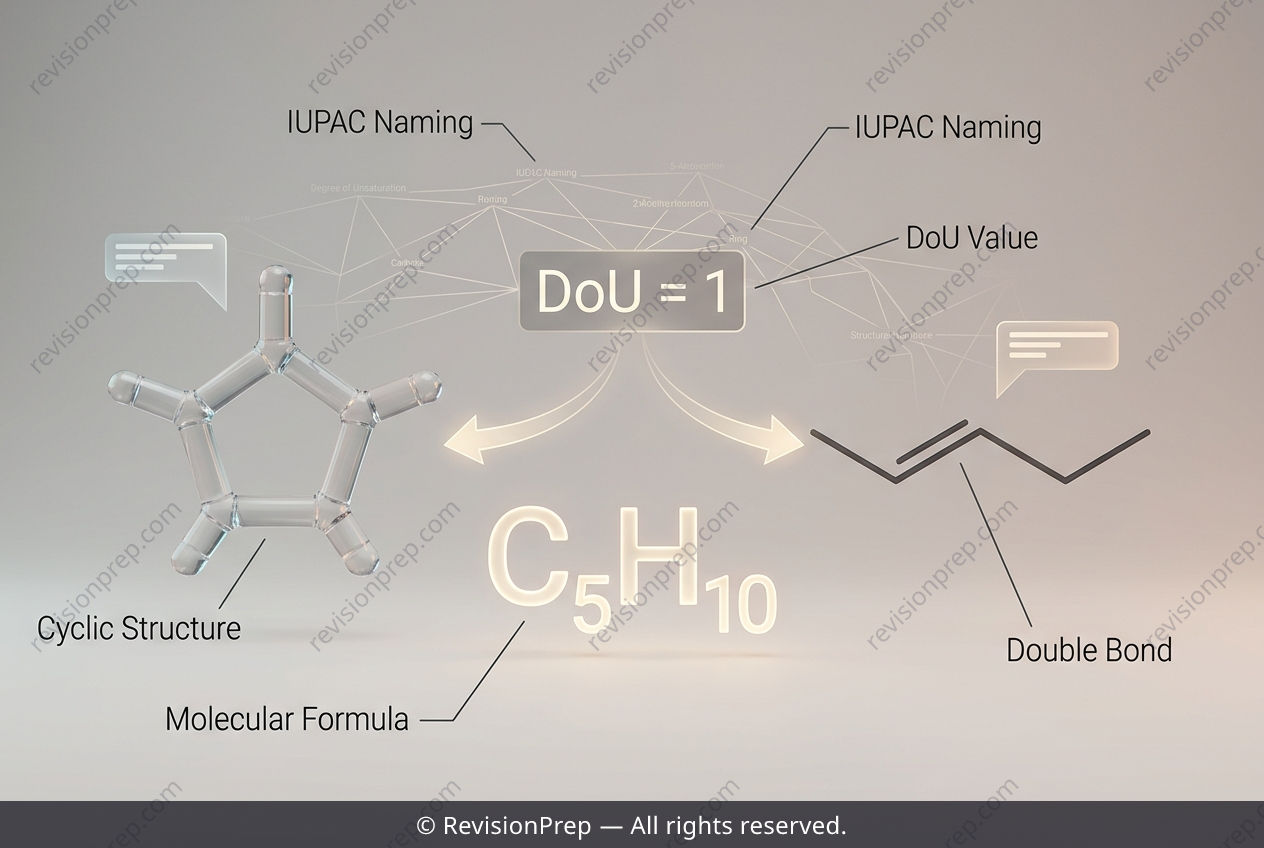
In organic chemistry, the link between a molecule’s formula and its actual structure is often indirect. The concept of structural isomerism reveals how the same set of atoms can be arranged into completely different compounds, such as an open-chain alkene versus a ring-shaped cycloalkane. At the heart of distinguishing these possibilities lies the degree of unsaturation (DoU), a simple calculation that counts the total number of rings and pi bonds present in a molecule. The formula DoU = (2C + 2 – H)/2 provides a powerful shortcut: it tells you how many “missing” hydrogen pairs exist relative to a saturated alkane. For a molecule like C₅H₁₀, this value points to exactly one such feature, but it cannot tell you whether that feature is a carbon-carbon double bond or a closed ring—both reduce the hydrogen count by two. This is where IUPAC nomenclature becomes essential. While DoU gives a numerical clue, the systematic name resolves the ambiguity: the suffix “-ene” with a locant (e.g., pent-1-ene) explicitly signals a double bond’s position, whereas the prefix “cyclo-” (e.g., cyclopentane) directly indicates a ring. Thus, DoU quantifies unsaturation, but IUPAC naming reveals the precise structural identity, connecting formula to form.
Start practising IB questions today
150,000+ IB-styled questions, criteria-mapped and instantly accessible.