
Chemistry: How Molecular Size Powers Oil Refining
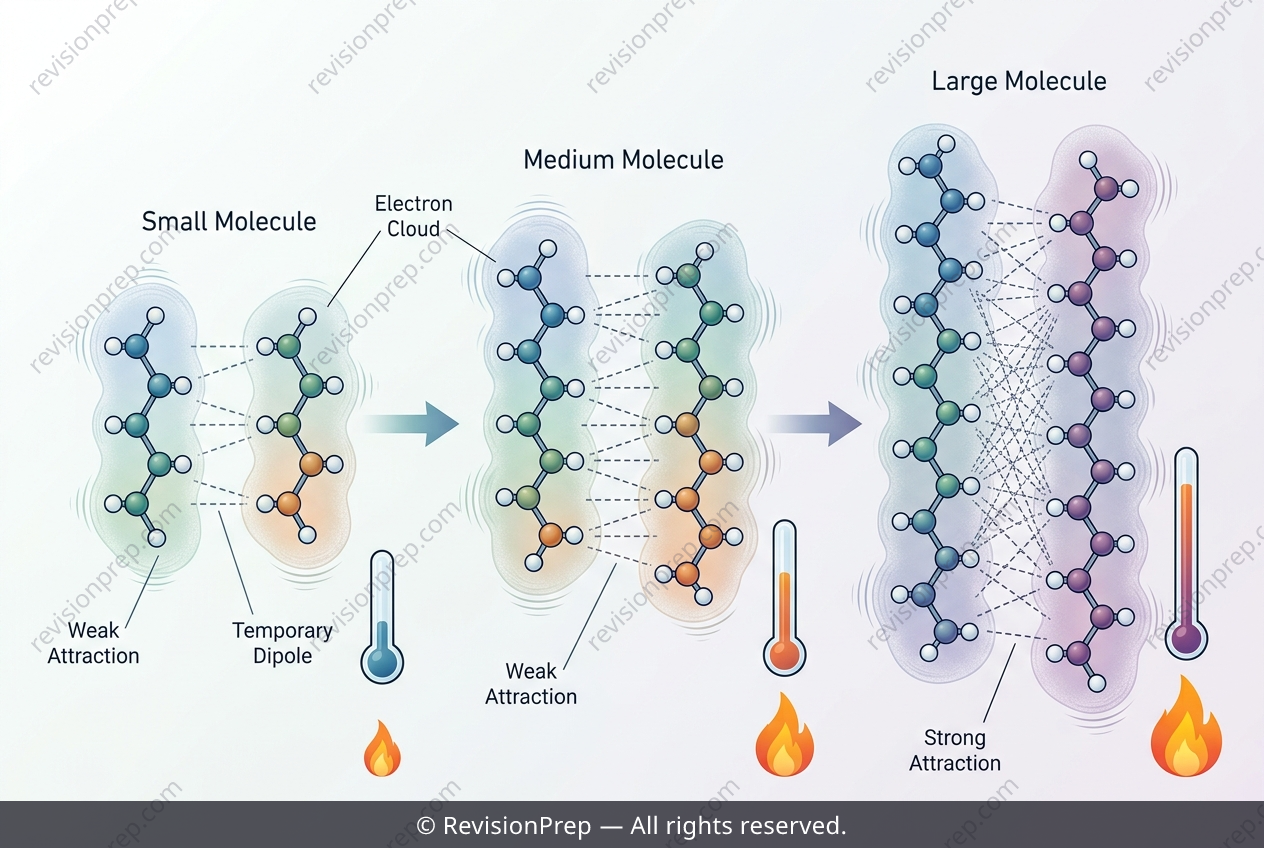
Why do some hydrocarbons boil as gases at room temperature while others flow as thick liquids? The answer lies not in the bonds within each molecule, but in the invisible attractions between them. For alkanes like pentane (C₅H₁₂), octane (C₈H₁₈), and dodecane (C₁₂H₂₆), the primary intermolecular force is the London dispersion force—a transient, induced dipole–induced dipole attraction that arises from momentary fluctuations in electron distribution. These forces are deceptively simple yet profoundly size-dependent. As the carbon chain lengthens, two things happen simultaneously: the total electron count rises, making each molecule more polarisable (its electron cloud distorts more easily to form stronger temporary dipoles), and the molecular surface area expands, allowing more points of close contact between neighbouring chains. Both effects amplify the cumulative London dispersion forces. Consequently, separating molecules in a longer chain demands more energy—which is precisely why boiling points climb steadily from 36 °C for pentane to 216 °C for dodecane. This relationship between molecular architecture and intermolecular strength underpins fractional distillation, the industrial process that separates crude oil into useful fractions based on boiling point ranges.
Start practising IB questions today
150,000+ IB-styled questions, criteria-mapped and instantly accessible.