
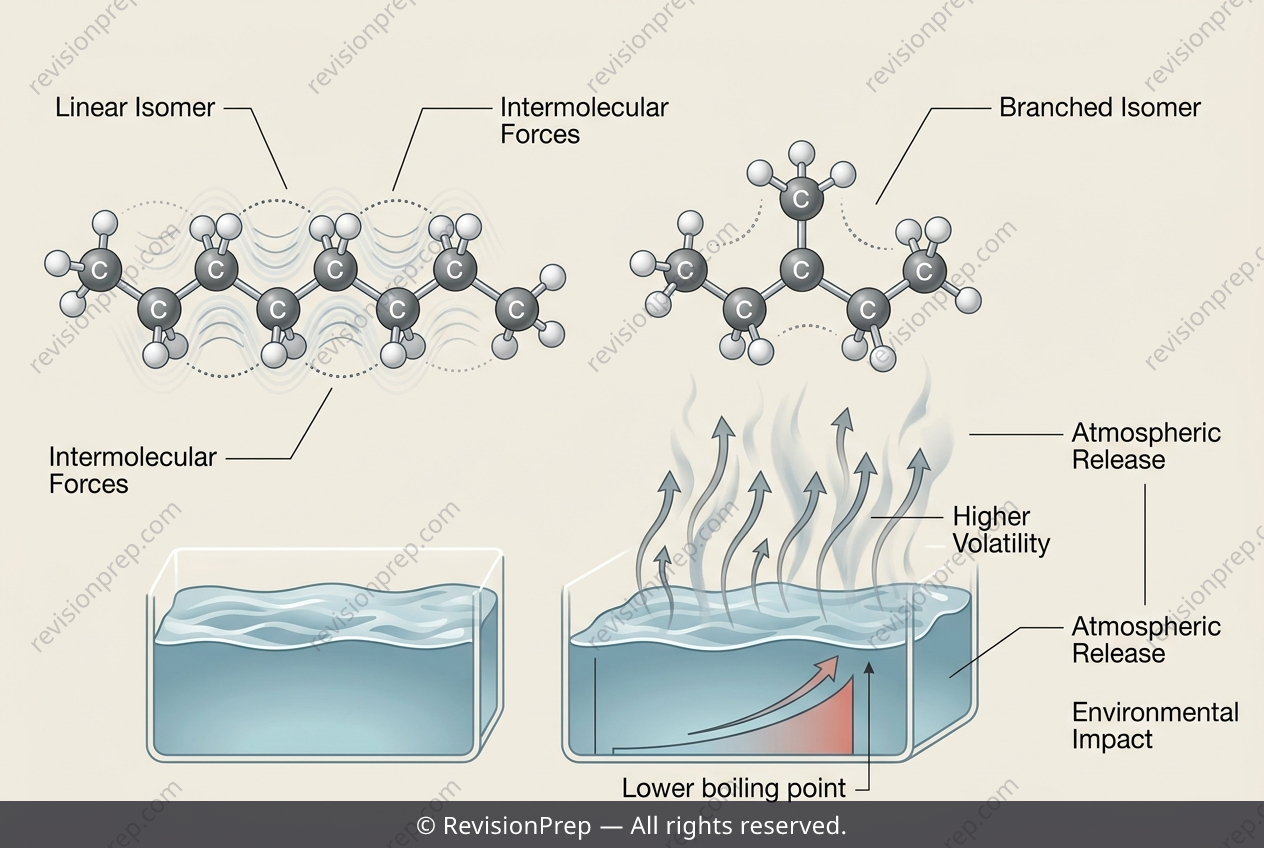
Chemistry: From Branching to Smog - A Hidden Link
When two molecules share the same molecular formula, they are not necessarily the same substance. This is the heart of isomerism, where the arrangement of atoms dictates a compound’s physical behaviour. For alkanes like C₆H₁₄, the difference between a straight chain and a branched chain is not merely cosmetic—it fundamentally alters how molecules interact. The condensed structural formulas, CH₃CH₂CH₂CH₂CH₂CH₃ versus (CH₃)₂CHCH₂CH₂CH₃, visually encode this: the branched isomer presents a smaller, more compact surface for neighbouring molecules to touch. This structural variation directly controls the strength of intermolecular forces, which in turn governs volatility. A lower boiling point signals weaker London dispersion forces, meaning less thermal energy is required to transition from liquid to gas. Consequently, the more branched isomer evaporates more readily at ambient temperatures. This concept matters beyond the lab bench: in industrial settings, choosing a solvent with higher volatility increases the release of volatile organic compounds (VOCs) into the air. These VOCs participate in sunlight-driven reactions with nitrogen oxides, leading to ground-level ozone and photochemical smog—linking a simple structural drawing to a tangible environmental consequence.
Start practising IB questions today
150,000+ IB-styled questions, criteria-mapped and instantly accessible.