
Chemistry: From Solvent to Smog - Acetone's Path
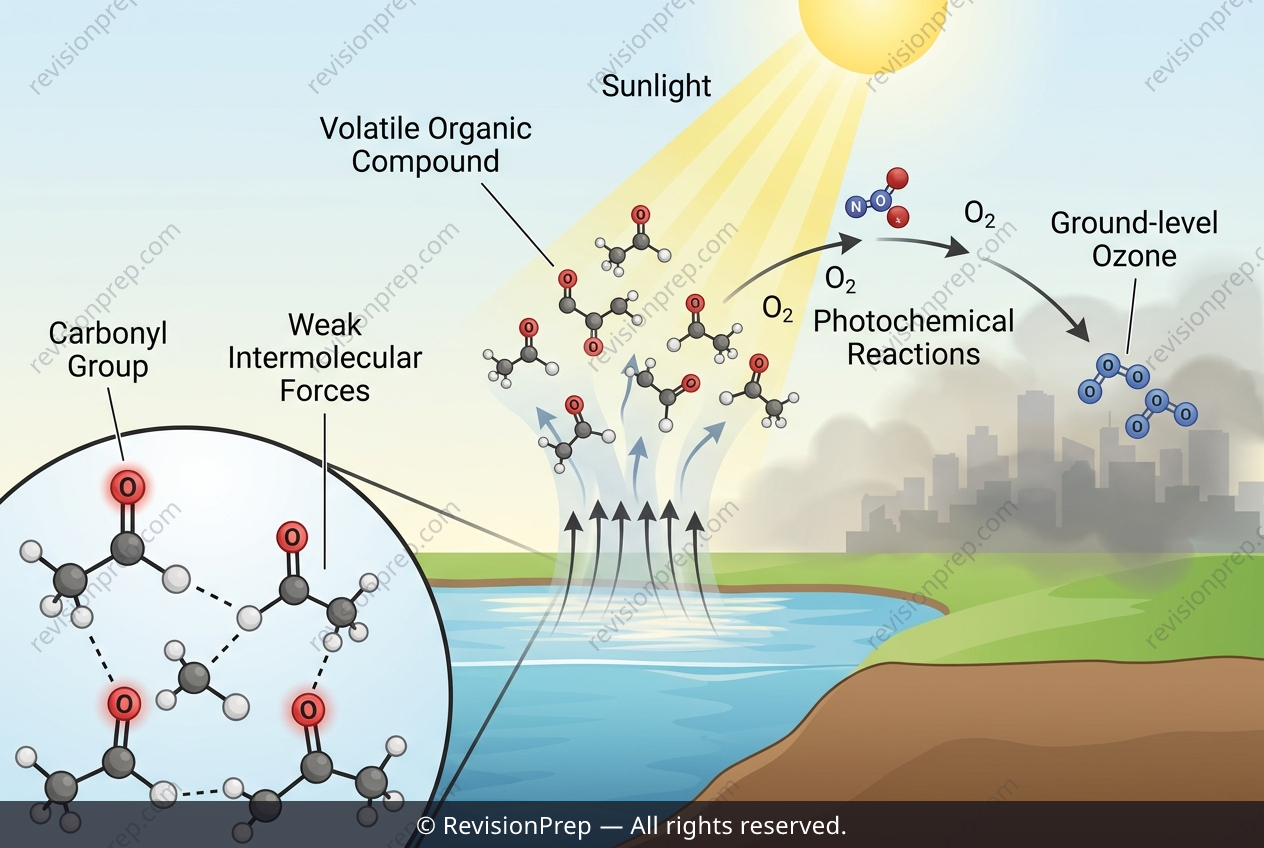
Volatile organic compounds (VOCs) like acetone are more than just industrial solvents—they are key players in the chemistry of our atmosphere. At the heart of this story lies the carbonyl group (C=O), a functional group that dictates a molecule’s polarity, its intermolecular forces, and ultimately its volatility. For acetone, a ketone where the carbonyl carbon is bonded to two other carbon atoms, the C=O group creates a permanent dipole. However, because acetone lacks a hydrogen atom attached to an electronegative atom (like oxygen or nitrogen), it can only accept hydrogen bonds, not donate them. This single structural detail weakens the overall intermolecular attraction compared to alcohols of similar size, giving acetone a low boiling point and high volatility. This seemingly simple chemical property has profound environmental consequences. Because acetone evaporates so readily, it escapes into the troposphere, where sunlight drives its photochemical reactions with nitrogen oxides (NOx). This process generates ground-level ozone (O3) and contributes to the formation of photochemical smog—a respiratory hazard. Understanding the link between molecular structure, intermolecular forces, and atmospheric reactivity is essential for grasping how everyday chemicals impact air quality and human health.
Start practising IB questions today
150,000+ IB-styled questions, criteria-mapped and instantly accessible.