
Chemistry: How Boiling Points Govern Oil Separation
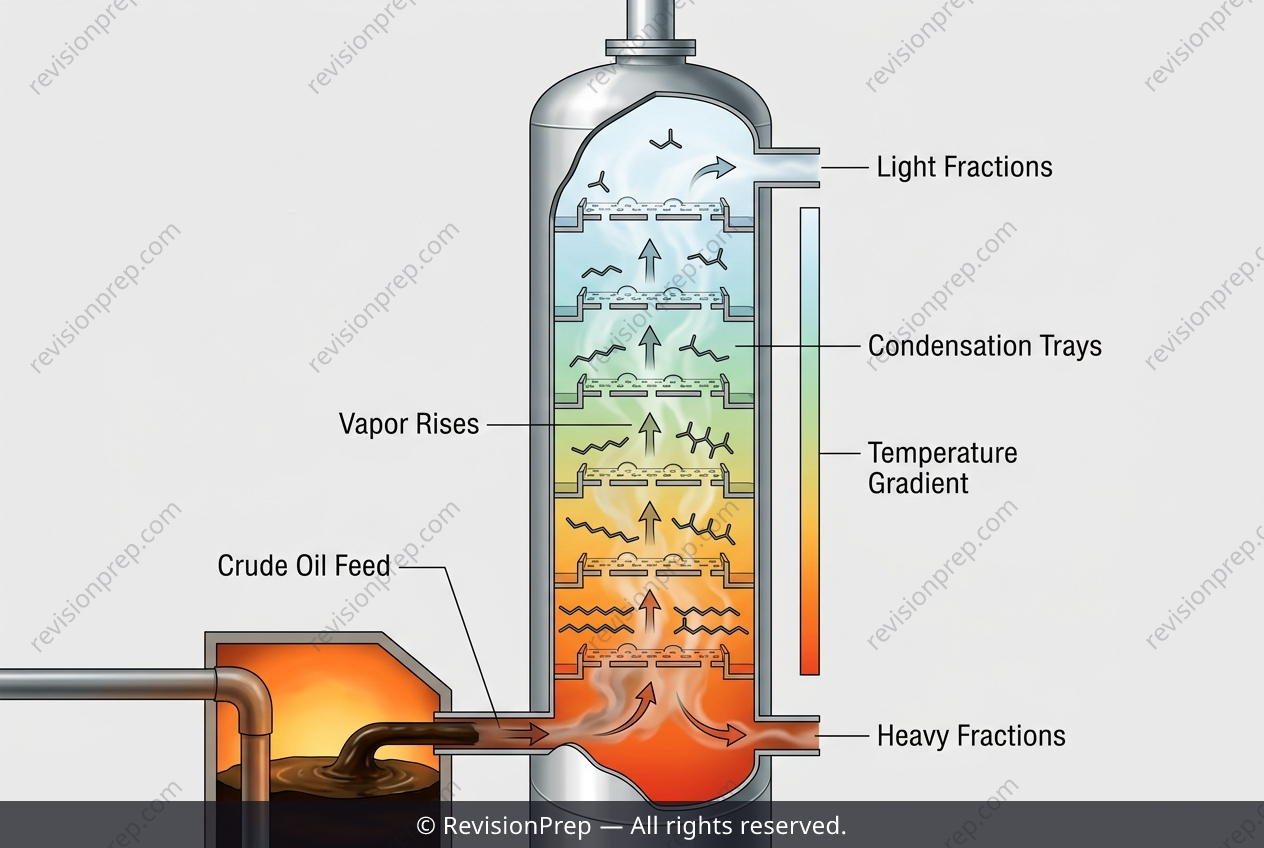
Fractional distillation is the physical process of separating a liquid mixture into its components by exploiting differences in boiling points—a property governed by the strength of intermolecular forces and molecular size. In crude oil, a complex mixture of hydrocarbons, smaller molecules with weaker London dispersion forces boil at lower temperatures, while larger, heavier molecules require far more energy to vaporize. This principle is harnessed in a tall fractionating column where a temperature gradient is established: hot at the base, cool at the top. As vapor rises, it cools and condenses at different heights, allowing distinct fractions to be drawn off at specific outlets. The position of each outlet is therefore not arbitrary—it directly reflects the boiling point range of the fraction collected. The topmost outlet, where the column is coolest, captures the most volatile components—those with the lowest boiling points. These are the smallest hydrocarbons, such as refinery gas (petroleum gas), which exist as gases at room temperature. Understanding this relationship between molecular size, intermolecular forces, and boiling point is essential for predicting not only where a fraction emerges but also its physical state and potential uses, from fuel to feedstock.
Start practising IB questions today
150,000+ IB-styled questions, criteria-mapped and instantly accessible.