
Chemistry: When Useful Esters Create Environmental Risk
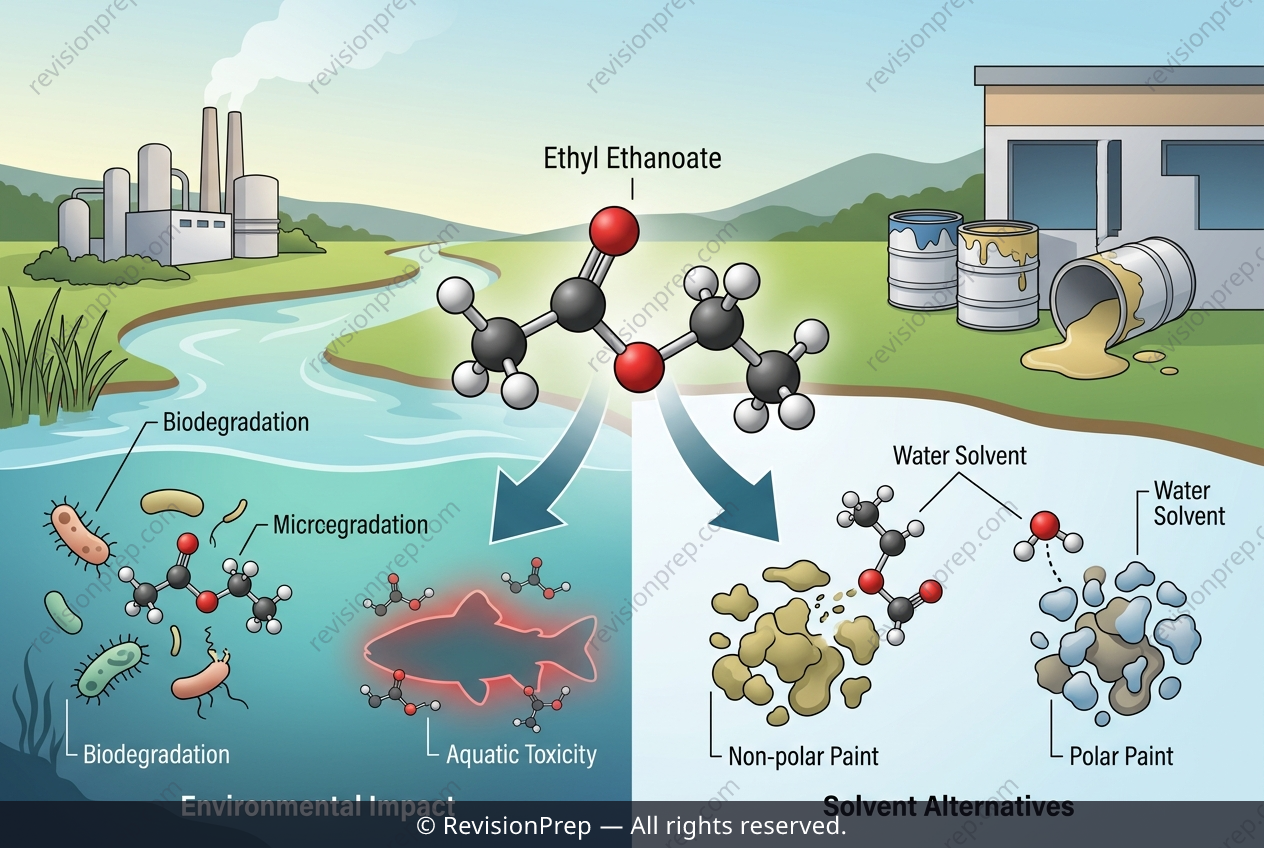
Esters are everywhere—from the sweet scent of pear drops to the industrial solvents that dissolve paints and varnishes. At their heart lies a simple condensation reaction: a carboxylic acid and an alcohol join forces, releasing a molecule of water. For ethyl ethanoate, the ester formed from ethanol and ethanoic acid, the process is represented by C₂H₅OH(l) + CH₃COOH(l) → CH₃COOC₂H₅(l) + H₂O(l). This reaction is reversible, acid-catalysed, and produces an ester whose volatility and non-polar nature make it an excellent solvent for organic compounds. But that same usefulness creates environmental tension. When ethyl ethanoate leaks into a river, its biodegradability means microbes will consume it—but in doing so, they deplete dissolved oxygen, stressing fish and invertebrates. At higher concentrations, the ester itself is directly toxic to aquatic life, disrupting cellular processes before breakdown even begins. This is why solvent choice matters beyond chemistry: a factory proposing a switch to water-based systems must weigh water’s polar nature against the non-polar resins and binders in paint. Water dissolves polar substances well, but struggles with hydrophobic components unless emulsifiers are added. The core concept here links molecular structure, reactivity, and ecological impact—showing how a single ester’s properties ripple from a reaction flask to an entire ecosystem.
Start practising IB questions today
150,000+ IB-styled questions, criteria-mapped and instantly accessible.