
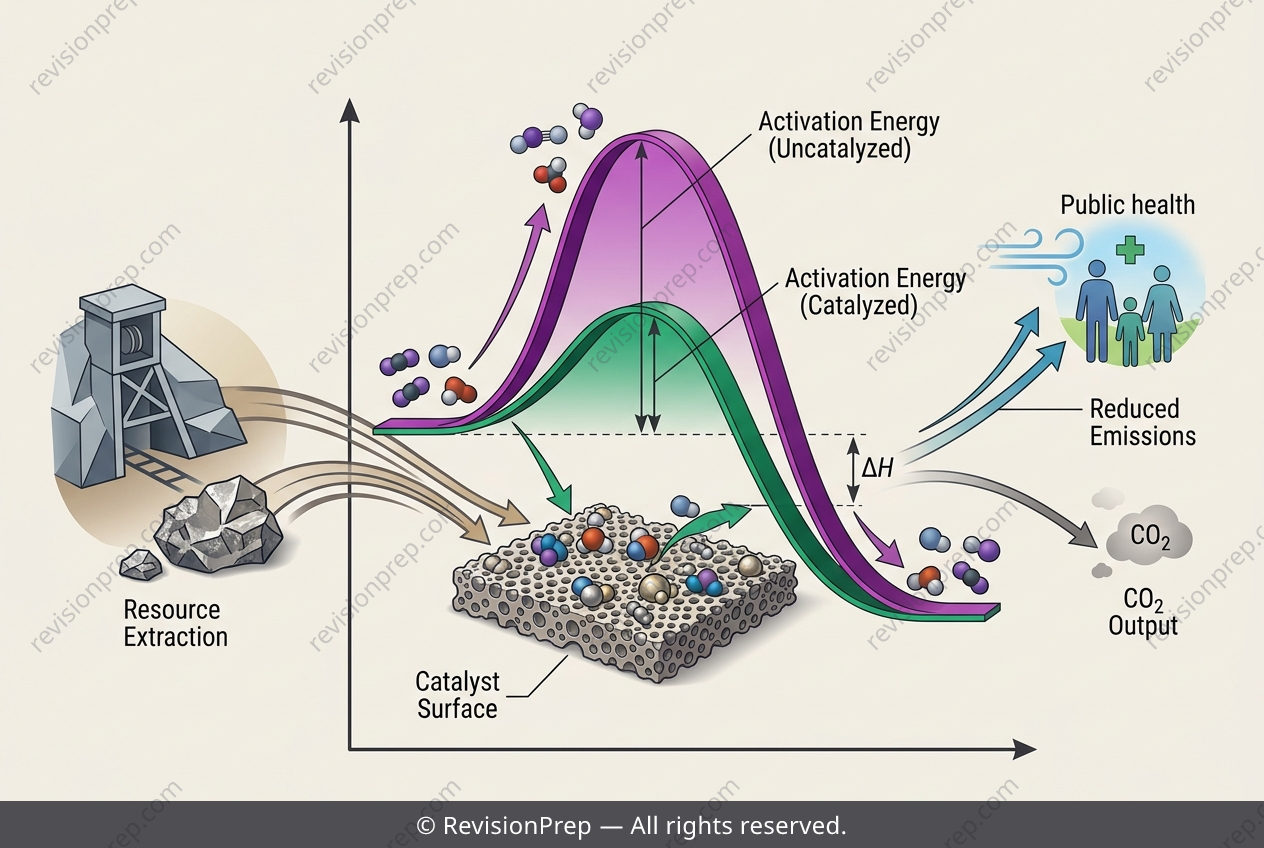
Chemistry: How Catalysts Lower the Energy Barrier
Catalysis is the art of speeding up a reaction without being consumed—and in a catalytic converter, platinum-group metals achieve this by offering reactant molecules a shortcut. Instead of requiring the high-energy collision needed to break strong bonds in CO, NOₓ, and hydrocarbons directly, the metal surface adsorbs these molecules, weakening their internal bonds and providing an alternative reaction pathway with a lower activation energy (Eₐ). Crucially, this shortcut does not alter the overall energy change (ΔH), because ΔH depends only on the energy difference between reactants and products, not on the route taken between them. This distinction matters far beyond the lab. On an energy profile diagram, the catalysed reaction shows a lower peak—a smaller Eₐ—while the starting and ending energy levels remain identical, meaning the same products (CO₂, N₂, H₂O) form with the same net energy release. Yet the trade-off is societal and environmental: cleaner urban air and reduced respiratory disease come at the cost of mining platinum-group metals, which drives habitat destruction and energy-intensive extraction. Understanding how catalysts lower barriers—and what that costs—connects molecular mechanism to real-world decision-making.
Start practising IB questions today
150,000+ IB-styled questions, criteria-mapped and instantly accessible.