
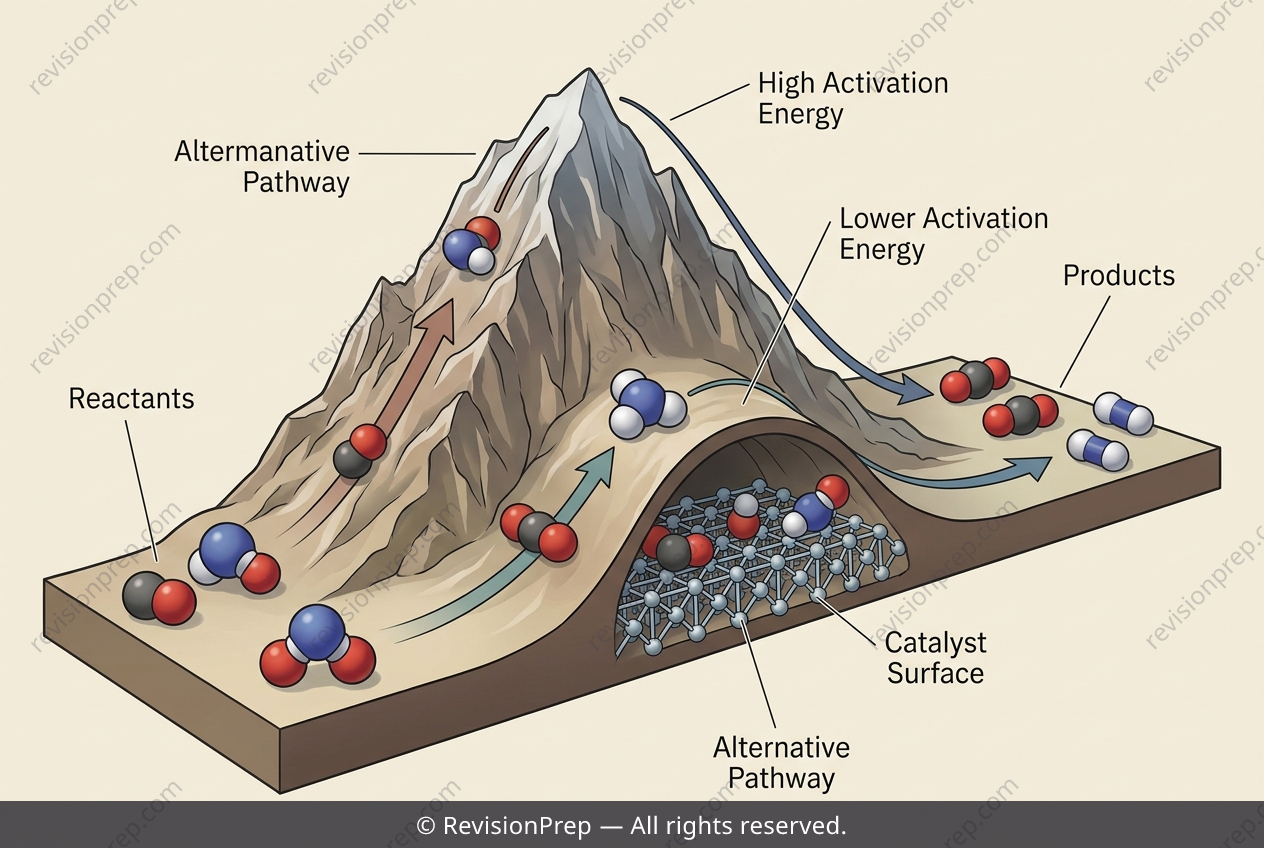
Chemistry: How Catalysts Speed Up Slow Reactions
Collision theory tells us that for a reaction to occur, reactant particles must collide with sufficient energy—at least equal to the activation energy (Ea)—and with the correct orientation. At the relatively low temperatures of a car exhaust (300–600 °C), only a tiny fraction of CO and NOₓ molecules possess that required energy, so the uncatalysed conversion to CO₂ and N₂ is far too slow to be practical. This is where catalysis steps in: by providing an alternative reaction pathway with a lower Ea, a catalyst dramatically increases the fraction of collisions that are effective, without being consumed itself. The key relationship is that a small drop in activation energy produces a large increase in reaction rate, because the Boltzmann distribution shows that far more particles have energy above a lower threshold. Platinum and palladium achieve this by adsorbing the toxic gases onto their surface, weakening the internal bonds of CO and NOₓ, and thereby lowering the energy barrier for the reaction. This same principle underpins countless industrial and biological processes—from catalytic converters cleaning urban air to enzymes accelerating metabolic reactions—and it highlights the delicate balance between reaction kinetics and thermodynamics: a catalyst changes the speed of a reaction, not its overall energy change.
Start practising IB questions today
150,000+ IB-styled questions, criteria-mapped and instantly accessible.