
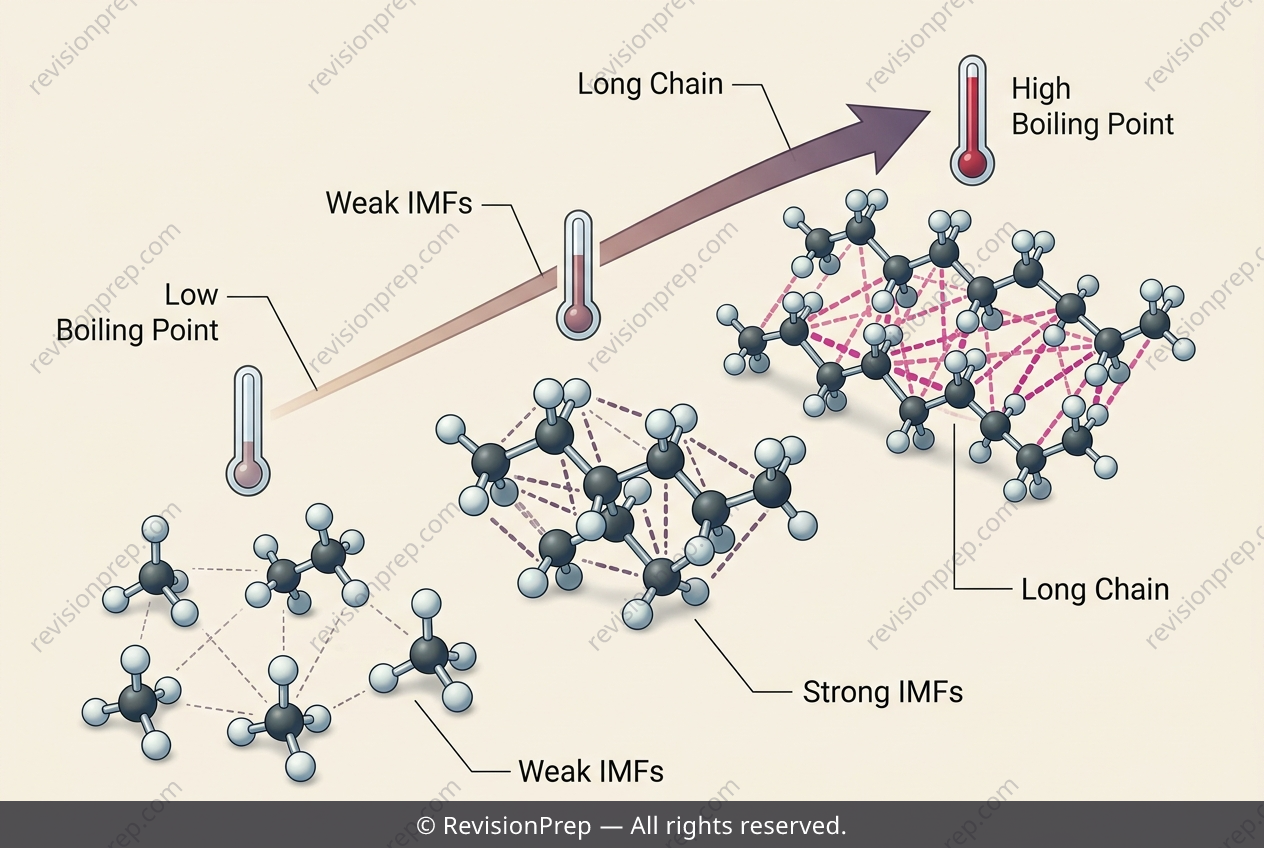
Chemistry: How Chain Length Unlocks Crude Oil's Uses
Crude oil is a complex mixture of thousands of different hydrocarbons, yet it is one of the most versatile resources we have. To unlock its value, we must first separate it into simpler fractions—like petrol, kerosene, and diesel—each with its own distinct use. Fractional distillation achieves this separation by exploiting a fundamental structure-property relationship: the boiling point of a hydrocarbon is not random, but a direct consequence of its molecular size and shape. The key pattern is simple: as hydrocarbon chain length increases, so does the boiling point. This happens because longer chains possess more electrons and a larger surface area, which leads to stronger London dispersion forces—the temporary, weak attractions between molecules. These stronger intermolecular forces require significantly more energy to overcome, meaning the molecules need a higher temperature to break free into the gas phase. Thus, the physical property of boiling point is intimately linked to the microscopic structure of each molecule, allowing us to separate the mixture by heating it in a tall column where temperature gradients do the rest of the work.
Start practising IB questions today
150,000+ IB-styled questions, criteria-mapped and instantly accessible.