
Chemistry: How "Cyclo-" Changes a Molecule's Shape
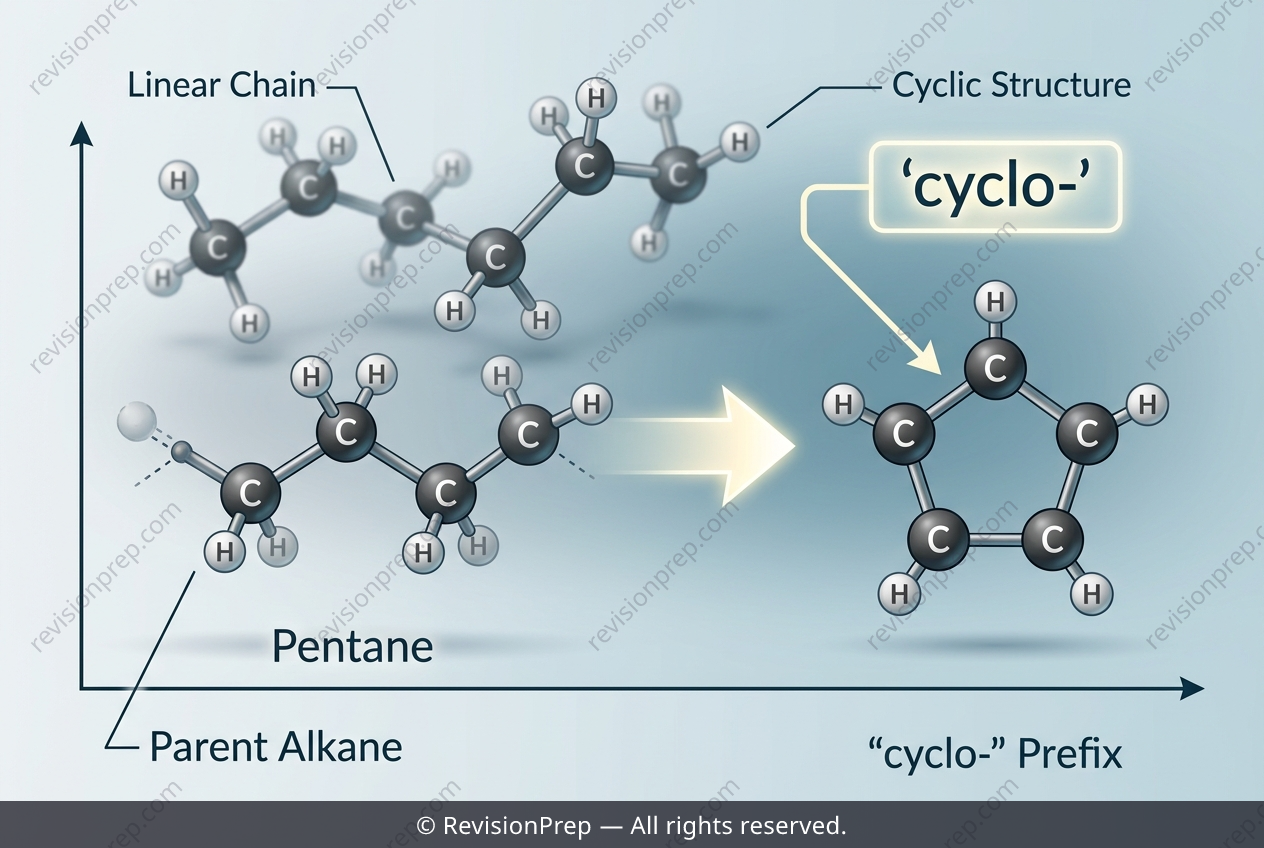
In the vast language of organic chemistry, names are more than labels—they are precise blueprints. IUPAC nomenclature provides the systematic rules for translating a molecule’s structure into a universally understood name, ensuring that a chemist in Tokyo and one in Toronto picture the exact same compound. For cyclic alkanes, this system introduces a crucial modifier that fundamentally changes how we read the molecule’s geometry. The core principle rests on the prefix "cyclo-". While a simple alkane like pentane (C₅H₁₂) implies a linear, open chain of carbon atoms, adding "cyclo-" transforms the name to cyclopentane (C₅H₁₀). This single prefix signals a profound structural shift: the carbon skeleton is now a closed ring, a cyclic arrangement where the chain’s ends have bonded together. This closure removes two hydrogen atoms, directly explaining the molecular formula difference. Understanding this prefix is essential, as it distinguishes between isomers with vastly different shapes, reactivities, and physical properties, forming the foundation for naming more complex bicyclic or substituted ring systems.
Start practising IB questions today
150,000+ IB-styled questions, criteria-mapped and instantly accessible.