
Chemistry: How Distillation Stops Oxidation Midway
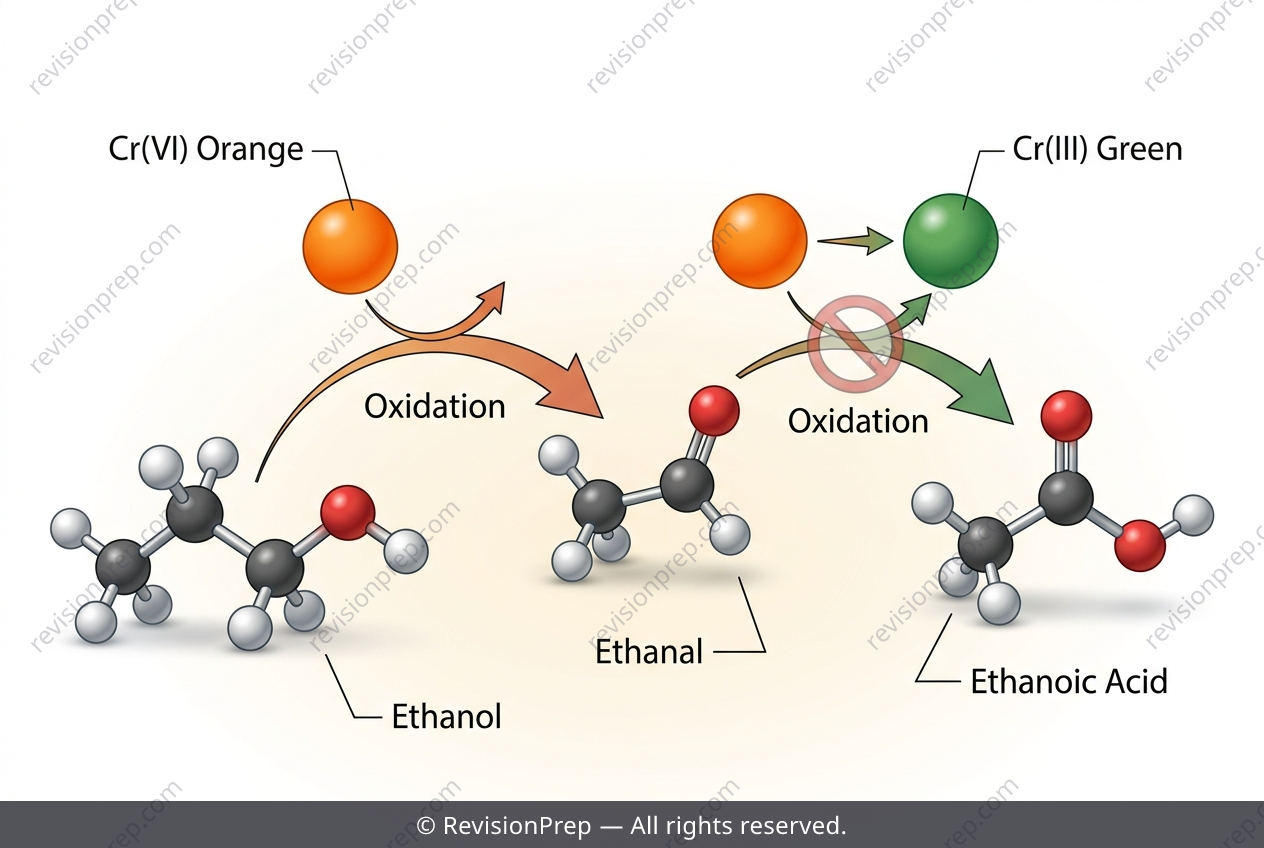
The controlled oxidation of alcohols is a cornerstone of organic chemistry, revealing how subtle changes in reaction conditions can steer a molecule down entirely different pathways. When a primary alcohol like ethanol meets an acidified dichromate(VI) solution, the orange Cr₂O₇²⁻ ion acts as a powerful oxidising agent, accepting electrons as it is reduced to the green Cr³⁺ ion. This vivid colour shift is your visual cue that redox chemistry is in full swing—the chromium is being reduced while the alcohol is being oxidised. The key to mastering this reaction lies in the apparatus. By heating the mixture and immediately distilling off the volatile product before the reaction runs to completion, you trap the intermediate aldehyde—ethanal (CH₃CHO)—before it can be oxidised further to ethanoic acid. This delicate balance between oxidation and distillation highlights why chemists must control both thermodynamics and kinetics. Understanding the electron transfer between dichromate and the alcohol not only explains the colour change but also illuminates the broader principle that oxidation states, not just functional groups, define reactivity in organic redox systems.
Start practising IB questions today
150,000+ IB-styled questions, criteria-mapped and instantly accessible.