
Chemistry: How IUPAC Names Encode Molecular Structure
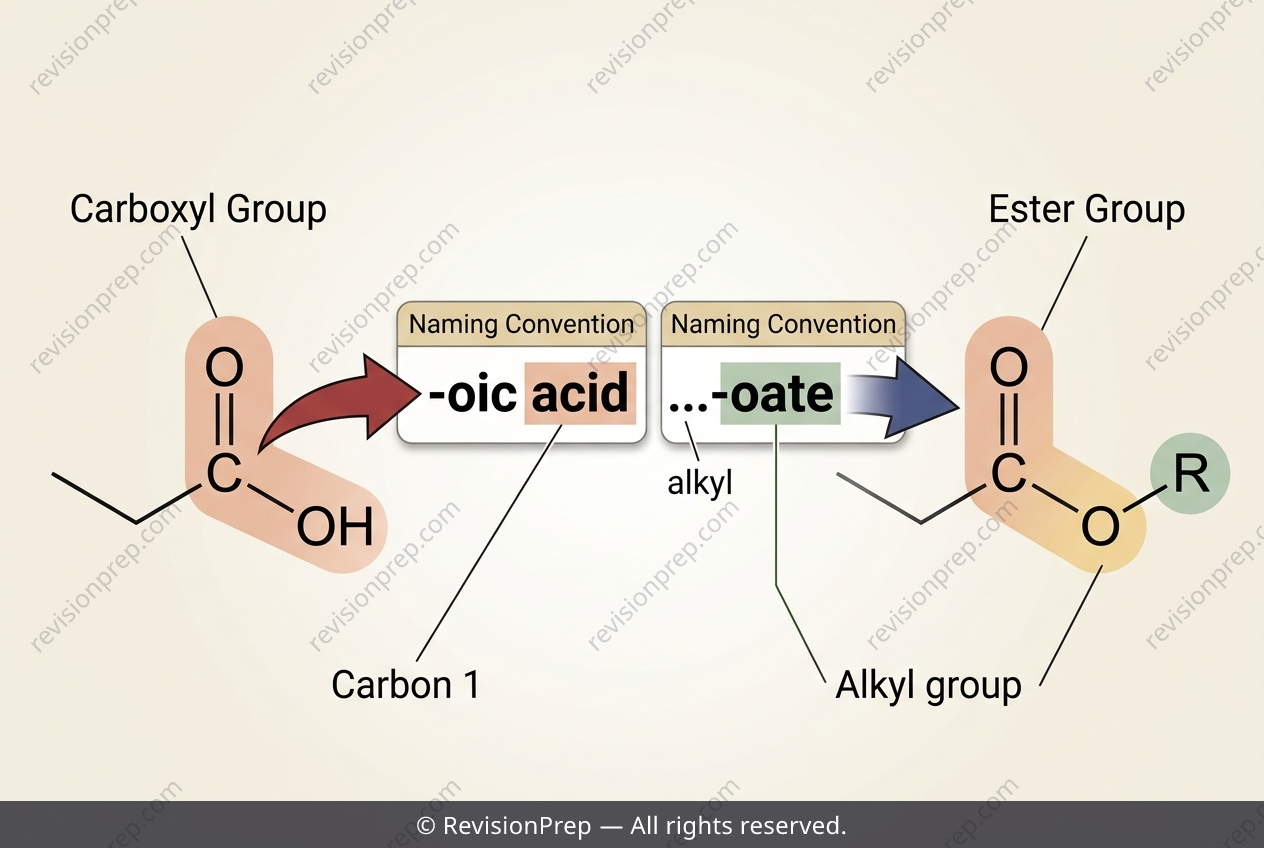
Naming organic compounds is the language of chemistry—a systematic code that lets any scientist, anywhere, translate a structural drawing into a precise, universally understood name. At the heart of this system lies IUPAC nomenclature, which hinges on identifying the parent carbon chain and the functional group that dictates the compound’s chemical personality. For students tackling this topic, the key is recognising that the name isn’t arbitrary; it encodes both the skeleton and the reactive centre of the molecule. Consider the contrast between a carboxylic acid and an ester—two functional groups that share a carbonyl (C=O) but diverge in structure and naming logic. A carboxylic acid, such as the two-carbon molecule X, features a carboxyl group (-COOH) where a hydroxyl (-OH) bonds directly to the carbonyl carbon. Its IUPAC name derives from counting that carboxyl carbon as position 1, giving the root “ethan-” and the suffix “-oic acid” (ethanoic acid); no locant is needed because the functional group’s position is fixed by definition. An ester, like molecule Y, instead arises from two components—an alcohol and an acid—so its name splits into two parts: the alkyl group from the alcohol (methyl) followed by the acid-derived acylate ending in “-oate” (ethanoate). This two-part naming directly mirrors the ester’s structural origin, revealing how nomenclature is not just a label but a map of molecular architecture.
Start practising IB questions today
150,000+ IB-styled questions, criteria-mapped and instantly accessible.