
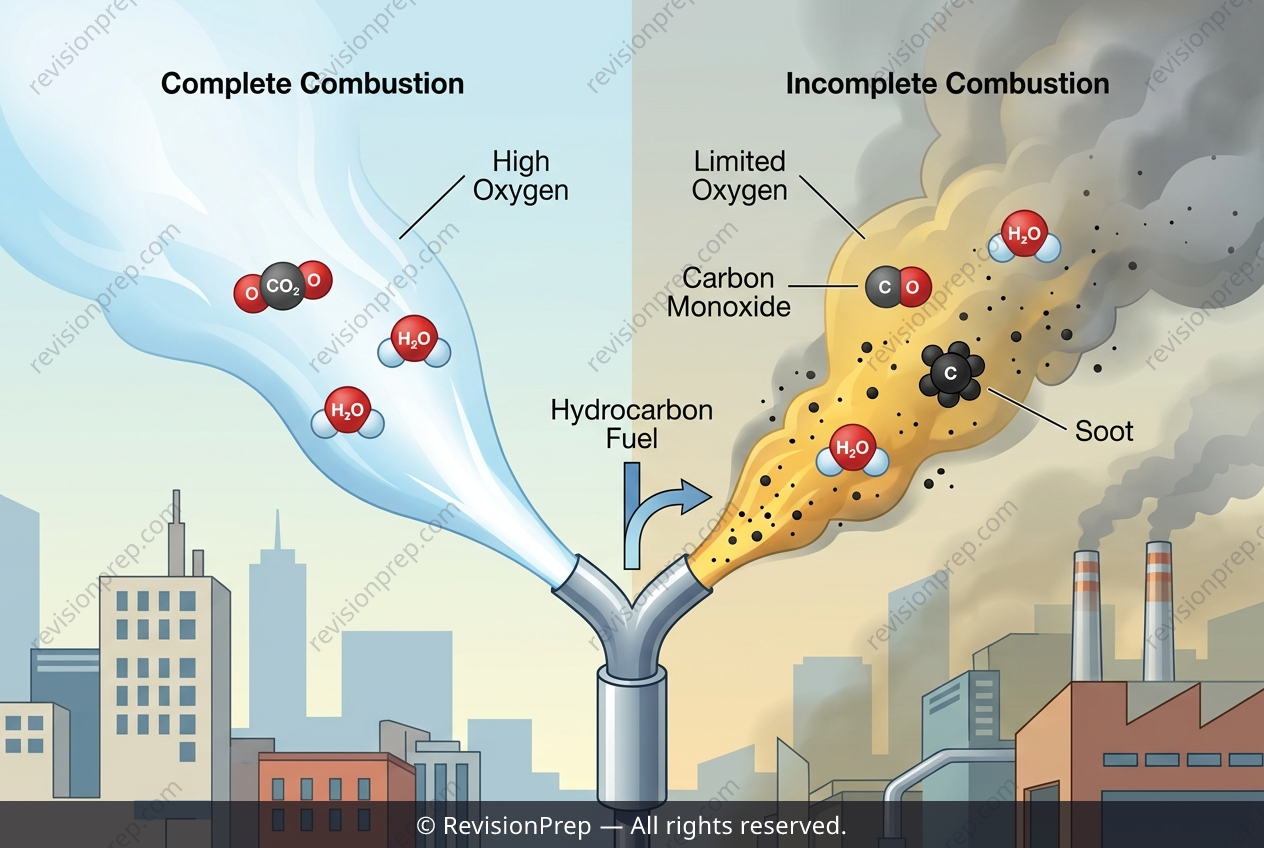
Chemistry: The Stoichiometry Behind Toxic Smoke
When a Bunsen burner flame turns yellow and leaves a black deposit on a cold surface, you are witnessing the real-world gap between ideal chemistry and practical combustion. This excerpt explores the fractional distillation of crude oil, focusing on the refinery gases—methane (CH₄), ethane (C₂H₆), propane (C₃H₈), and butane (C₄H₁₀)—which are widely burned as domestic and industrial fuels. The core concept here is combustion stoichiometry: the precise balancing of fuel and oxygen to predict products. Complete combustion of methane follows CH₄ + 2O₂ → CO₂ + 2H₂O, but when oxygen is limited, the reaction shifts to incomplete pathways, producing carbon monoxide (CO) or even solid soot (C) alongside water, as seen in 2CH₄ + 3O₂ → 2CO + 4H₂O. Why does this matter? Because the products are not merely chemical curiosities—they carry severe environmental and health consequences. CO binds to haemoglobin far more strongly than oxygen, reducing blood’s oxygen-carrying capacity and causing toxicity indoors. Soot particles penetrate deep into lungs, aggravating asthma and contributing to urban warming. Yet many air-quality models assume 100% complete combustion, predicting only CO₂ and H₂O. This assumption systematically underestimates real pollutants, meaning the stoichiometric equations you balance are not just academic—they are the foundation for understanding how fuel choice, oxygen supply, and combustion conditions connect to the air we
Start practising IB questions today
150,000+ IB-styled questions, criteria-mapped and instantly accessible.