
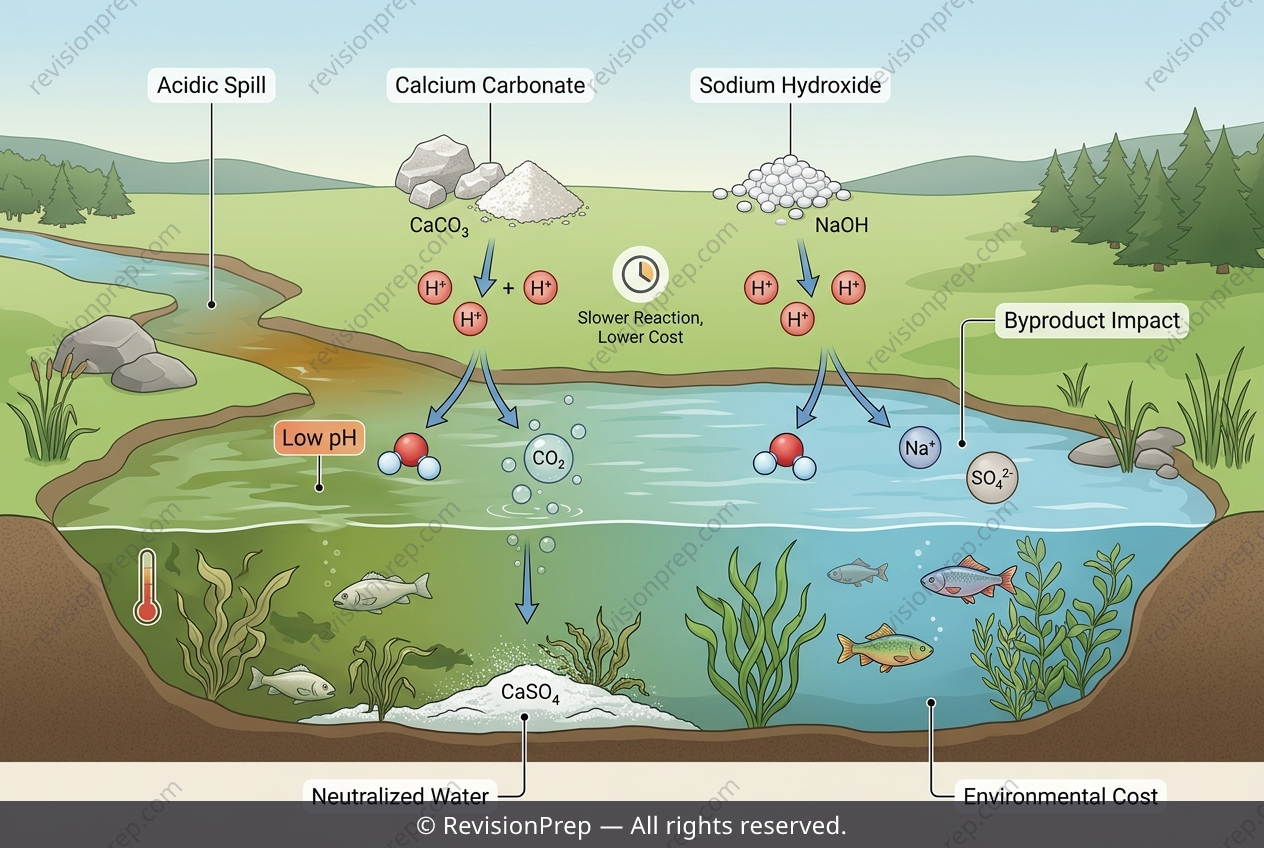
Chemistry: How Stoichiometry Guides Acid-Spill Cleanup
Neutralising an acid spill means choosing a reagent that works fast, safely, and at a scale the environment can tolerate. When concentrated sulfuric acid enters a river, the immediate priority is raising the pH back toward neutrality through a balanced acid–base reaction, but the reagent chosen also determines the mass of material needed, the cost, and the byproducts left behind. This is where stoichiometry meets environmental chemistry. The chemistry begins with the mole ratio in each balanced equation. Sulfuric acid reacts with calcium carbonate in a 1:1 ratio, producing sparingly soluble calcium sulfate, water, and carbon dioxide, while sodium hydroxide reacts in a 1:2 ratio, forming soluble sodium sulfate and water. Because n = c × V gives the moles of acid spilled, these ratios directly scale the required mass of each reagent through m = n × M. Comparing the two options therefore means weighing cost, availability, and downstream effects on aquatic life alongside the raw quantities calculated.
Start practising IB questions today
150,000+ IB-styled questions, criteria-mapped and instantly accessible.