
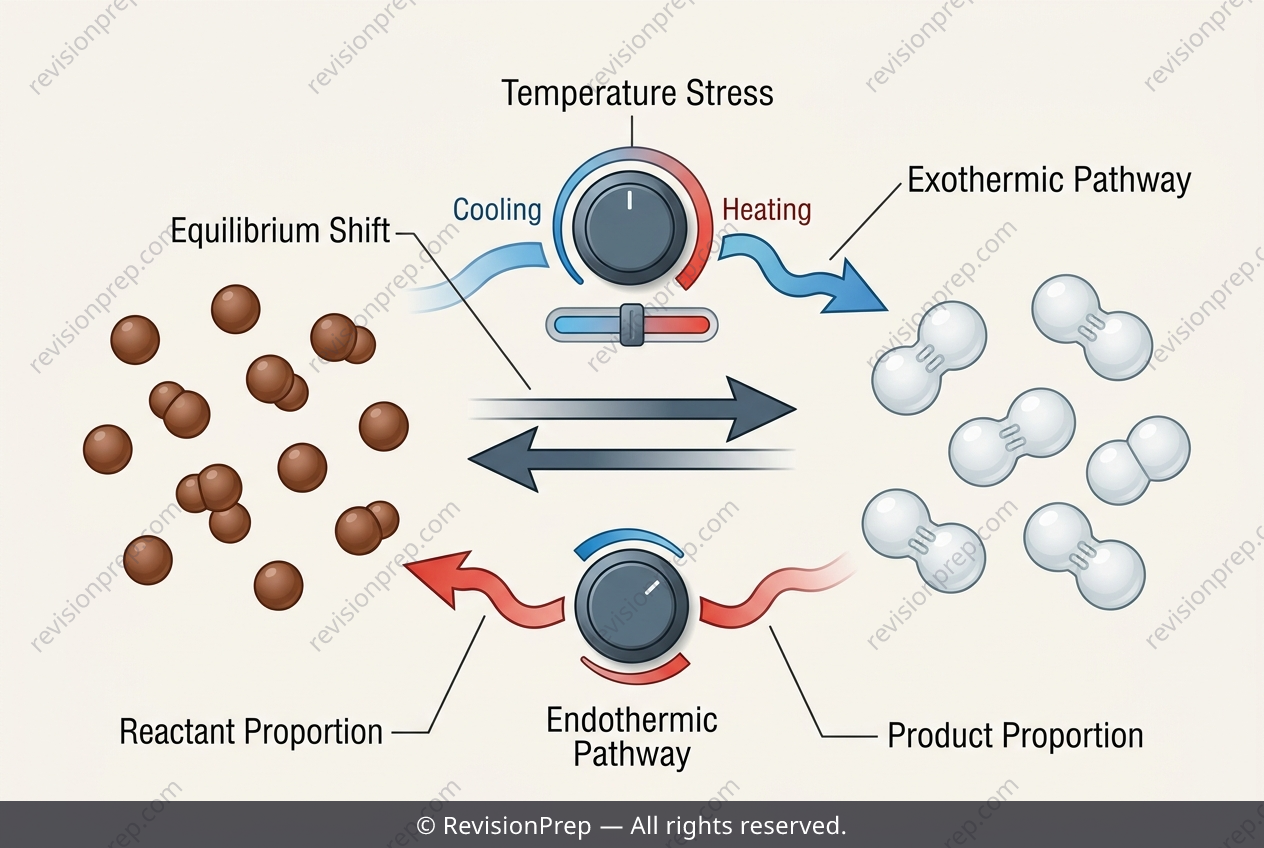
Chemistry: How Temperature Colours an Equilibrium
Le Chatelier’s principle is the compass for predicting how a chemical system at equilibrium responds to disturbance. In the reversible reaction between brown nitrogen dioxide (NO₂) and colourless dinitrogen tetroxide (N₂O₄), temperature acts as a powerful external stress, shifting the balance between the two gases and producing a visible colour change. This principle matters because it connects the abstract idea of equilibrium to real-world observations: cooling the system (placing a flask in ice) removes heat, so the equilibrium shifts to produce more heat, favouring the exothermic forward reaction that forms colourless N₂O₄. Conversely, heating the system (hot water) adds heat, shifting equilibrium to absorb that energy, favouring the endothermic reverse reaction that regenerates brown NO₂. The result is a clear visual gradient—lighter in the cold flask, darker in the hot one—that directly reveals the direction of the shift. By linking the colour change to the heat released or absorbed, you can deduce that the forward reaction is exothermic, while the reverse is endothermic. This temperature–colour relationship is a classic demonstration of how equilibrium systems self-correct, always opposing the applied stress to minimise disturbance.
Start practising IB questions today
150,000+ IB-styled questions, criteria-mapped and instantly accessible.