
Chemistry: Ions vs Molecules - Why the Bulb Lights
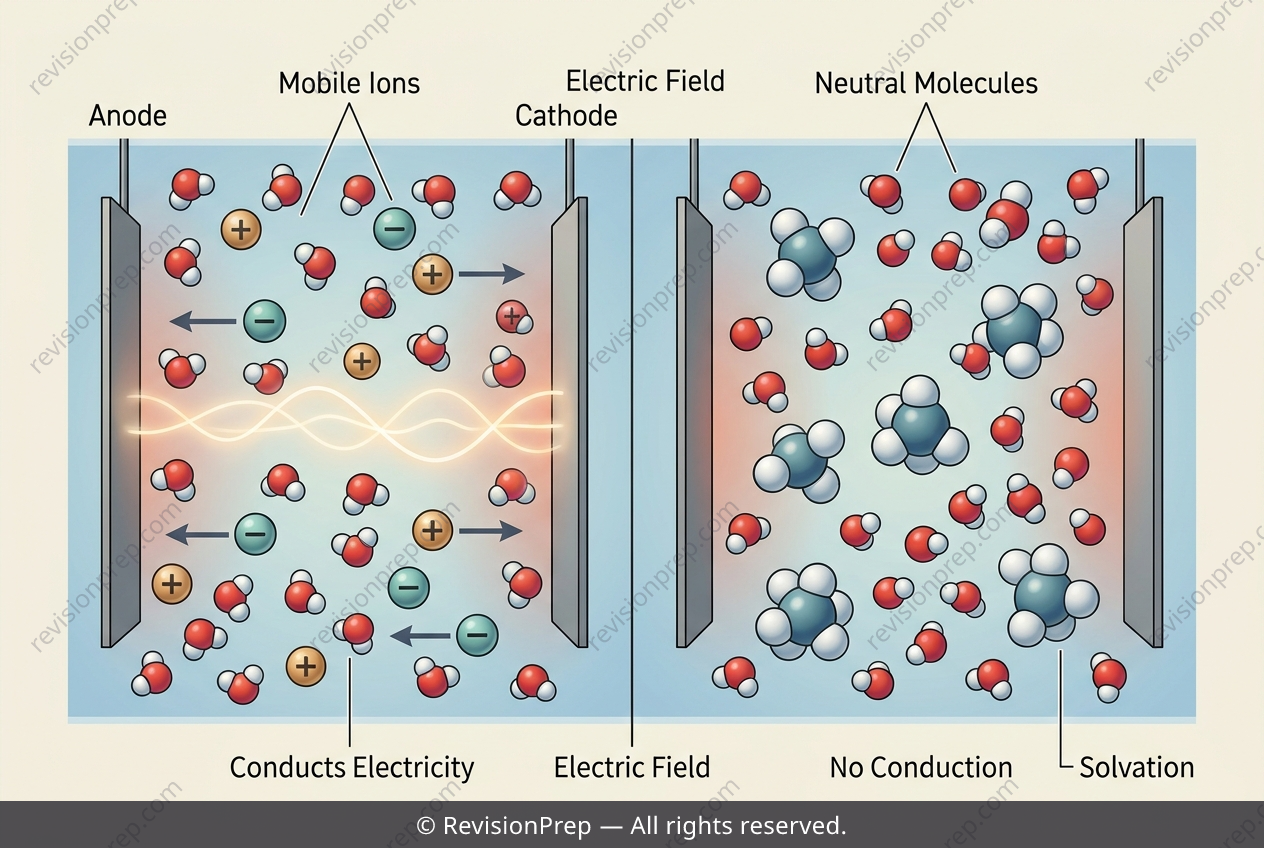
Why do some aqueous solutions light up a circuit while others leave the bulb dark? The answer lies in how a solute behaves when it dissolves. When hydrogen chloride gas enters water, it dissociates completely, splitting into H⁺(aq) and Cl⁻(aq) ions according to HCl(aq) → H⁺(aq) + Cl⁻(aq). These mobile charged particles are the key: under an applied potential difference, they migrate toward oppositely charged electrodes, transferring charge through the solution and completing the circuit. Sucrose behaves very differently. As a covalent molecular compound, it dissolves as intact, neutral C₁₂H₂₂O₁₁ molecules, producing no ions at all. With no mobile charge carriers, no current can flow, so the bulb stays off — and increasing the concentration merely adds more neutral molecules rather than generating ions. This contrast between complete dissociation and molecular dissolution underpins electrical conductivity in aqueous solutions, linking bonding type and particle behaviour to an observable property.
Start practising IB questions today
150,000+ IB-styled questions, criteria-mapped and instantly accessible.