
Chemistry: One Equation Behind Every Neutralization
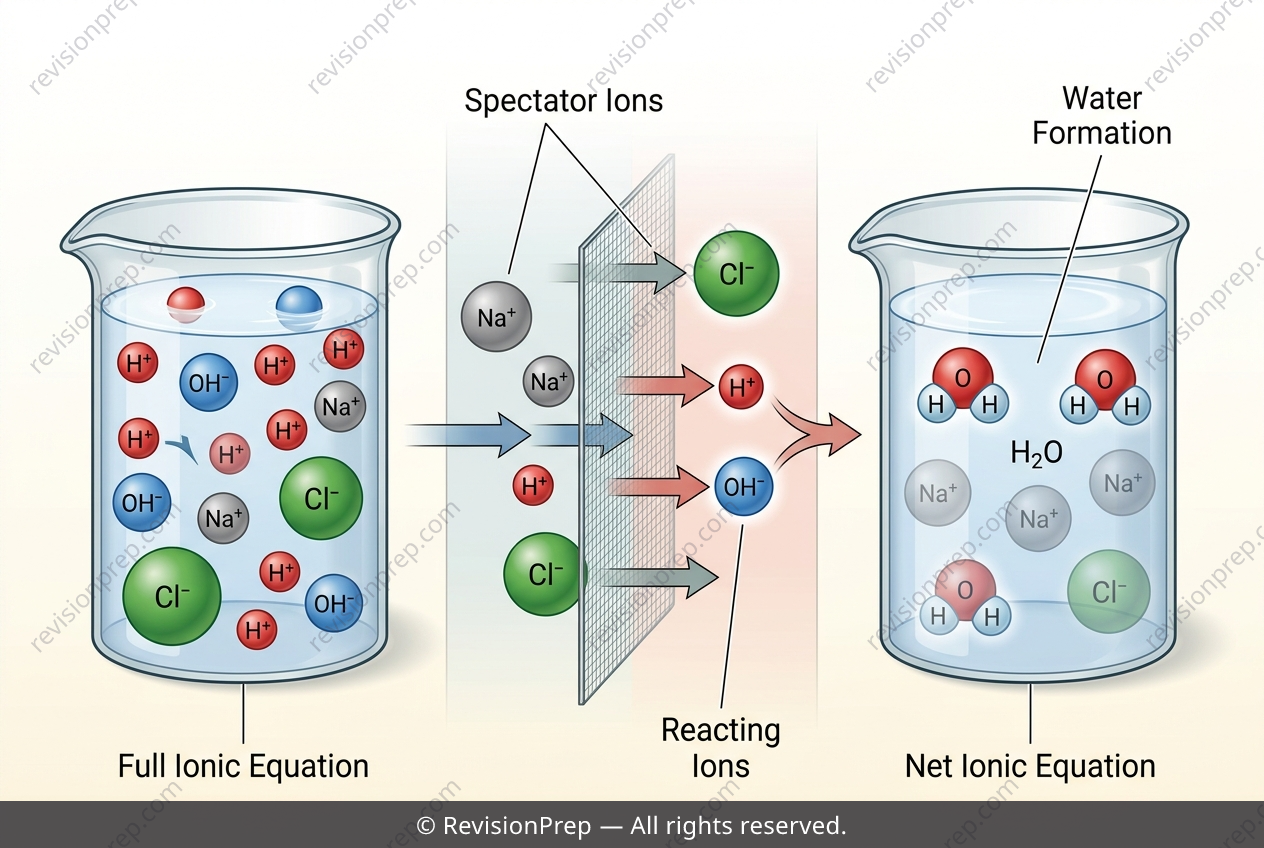
Neutralization reactions sit at the heart of acid–base chemistry, and the strong acid–strong alkali case is where their underlying simplicity becomes clearest. When hydrochloric acid meets sodium hydroxide solution, the beaker holds freely moving H⁺, Cl⁻, Na⁺, and OH⁻ ions, and the essential change is the combination of H⁺ and OH⁻ to form water. This matters because it reveals what actually drives the reaction. Strong acids and strong alkalis dissociate completely in water, so the only bond-making and bond-breaking involves H⁺(aq) + OH⁻(aq) → H₂O(l). The spectator ions, Na⁺ and Cl⁻, remain unchanged and cancel from both sides of the full ionic equation. That cancellation explains why the same net ionic equation describes every strong acid–strong alkali neutralization, regardless of which specific acid or alkali is used. Recognising this connection between full equations, ionic equations, and spectator ions is the key to interpreting neutralization generally.
Start practising IB questions today
150,000+ IB-styled questions, criteria-mapped and instantly accessible.