
Chemistry: Reshaping the Path, Not the Destination
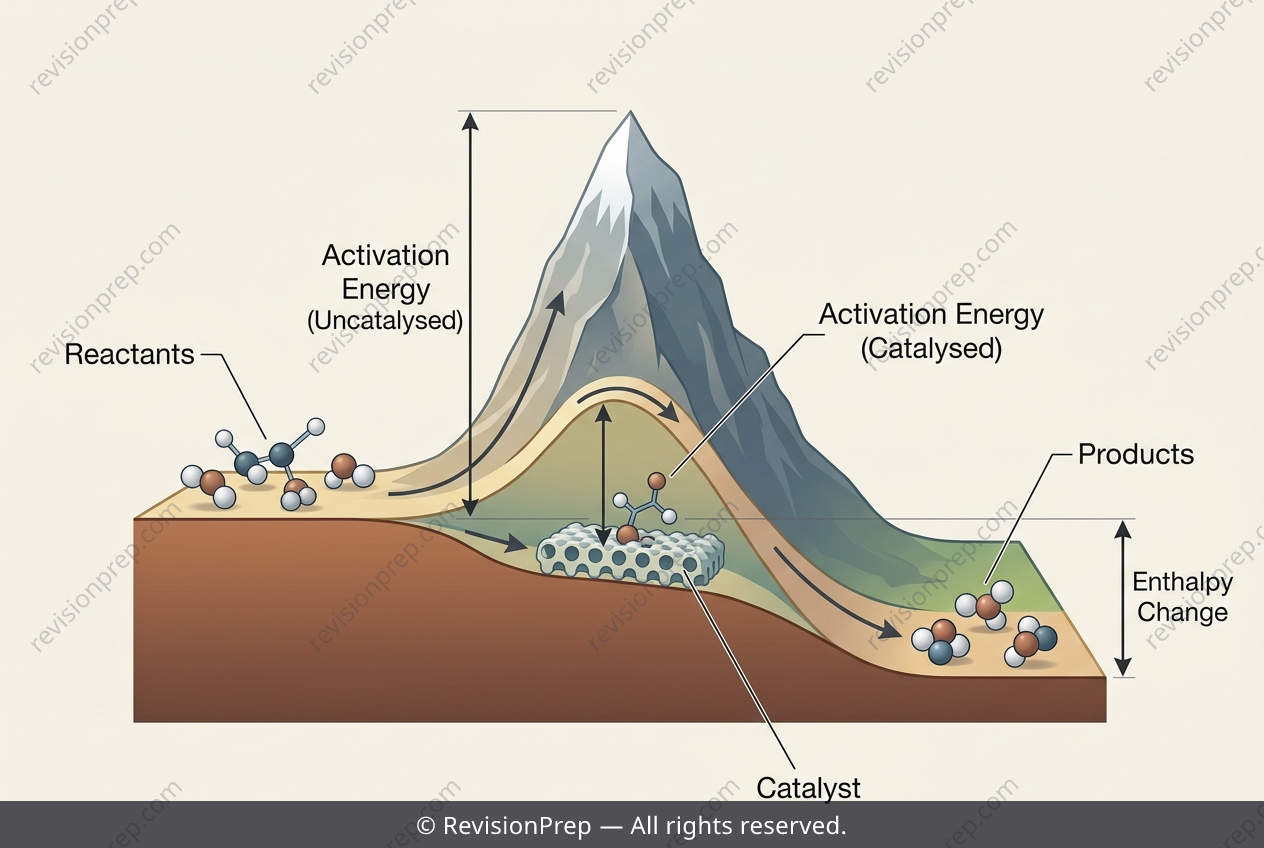
Chemical reactions are more than just reactants turning into products—they are journeys across an energy landscape. In an exothermic reaction like 2CO + 2NO → 2CO₂ + N₂, the products sit at a lower energy level than the reactants, meaning the overall enthalpy change (ΔH) is negative. But between those two states lies a barrier: the activation energy (Eₐ), the minimum energy needed to reach the transition state. This barrier determines how slowly or quickly the reaction proceeds under normal conditions. Catalysis reshapes that journey without changing the destination. A catalyst offers an alternative pathway with a lower activation energy (Eₐ(cat)), allowing more molecules to overcome the hurdle at a given temperature. Crucially, the catalyst is not consumed, so the reactant and product energy levels remain identical—only the peak between them is lowered. This is exactly how catalytic converters work: they transform toxic CO and NO into harmless CO₂ and N₂ by providing a faster, lower-energy route. Understanding this relationship between ΔH, Eₐ, and the catalyst’s role reveals why energetics and bond theory are central to controlling real-world chemical processes.
Start practising IB questions today
150,000+ IB-styled questions, criteria-mapped and instantly accessible.