
Chemistry: Reversible Reactions — Heat and Water
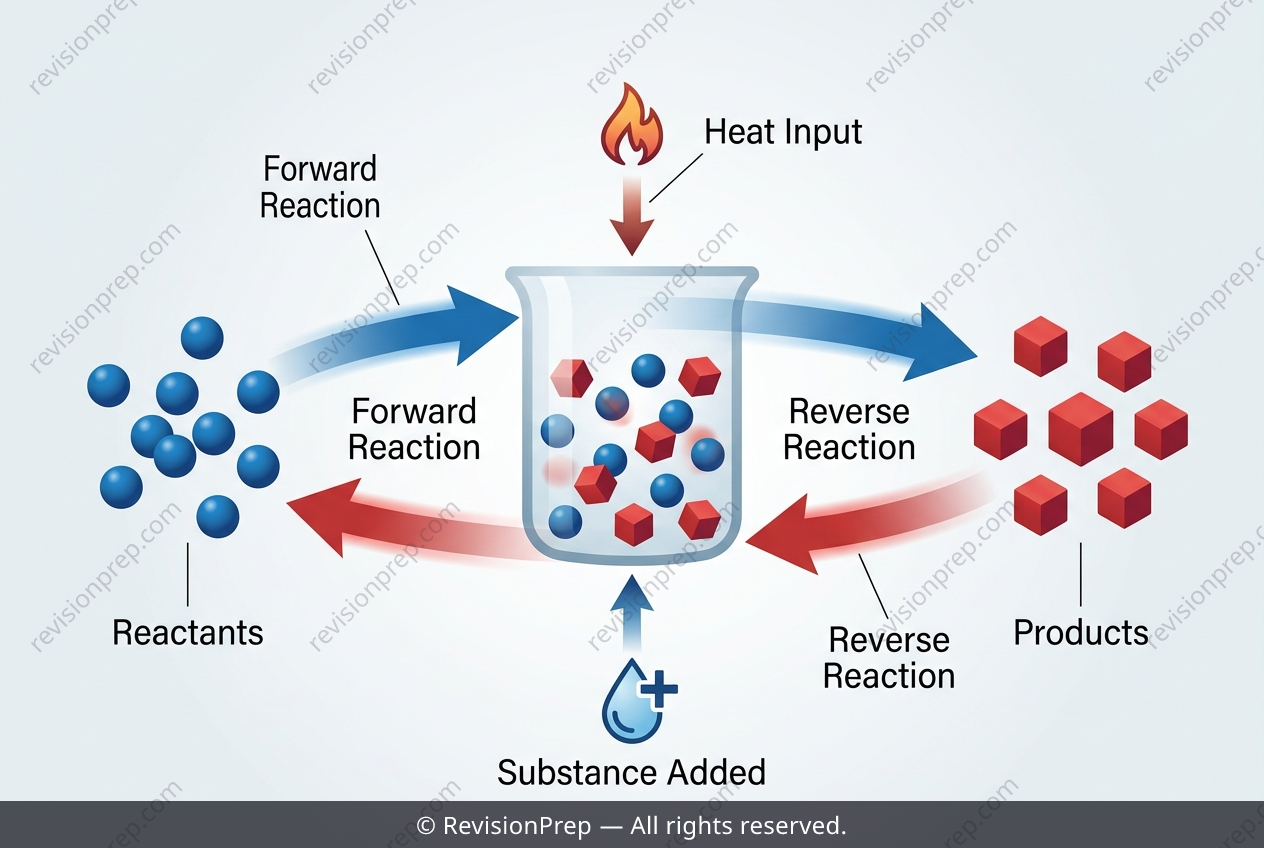
Reversible reactions sit at the heart of chemical change: unlike one-way processes, they can proceed in both directions depending on the conditions applied. The classic example of hydrated copper(II) sulfate illustrates this beautifully. When blue crystals of CuSO₄·5H₂O are heated, they lose water to form white anhydrous CuSO₄ and water vapour—a dehydration step. But the story does not end there: simply adding water to the white powder at room temperature reverses the process, restoring the blue hydrate. This two-way behaviour is what defines a reversible reaction: the products of the forward change can react to regenerate the original reactants under suitable, often different, conditions. The key insight lies in how the direction is controlled. In this system, heating drives the forward reaction (CuSO₄·5H₂O → CuSO₄ + H₂O), while adding water drives the reverse (CuSO₄ + H₂O → CuSO₄·5H₂O). No single condition—like heat alone—dictates the outcome universally. Instead, each direction has its own trigger, and the double arrow in the equation captures this dynamic balance. Understanding this interdependence between reactants, products, and conditions is fundamental to predicting how systems respond to change, a concept that extends far beyond copper salts into industrial processes and biological equilibria.
Start practising IB questions today
150,000+ IB-styled questions, criteria-mapped and instantly accessible.