
Chemistry: The Alphabetical Logic Behind IUPAC Names
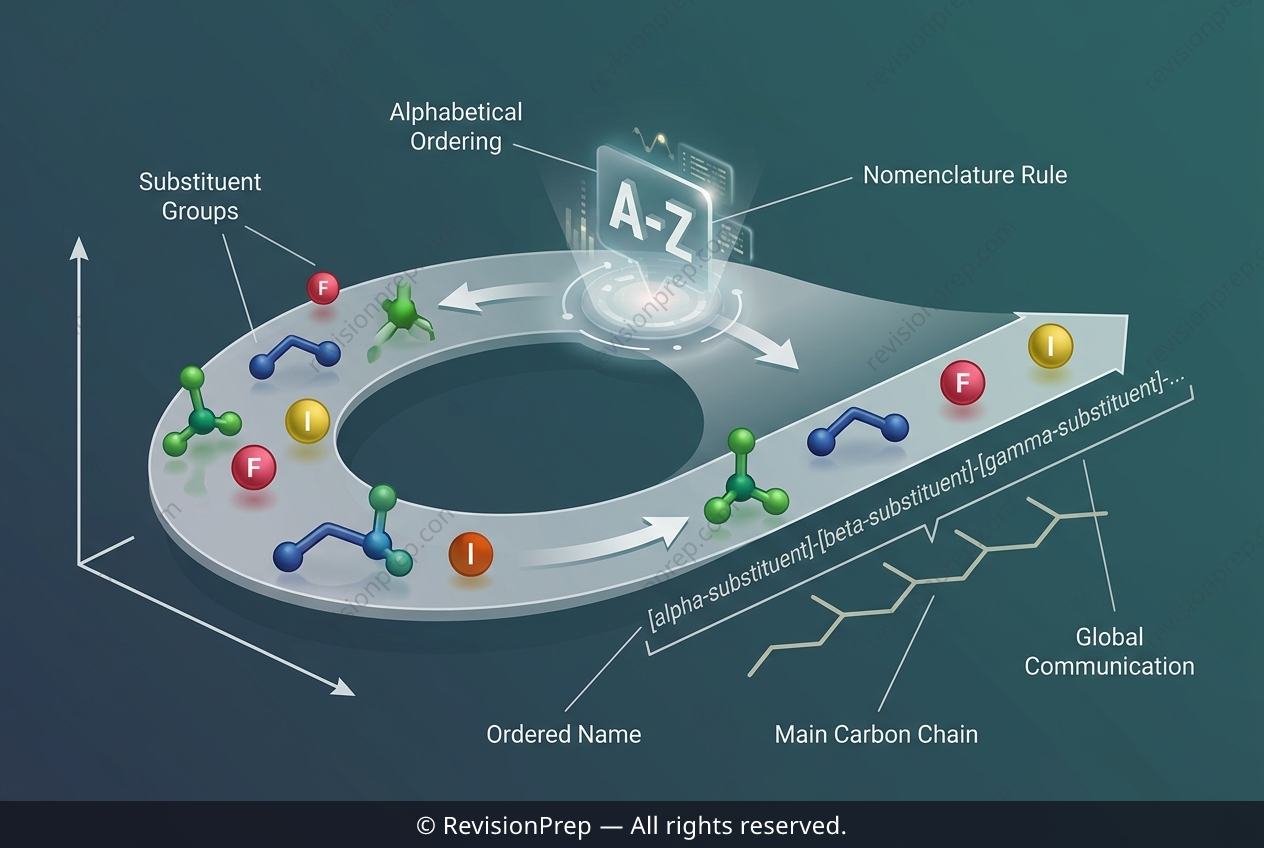
Naming organic compounds is far more than a vocabulary exercise—it is the grammar of chemistry. The IUPAC system provides a universal set of rules that translate a three-dimensional molecular structure into a single, precise string of text. At its heart lies a simple but powerful principle: every substituent (a branch attached to the main carbon chain) must be identified and then ordered in a way that leaves no room for interpretation. In the case of a molecule bearing both an ethyl group (–C₂H₅) and a methyl group (–CH₃), the challenge is not just spotting the branches, but deciding which name comes first. The rule that resolves this is alphabetical order based on the complete substituent name, ignoring any multiplying prefixes like di- or tri-. Because “ethyl” begins with ‘e’ and “methyl” with ‘m’, ethyl is always cited before methyl—regardless of which carbon number it occupies on the parent chain. This seemingly arbitrary convention is what makes nomenclature systematic: it ensures that a chemist in Tokyo and one in Toronto will write the exact same name for the exact same molecule. Without this shared ordering logic, a single structure could acquire multiple valid-sounding names, breaking the unambiguous link between a written name and the physical compound it represents—a link essential for safe replication in labs, industry, and regulatory documentation.
Start practising IB questions today
150,000+ IB-styled questions, criteria-mapped and instantly accessible.