
Chemistry: The Balanced Motion of Equilibrium
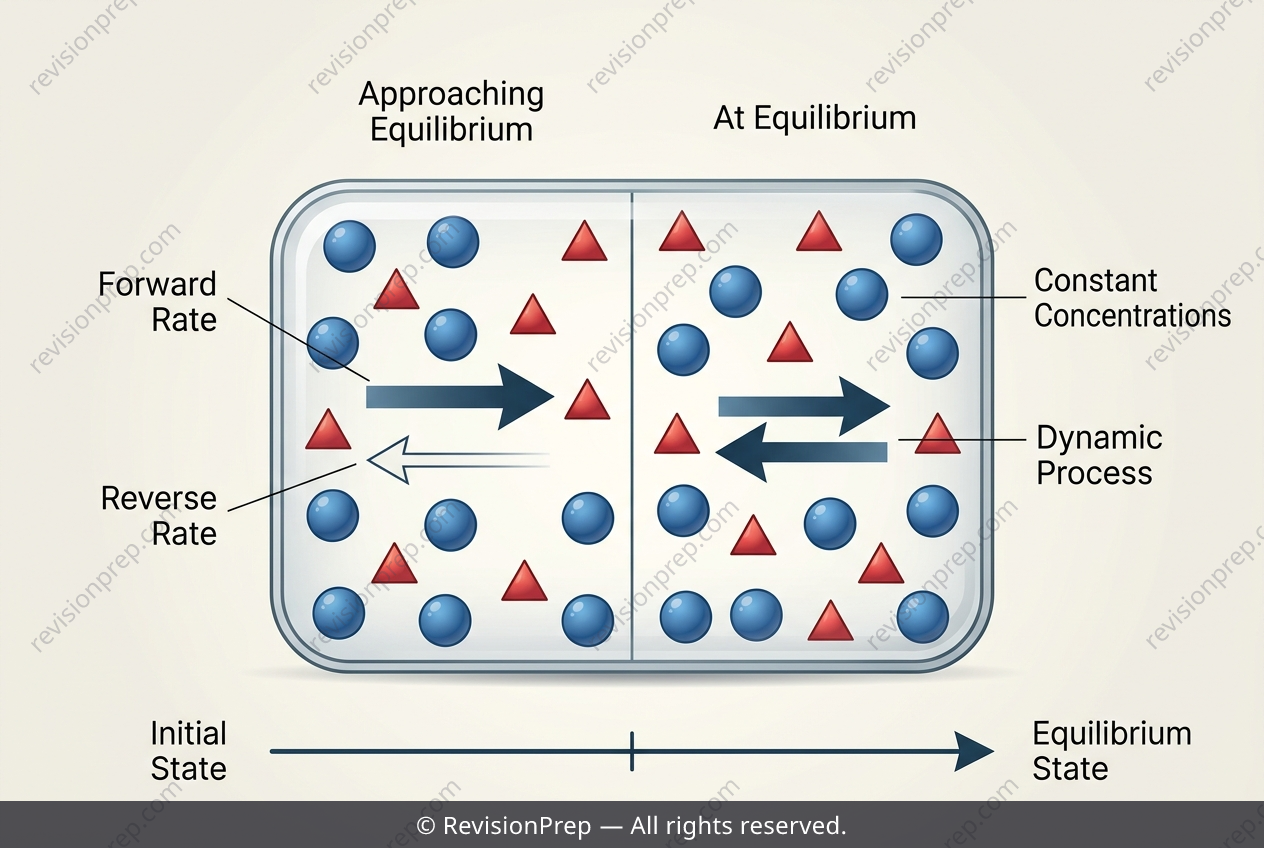
Dynamic chemical equilibrium is one of the most counterintuitive ideas in chemistry: a reaction that appears “finished” is actually still racing in both directions at once. For a closed system at constant temperature, such as the interconversion of dinitrogen tetroxide and nitrogen dioxide (N₂O₄ ⇌ 2NO₂), equilibrium is reached not when reactions stop, but when the forward and reverse rates become equal and stay equal. This single condition—equal, constant rates—defines the state, and it is the key to understanding why concentrations remain unchanged even though molecules keep reacting. The beauty of this concept lies in its dynamic nature. At the start, only the forward reaction occurs, but as products form, the reverse reaction begins and accelerates. Over time, the two rates converge until they match, at which point the system is in equilibrium. The equal rates mean that for every molecule of N₂O₄ consumed to form NO₂, an equivalent amount of NO₂ recombines to reform N₂O₄. Thus, the net concentrations of both species stay fixed, yet the forward and reverse processes never cease—they are locked in a perpetual, balanced dance. This balance is the heart of qualitative equilibrium, explaining why a system at equilibrium is alive with activity, not frozen in time.
Start practising IB questions today
150,000+ IB-styled questions, criteria-mapped and instantly accessible.