
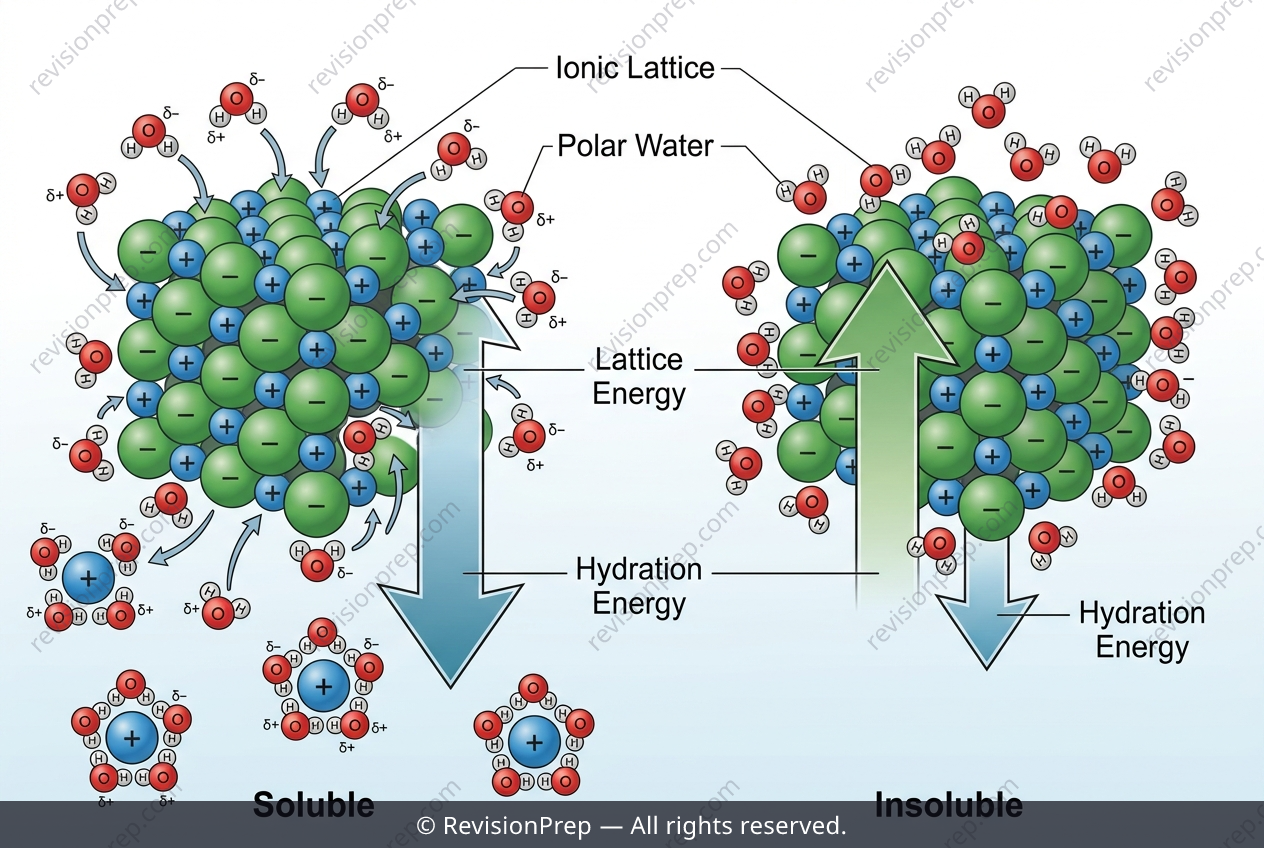
Chemistry: The Energy Tug-of-War Behind Solubility
Why do some salts dissolve while others remain solid? The answer lies in the tug-of-war between lattice energy and hydration energy. Lattice energy is the energy required to separate one mole of an ionic lattice into gaseous ions, while hydration energy is released when those ions are surrounded by water molecules. Dissolution depends on whether hydration energy can compensate for the lattice energy. Water's polarity is key. Its oxygen atom carries a partial negative charge and its hydrogens carry partial positive charges, so water forms ion-dipole attractions with ions. These attractions can overcome the electrostatic forces holding a lattice together, allowing ions to separate and become hydrated. In sodium chloride, this balance favours dissolution. In silver chloride, stronger electrostatic attractions between Ag+ and Cl- give a much higher lattice energy, which hydration energy cannot offset. Comparing these energies explains solubility.
Start practising IB questions today
150,000+ IB-styled questions, criteria-mapped and instantly accessible.