
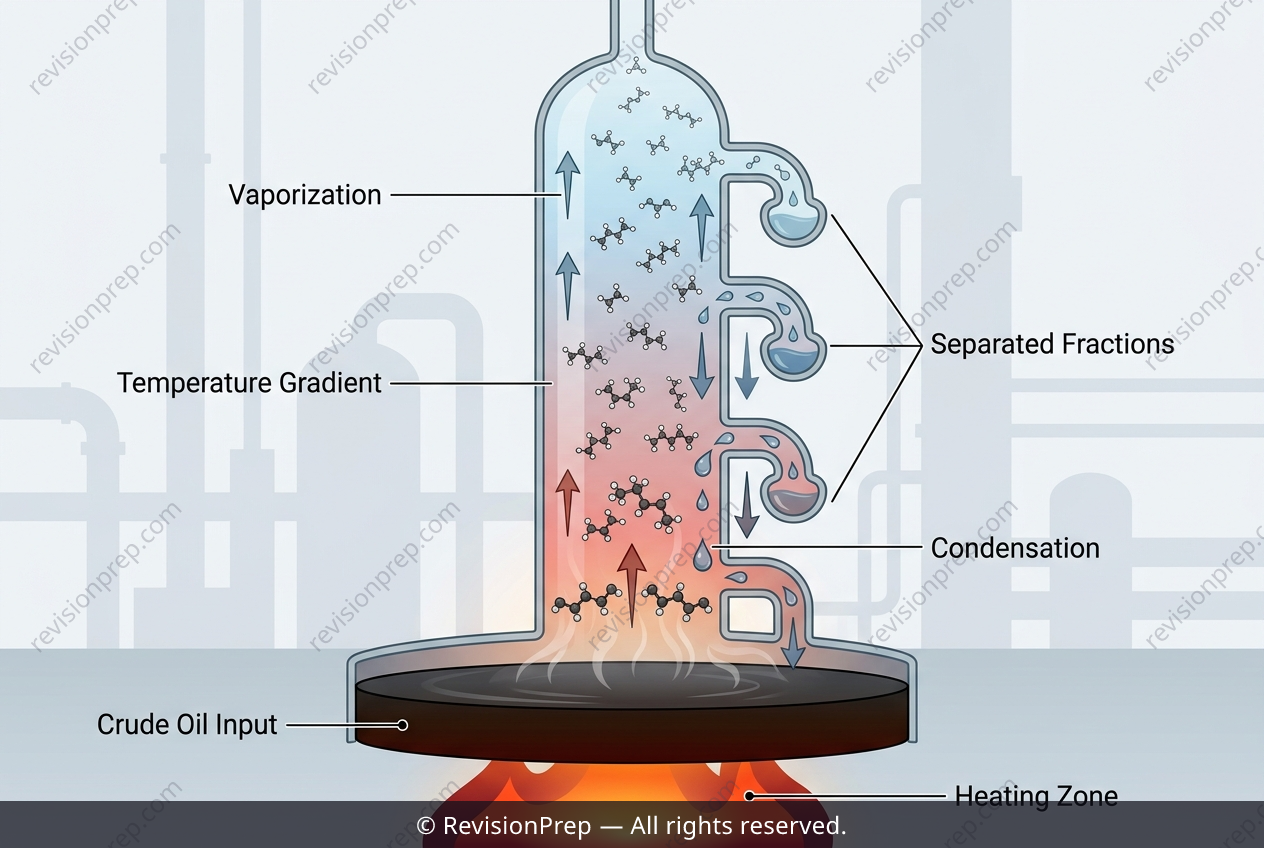
Chemistry: The Engine Behind Fractional Distillation
Crude oil is a complex mixture of thousands of different hydrocarbons, and its value lies in separating these into useful fractions like petrol, diesel, and kerosene. The core principle that makes this possible is boiling point separation: because each hydrocarbon has a unique boiling point, heating the mixture allows lighter molecules to vaporise first, while heavier ones remain liquid. This is not a single-step process but a continuous, temperature-graded cascade, and the fractional distillation column is the engineered stage where this physical separation unfolds. At the heart of this system is the initial energy input. The crude oil must first be heated to a high temperature—typically around 350–400°C—to ensure that even the heaviest fractions can at least begin to vaporise. This is achieved by component X, the furnace (or boiler), which sits at the base of the column. Its function is not merely to warm the oil but to drive a complete change of state: converting the liquid crude into a rising vapour. As this vapour ascends, it encounters a temperature gradient—hot at the bottom, cooler at the top—causing different fractions to condense at distinct heights. The furnace therefore initiates the entire separation mechanism, linking heat energy directly to the physical process of vaporisation that makes the column’s layered collection possible.
Start practising IB questions today
150,000+ IB-styled questions, criteria-mapped and instantly accessible.