
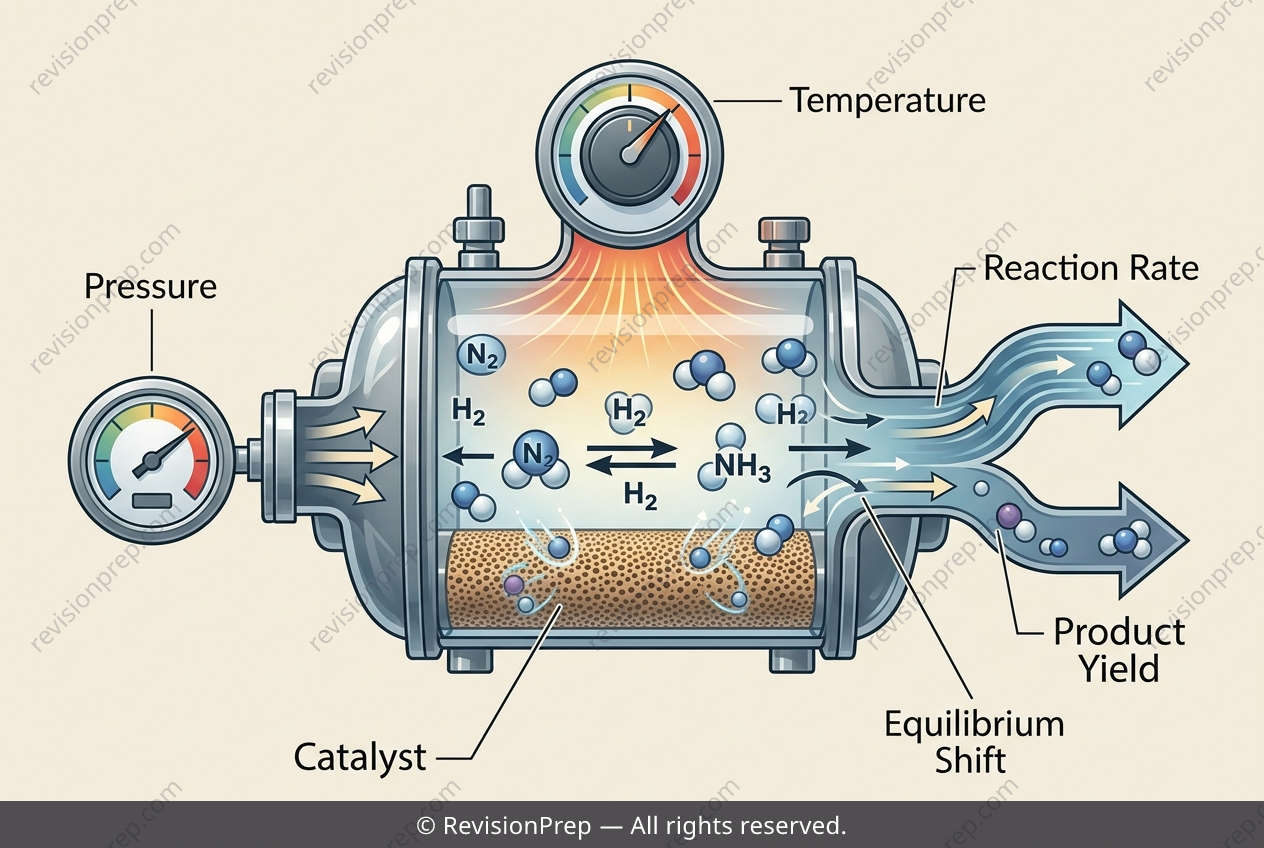
Chemistry: The Haber Process — Yield vs Speed
In industrial chemistry, the goal is rarely to achieve the maximum theoretical yield, but rather to produce a product as quickly and cheaply as possible. This is the central tension explored in the study of reversible reactions and equilibrium, where the Haber process for ammonia synthesis serves as the classic case study. The reaction between nitrogen and hydrogen gas is exothermic and involves a change in the number of gas moles, meaning both temperature and pressure can be used to manipulate the system's position of equilibrium. The core principle governing this manipulation is Le Chatelier's principle, which states that a system at equilibrium will shift to counteract any imposed change. For the Haber process, increasing the pressure forces the equilibrium to shift toward the side with fewer gas molecules—the product side—thereby boosting ammonia yield. However, because the forward reaction is exothermic, a lower temperature would also favour higher yields. The industrial compromise of 450 °C exists because while lower temperatures improve the equilibrium yield, they slow the reaction rate to an economically impractical level. The chosen temperature, alongside an iron catalyst, balances a sufficiently fast rate with an acceptable equilibrium conversion, illustrating how thermodynamic predictions must always be tempered by kinetic realities.
Start practising IB questions today
150,000+ IB-styled questions, criteria-mapped and instantly accessible.