
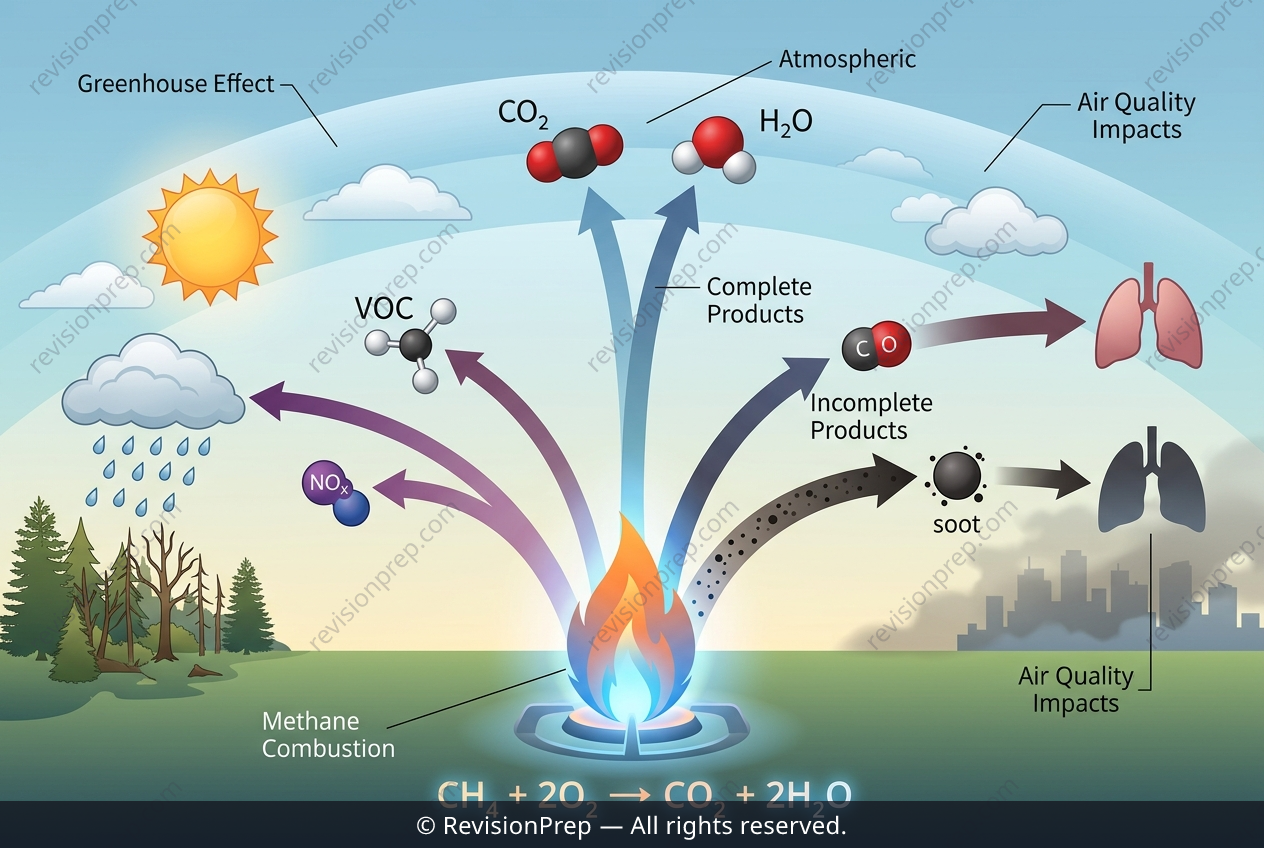
Chemistry: The Hidden Emissions in a Kitchen Flame
When methane (CH₄) burns in a home gas stove, the familiar equation CH₄ + 2O₂ → CO₂ + 2H₂O appears clean and complete. Yet this tidy representation hides a messier reality. The core concept here is the environmental chemistry of combustion—specifically, how idealised reaction equations diverge from what actually happens in your kitchen, and why that gap matters for the atmosphere. This matters because combustion is never just a chemistry exercise; it is a daily source of emissions with real climatic and health consequences. The equation above captures the ideal: full conversion to carbon dioxide and water. But real stoves also produce incomplete combustion products—carbon monoxide (CO) and soot (unburned carbon particles)—which are omitted entirely. Furthermore, the CO₂ released is itself a potent greenhouse gas, trapping heat and driving global warming. Even unburned methane, leaking from fittings, is a far stronger greenhouse gas than CO₂. Thus, the equation underestimates the full atmospheric burden: it shows only one product pathway, while reality includes multiple pollutants, each with distinct warming or toxic effects. Understanding this gap between model and reality is essential for assessing any fuel’s true environmental footprint.
Start practising IB questions today
150,000+ IB-styled questions, criteria-mapped and instantly accessible.