
Chemistry: The Pattern Behind Carboxylic Acid Names
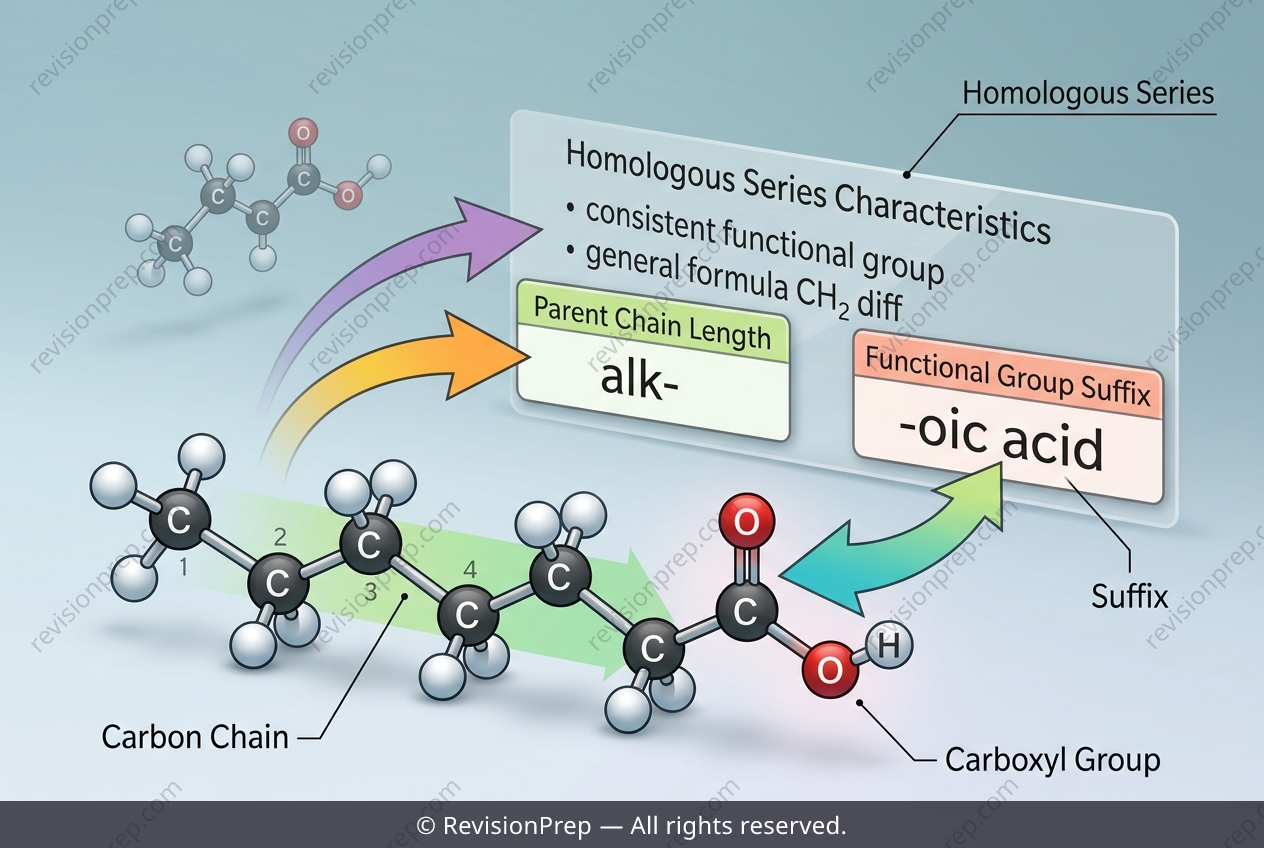
Carboxylic acids are the foundational “end point” of organic oxidation, defined by the presence of the carboxyl functional group (–COOH). This group combines a carbonyl (C=O) and a hydroxyl (–OH) on the same carbon, giving the family its characteristic acidity and its unique position at the top of the functional group ladder. In IUPAC nomenclature, naming these compounds is a systematic exercise in translating structure into a precise, universal language—one that removes ambiguity and allows chemists anywhere to reconstruct a molecule from its name alone. The process hinges on three interlocking rules: identifying the longest continuous carbon chain that includes the carboxyl carbon, confirming that all bonds are single (saturated), and then applying the correct suffix. For a six-carbon saturated chain, the root “hex-” combines with the infix “-an-” and the suffix “-oic acid,” yielding “hexanoic acid.” Notably, no locant (number) is needed because the carboxyl carbon is always assigned position 1 by convention. This family also follows a strict mathematical pattern: the general formula CₙH₂ₙO₂, where each successive member adds one –CH₂– unit. That consistency—shared functional group, identical suffix, and stepwise formula—is what defines a homologous series, allowing predictions of physical properties and reactivity across the entire group.
Start practising IB questions today
150,000+ IB-styled questions, criteria-mapped and instantly accessible.