
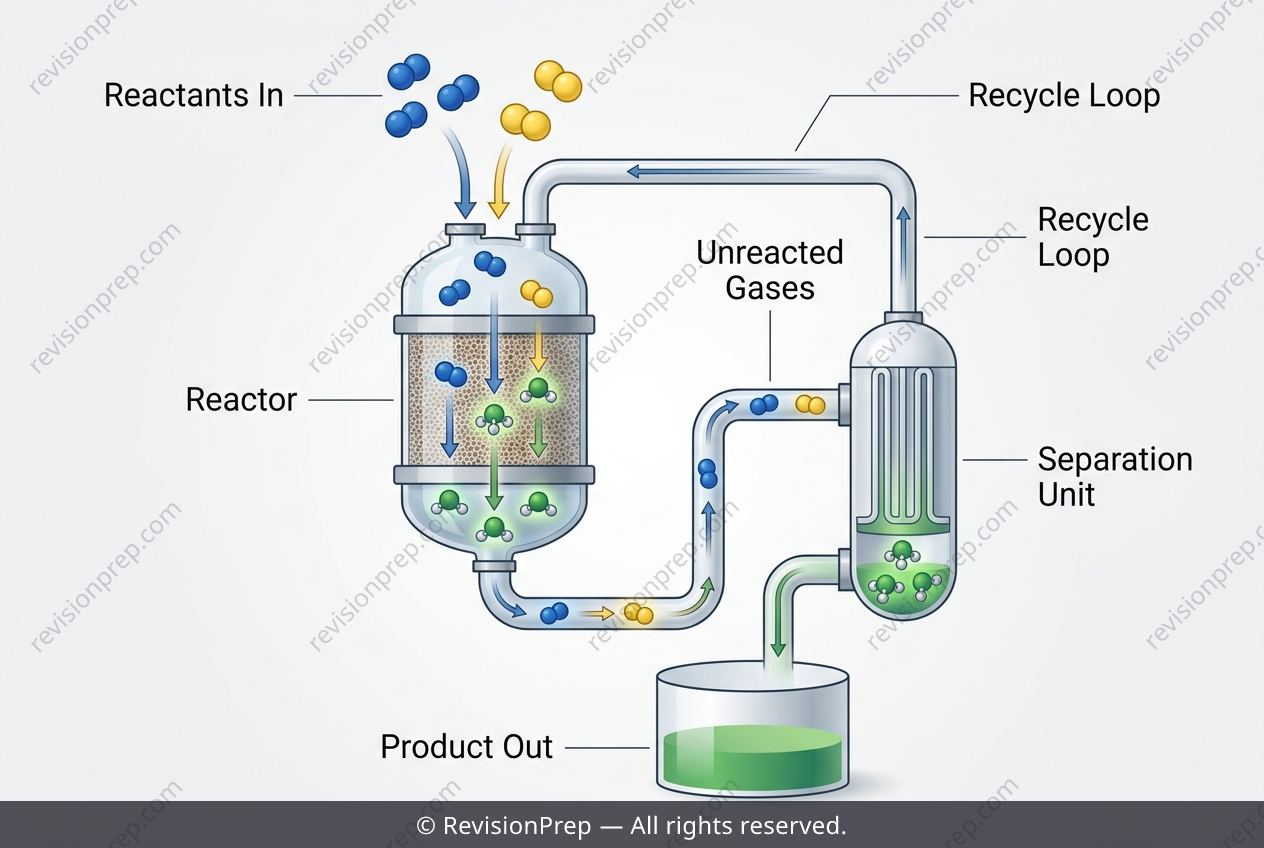
Chemistry: The Recycle Loop Behind Ammonia Yield
Reversible reactions sit at the heart of industrial chemistry, where the goal is rarely just to make a product—but to make as much of it as possible, efficiently and economically. In the Haber process, nitrogen and hydrogen combine to form ammonia via the equilibrium N₂ + 3H₂ ⇌ 2NH₃, a reaction that never runs to completion in a single pass. Instead, only a fraction of the reactants convert before the system reaches a dynamic balance between forward and reverse rates. This is where the design of the process becomes crucial: the reaction chamber (or catalyst bed) provides the conditions—temperature, pressure, and an iron catalyst—to push the equilibrium toward ammonia, while the condenser cools the gas mixture to liquefy and collect the product. What makes the process truly efficient is the recycle loop. Because the reaction is reversible and incomplete, unreacted nitrogen and hydrogen are not wasted; they are routed back through the reaction chamber for another chance to react. This recycling directly increases the overall yield of ammonia per unit of reactant fed into the system, transforming a single-pass conversion of perhaps 15% into a cumulative yield that is commercially viable. Understanding this interplay—between equilibrium position, reaction kinetics, and process engineering—is the key to mastering how real-world industries maximise output from reversible reactions.
Start practising IB questions today
150,000+ IB-styled questions, criteria-mapped and instantly accessible.