
Chemistry: The Trade-Off Between Coal and Sunlight
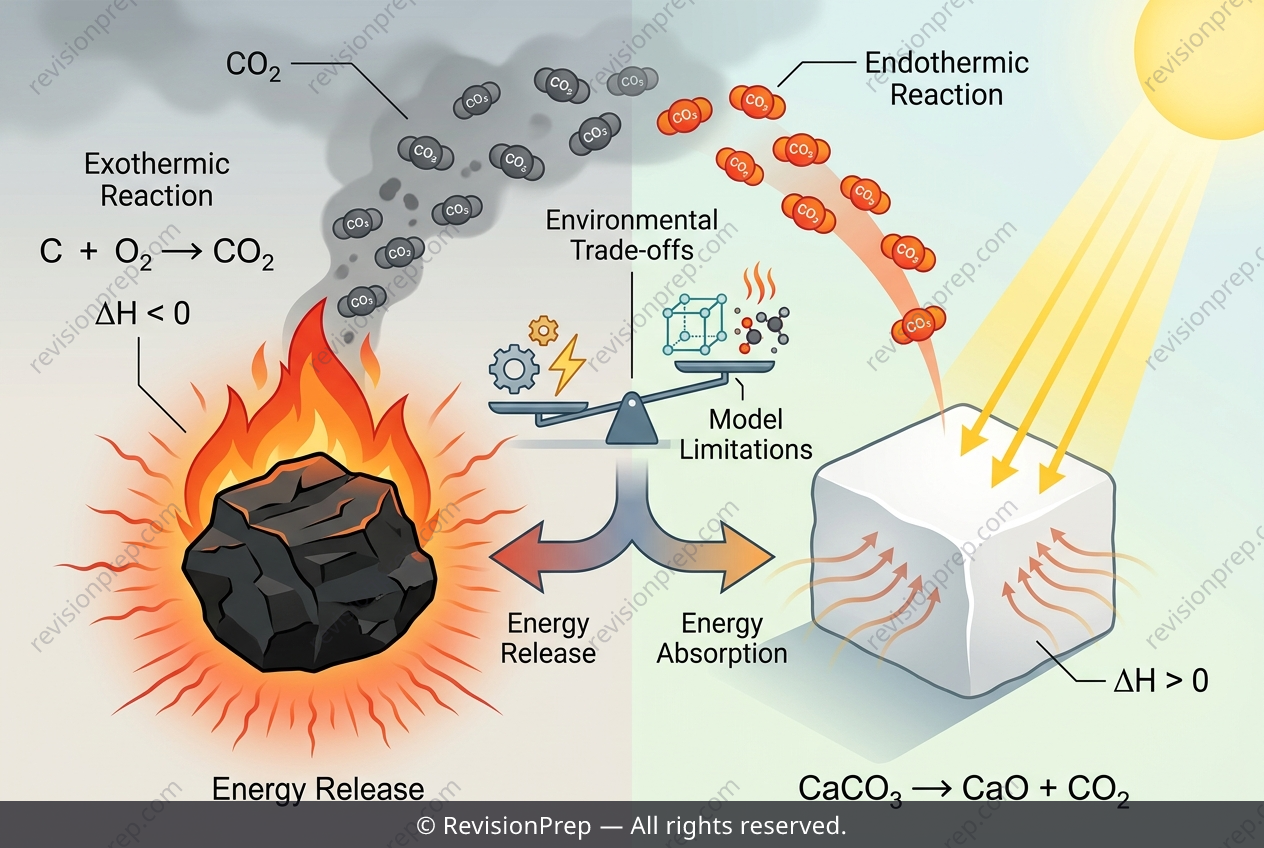
When a chemical reaction releases heat into its surroundings, we call it exothermic, and the enthalpy change, ΔH, is negative. Conversely, when a reaction must absorb energy to proceed, it is endothermic, with ΔH positive. This simple sign convention is the heartbeat of thermodynamics, governing everything from the combustion of coal in a power plant to the thermal decomposition of limestone using concentrated sunlight. Understanding this energy exchange is not just an academic exercise—it is central to how societies weigh the costs and benefits of their energy systems. In the coal reaction, C(s) + O₂(g) → CO₂(g), the products hold less chemical potential energy than the reactants, so the released thermal energy is harnessed to generate electricity. In contrast, the solar-driven decomposition of CaCO₃(s) requires a continuous input of sunlight to push the reaction uphill, storing energy in the chemical bonds of its products. These two pathways illustrate a fundamental trade-off: one offers reliable, constant power but releases CO₂ directly, while the other offers a potentially carbon-neutral cycle, yet depends entirely on intermittent sunlight and the efficiency of energy capture. The choice between them is a balancing act of thermodynamics, environmental impact, and practical reliability.
Start practising IB questions today
150,000+ IB-styled questions, criteria-mapped and instantly accessible.