
Chemistry: The Trade-offs Behind Liming a Lake
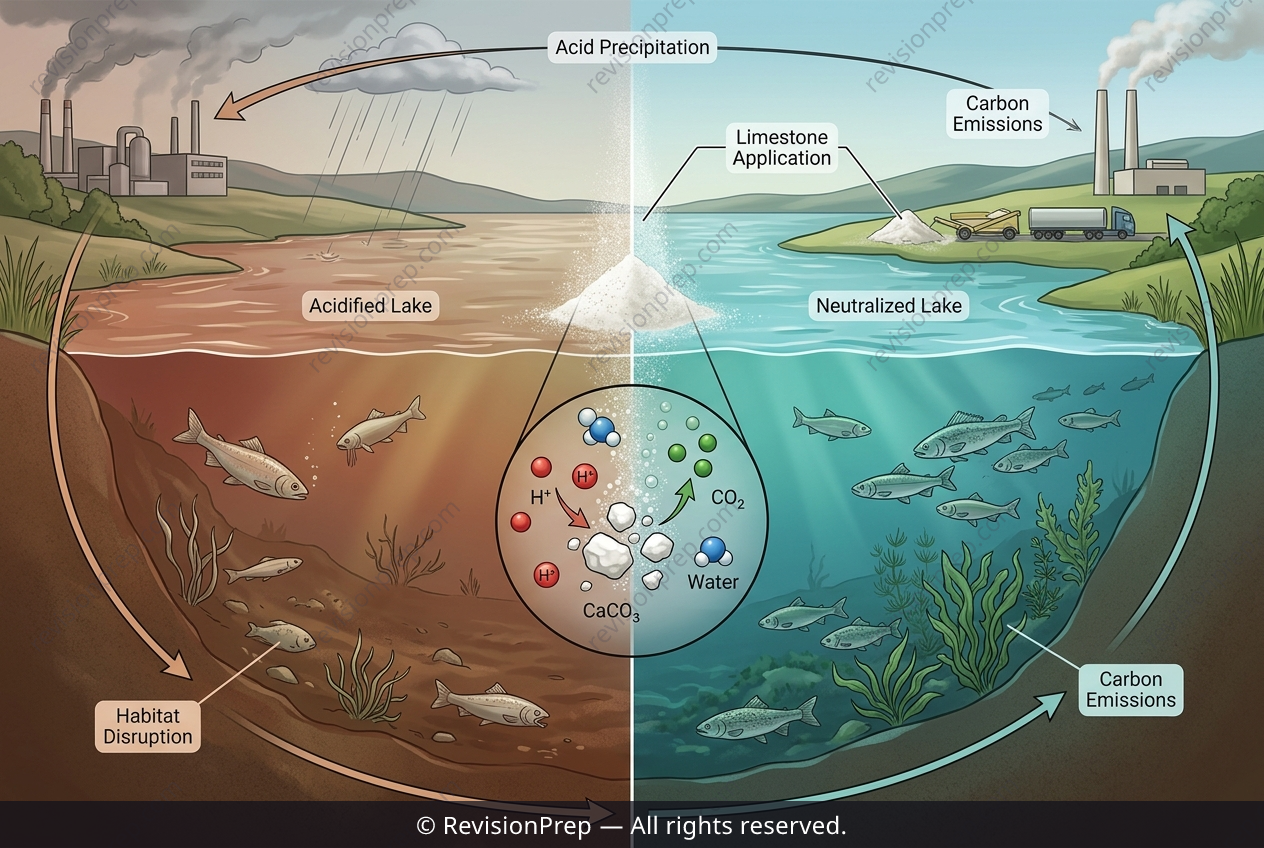
Acid rain can push freshwater ecosystems past a critical threshold: when lake pH falls below 5, excess H+ ions damage fish gills and wipe out acid-sensitive species. Liming — the aerial scattering of powdered limestone — is a direct chemical intervention. The neutralisation reaction, CaCO3(s) + 2H+(aq) → Ca2+(aq) + CO2(g) + H2O(l), shows limestone acting as a base, accepting H+ ions and lifting pH towards 6–7, where aquatic life can return. But this is a study in systemic trade-offs, not a simple fix. Ecologically, restored pH lets fish, invertebrates and plants recover, rebuilding food webs and biodiversity. Societally, recovered fisheries and tourism bring economic and cultural benefits. Yet quarrying limestone destroys habitats, and transporting it burns fossil fuels, releasing CO2 — the very gas driving acid rain. Understanding these connected costs and benefits is what turns a neutralisation equation into genuine environmental literacy.
Start practising IB questions today
150,000+ IB-styled questions, criteria-mapped and instantly accessible.