
Chemistry: When Neutralisation Pushes pH Too High
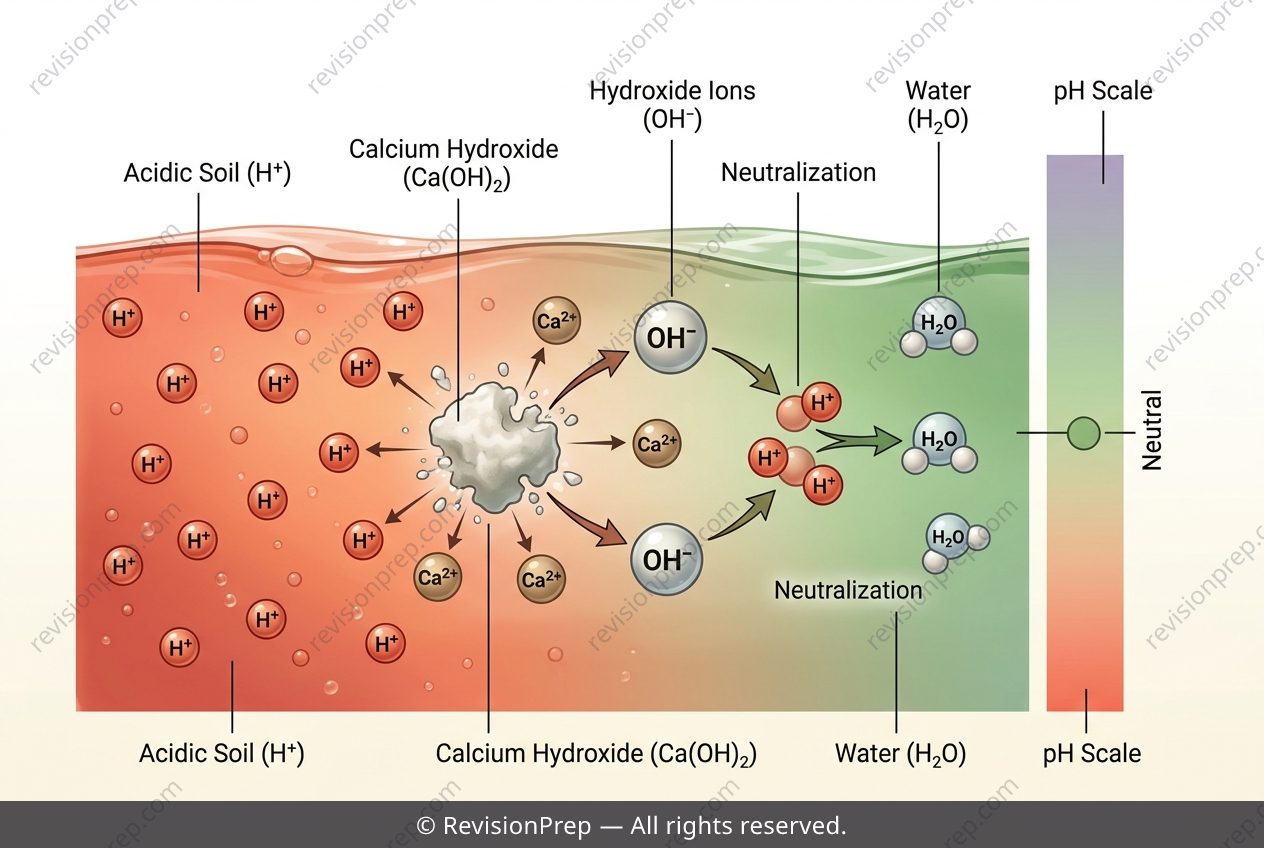
Neutralization reactions are the chemical counterbalance to acidity, where an acid and a base react to form water and a salt. In soil, this process is central to pH regulation: calcium hydroxide, Ca(OH)₂, dissolves in soil water and releases hydroxide ions, OH⁻. These ions react with the excess hydrogen ions, H⁺, that define an acidic environment, following H⁺ + OH⁻ → H₂O. Because this reaction consumes H⁺, its concentration falls and the pH rises toward neutral — a direct, quantifiable link between ionic behaviour and a measurable property. Understanding this relationship matters because pH governs nutrient availability, microbial activity, and crop health. Yet the same chemistry that corrects acidity can overshoot: applying excess base drives pH above 7, making soil alkaline and reducing the bioavailability of essential nutrients such as iron and manganese. Neutralization is therefore not simply about removing acid, but about balancing H⁺ and OH⁻ concentrations within a range where living systems thrive.
Start practising IB questions today
150,000+ IB-styled questions, criteria-mapped and instantly accessible.