
Chemistry: When Stoichiometry Meets Real-World Risk
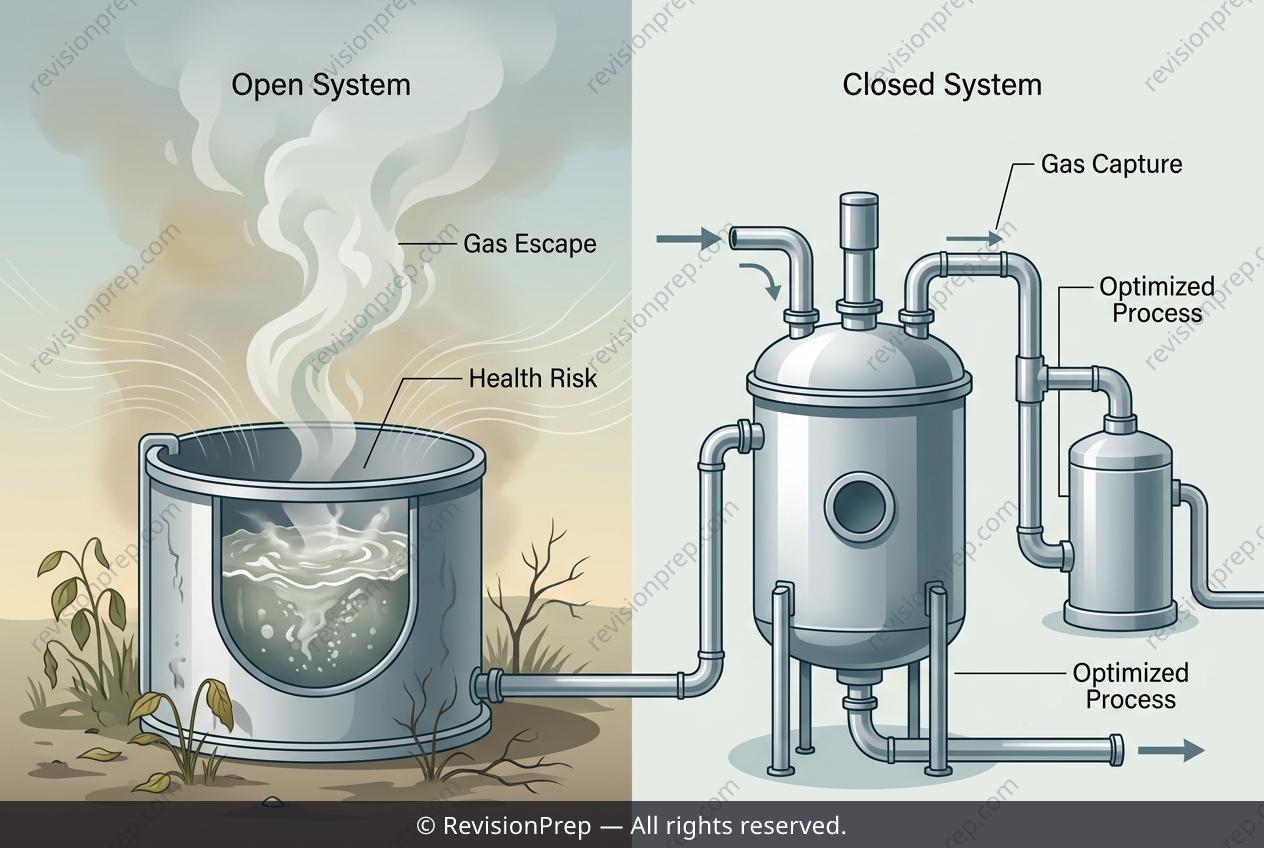
Making and testing salts sits at the heart of industrial chemistry, where a simple neutralisation reaction — acid plus base forming a salt and water — becomes a question of efficiency, purity, and safety at scale. Here, ammonia solution reacts with sulfuric acid to produce ammonium sulfate, a widely used fertilizer: NH3(aq) + H2SO4(aq) → (NH4)2SO4(aq). Balancing this equation reveals the essential 2:1 molar relationship between ammonia and acid, the stoichiometric ratio that governs complete neutralisation and determines how much product actually forms. That ratio matters because real processes rarely behave as cleanly as equations suggest. In an open tank, ammonia gas escapes, and this single flaw connects chemistry to consequences: ammonia is toxic and corrosive to the respiratory system, while its deposition in waterways drives eutrophication, depleting dissolved oxygen and creating aquatic dead zones. Scaling up magnifies these problems, since holding a precise 2:1 ratio in an open vessel becomes impractical, leaving excess reactants that reduce product purity and breach emission limits. Understanding these links between stoichiometry, human health, and environmental impact is what turns a textbook equation into genuine chemical literacy.
Start practising IB questions today
150,000+ IB-styled questions, criteria-mapped and instantly accessible.