
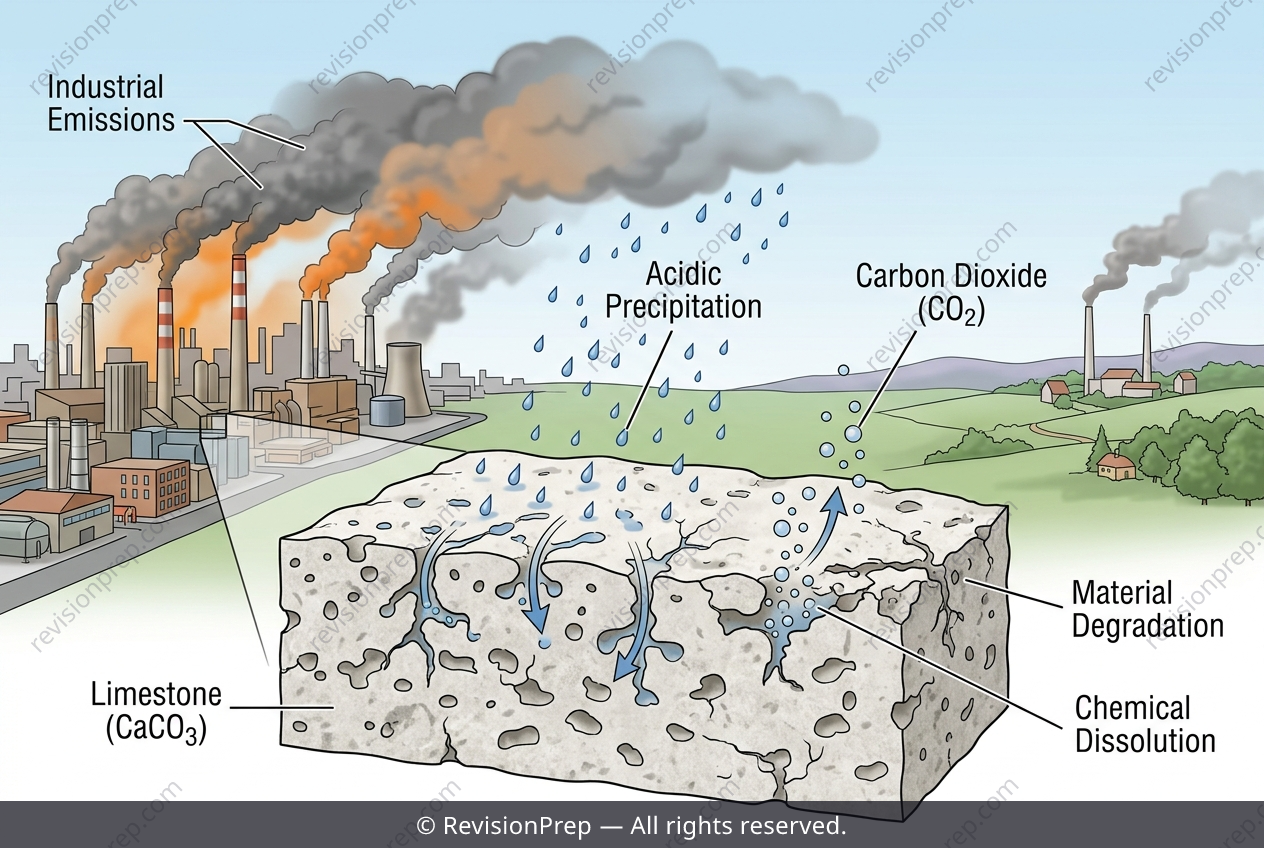
Chemistry: Why Acid Rain Slowly Destroys Monuments
Acid rain is a direct chemical consequence of industrialisation, forming when sulfur dioxide and nitrogen oxides dissolve in atmospheric water to produce acidic solutions. These acids then react with carbonate-based materials — most notably calcium carbonate, CaCO₃, the mineral that forms limestone and marble. The reaction between sulfuric acid and calcium carbonate, CaCO₃(s) + H₂SO₄(aq) → CaSO₄(aq) + H₂O(l) + CO₂(g), is central to understanding how monuments such as the Parthenon and Europe's medieval cathedrals slowly lose their surfaces. This chemistry matters because the products of the reaction are not left in place. Soluble calcium sulfate dissolves and is washed away by rainfall, removing material from the stone and weakening the structure over time. The rate of this damage depends on acidity: higher concentrations of SO₂ and NOₓ in industrialised cities lower the pH of rainwater, increasing the concentration of H⁺ ions and accelerating the reaction with CaCO₃. The result is faster, cumulative erosion in urban environments than in rural ones.
Start practising IB questions today
150,000+ IB-styled questions, criteria-mapped and instantly accessible.