
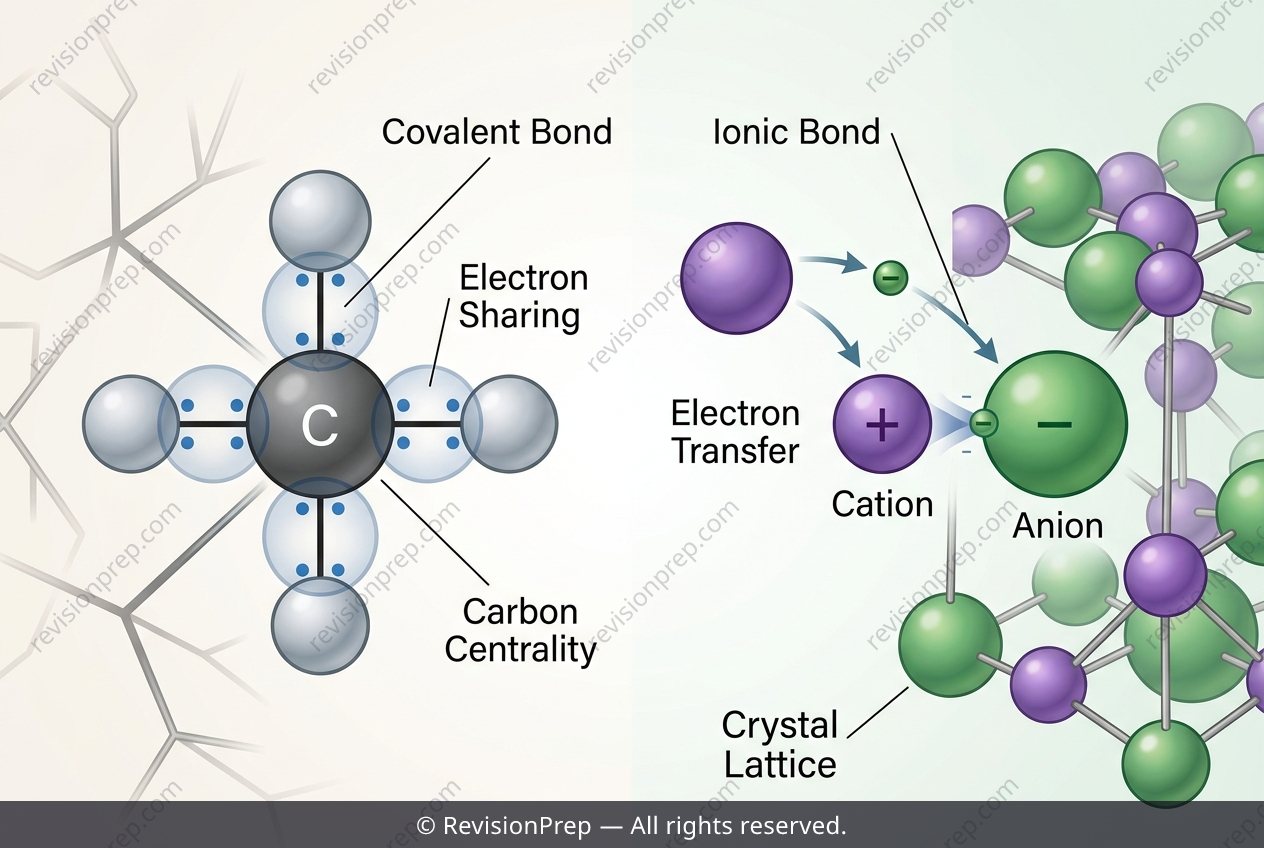
Chemistry: Why Bonding Defines Organic and Inorganic
The line between organic and inorganic chemistry is not drawn by where a compound comes from, but by how its atoms are held together—and carbon sits at the very centre of that divide. In this introduction, we explore the classification of compounds by examining methane (CH₄) and sodium chloride (NaCl), two substances that look simple yet embody the fundamental distinction: organic compounds are built on carbon forming covalent bonds with other non-metals, while inorganic compounds typically lack carbon and rely on ionic bonding. Why does this matter? Because bonding type dictates nearly every physical and chemical property—from melting points to solubility to reactivity. Methane’s central carbon atom shares its four outer electrons with four hydrogen atoms, creating four single covalent bonds, as shown by the shared electron pairs in its diagram. This covalent framework, carbon-to-hydrogen, is the hallmark of organic chemistry. Sodium chloride, in contrast, shows no carbon at all; instead, a sodium ion (Na⁺) and a chloride ion (Cl⁻) are held in a lattice by electrostatic ionic bonds. Recognising these patterns—covalent carbon networks versus ionic, carbon-free structures—lets you predict behaviour and classify any compound with confidence.
Start practising IB questions today
150,000+ IB-styled questions, criteria-mapped and instantly accessible.