
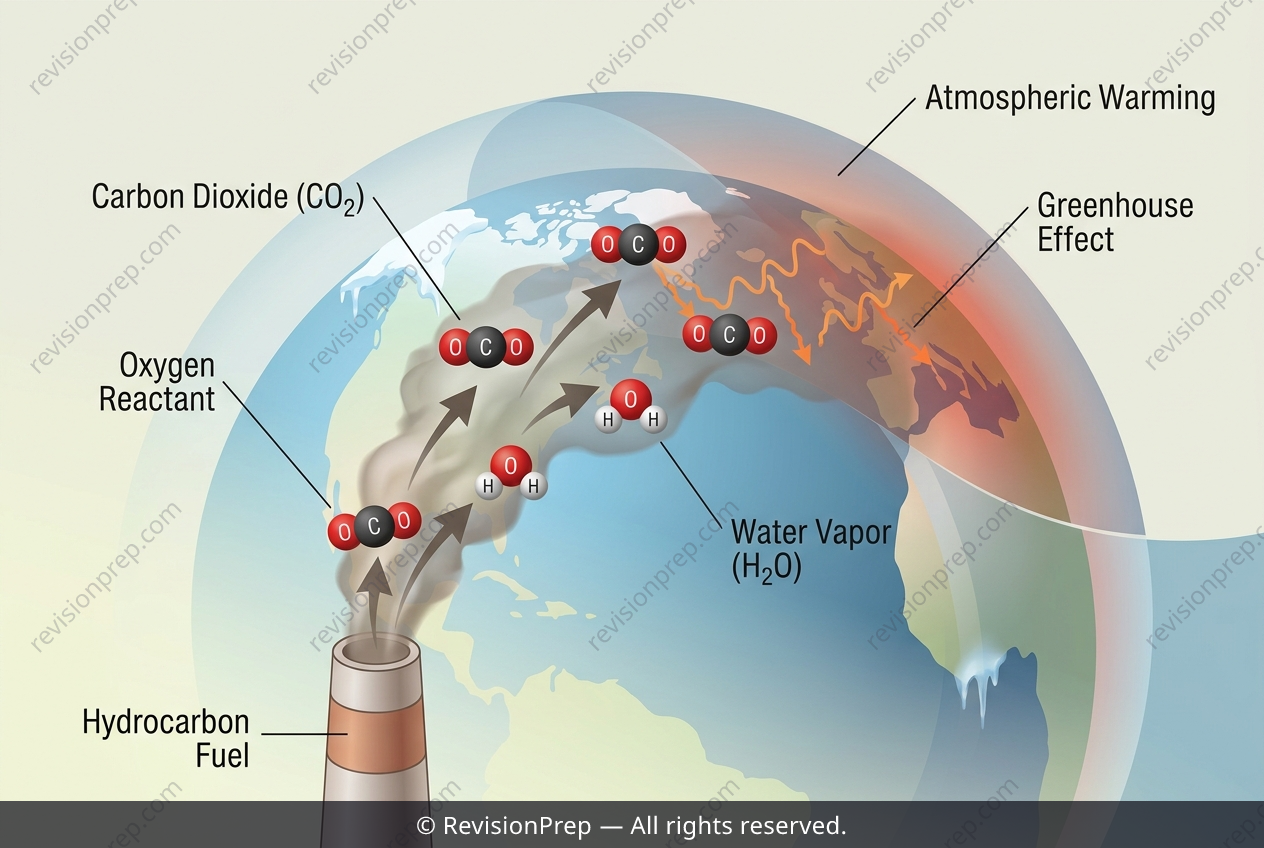
Chemistry: Why Burning Propane Warms the Planet
When propane (C₃H₈) burns completely in a barbecue cylinder, it reacts with oxygen to yield carbon dioxide (CO₂) and water (H₂O) — products that seem harmless at first glance but carry significant environmental weight. The balanced equation, C₃H₈ + 5O₂ → 3CO₂ + 4H₂O, shows that every molecule of this three-carbon fuel generates three molecules of CO₂, a direct link between the familiar “prop” prefix and the atmospheric consequences of its use. Understanding these products matters because their release is not neutral. Carbon dioxide is a greenhouse gas: it absorbs infrared radiation emitted from Earth’s surface and re-emits it back toward the planet, trapping heat and driving global warming and climate change. Water vapour, the other product, acts similarly as a greenhouse gas, though its atmospheric role is more variable. The core concept here is that combustion chemistry — seemingly simple equations — connects directly to planetary-scale environmental mechanisms, where the identity of each product dictates its impact on heat balance and climate stability.
Start practising IB questions today
150,000+ IB-styled questions, criteria-mapped and instantly accessible.