
Chemistry: Why Carbon Structure Shapes Combustion
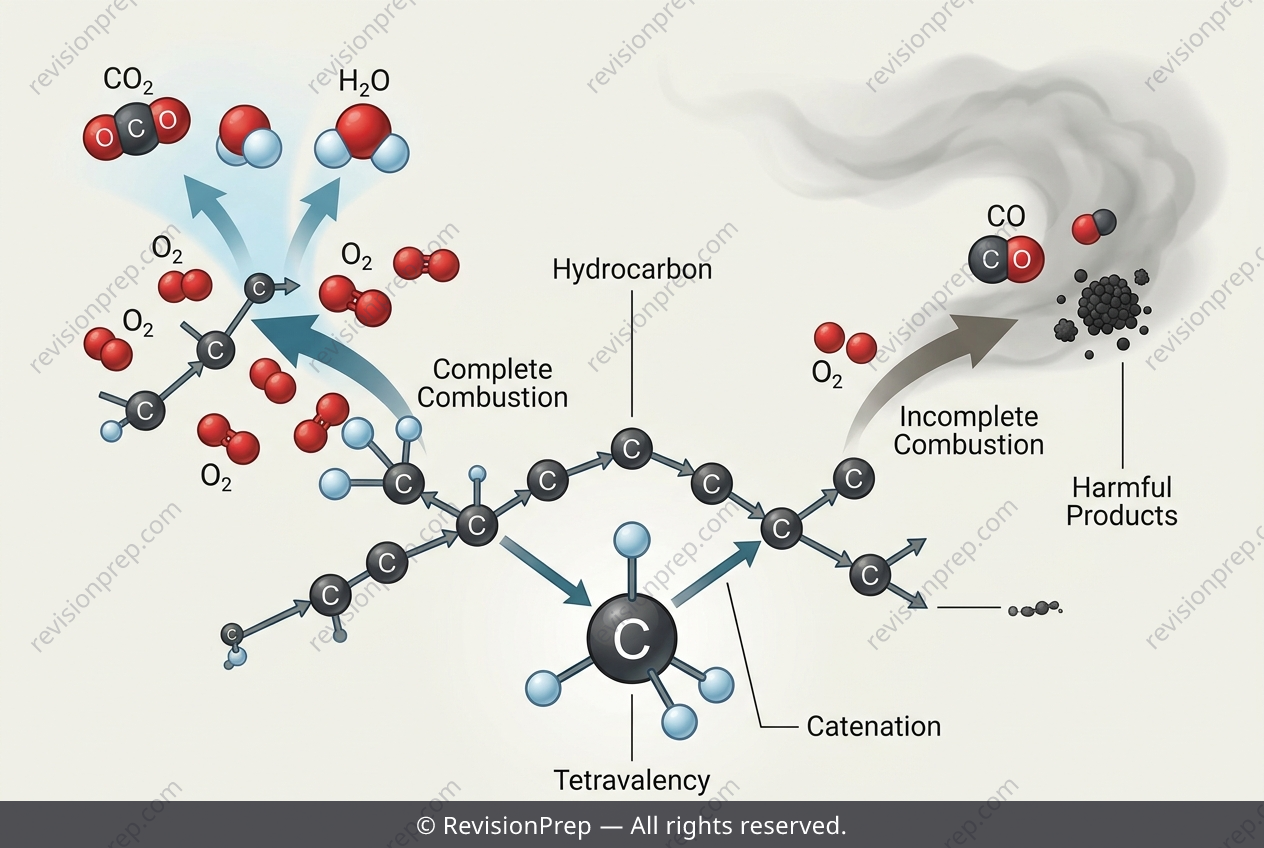
Carbon sits at the heart of organic chemistry, and its unique atomic structure is the reason we have fuels like octane (C₈H₁₈) powering our cars. At its core, this topic explores how a single element can form an almost infinite variety of stable, complex molecules—from simple methane to long-chain hydrocarbons—by understanding two fundamental properties: tetravalency and catenation. Tetravalency means carbon has four valence electrons, allowing it to form four strong covalent bonds with other atoms. Catenation, meanwhile, is carbon’s remarkable ability to bond with itself, creating stable C–C chains. Together, these properties explain why octane exists as an eight-carbon linear molecule rather than as isolated atoms. But structure also dictates behaviour: when octane burns in an engine with insufficient oxygen, incomplete combustion occurs, producing harmful substances like carbon monoxide (CO) or soot—unburned carbon particles—instead of the cleaner carbon dioxide (CO₂) seen in complete combustion. Understanding this link between molecular architecture and reaction products is essential for grasping both fuel efficiency and environmental pollution from vehicles.
Start practising IB questions today
150,000+ IB-styled questions, criteria-mapped and instantly accessible.