
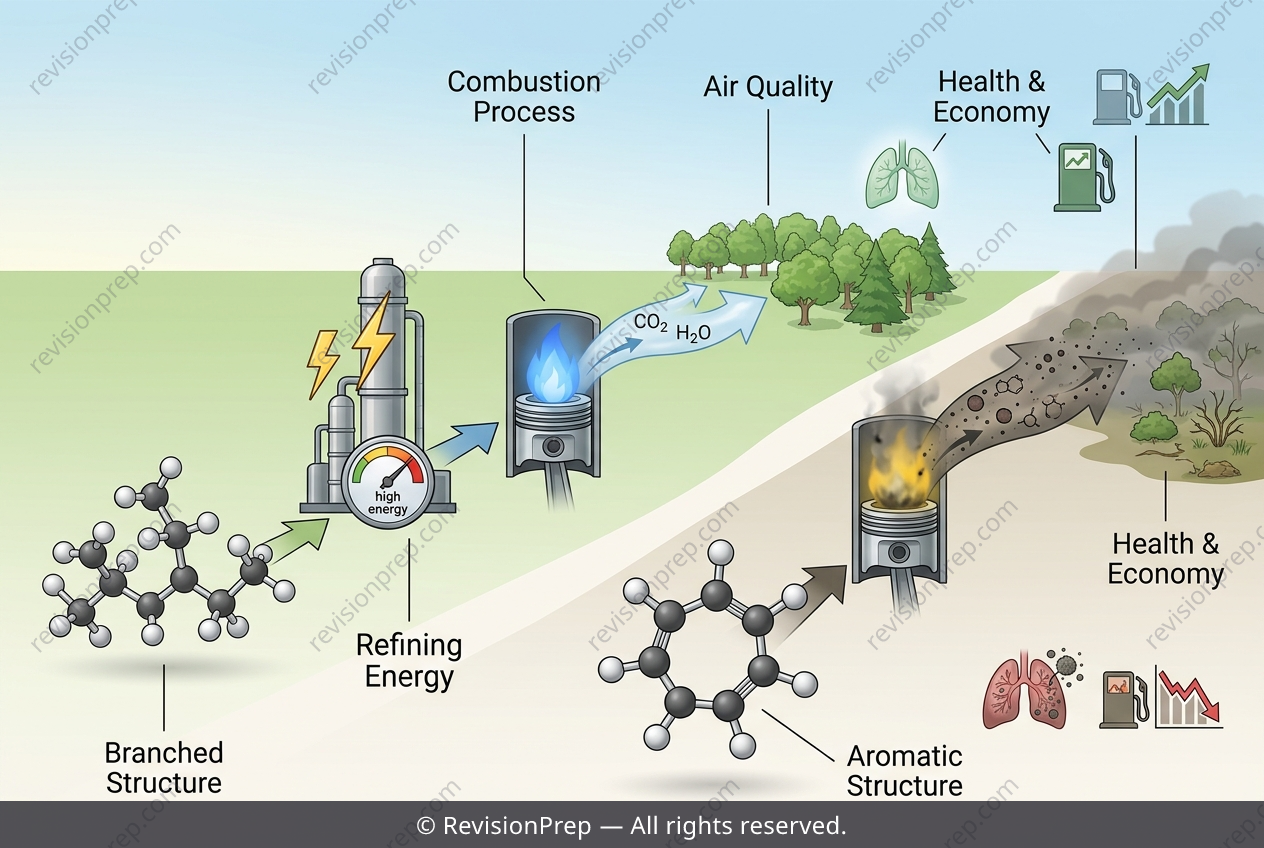
Chemistry: Why Fuel Structure Shapes Health Costs
Isomerism is the reason two molecules can share the exact same molecular formula yet behave as entirely different substances. In this case, C₈H₁₈ branched octanes and C₈H₁₀ aromatic xylenes both qualify as fuel additives, but their structural skeletons dictate everything from combustion efficiency to public health impact. The core relationship here is structure–property: how atoms are connected determines how a molecule breaks down under heat and pressure. Branched alkanes possess only single C–C bonds in an open chain, where increased branching suppresses auto-ignition, allowing smoother, more complete combustion into CO₂ and H₂O. In contrast, aromatic xylenes contain a benzene ring with delocalised π electrons—a highly stable arrangement that resists thermal breakdown, promoting incomplete combustion and the release of carcinogenic particulates. These differences create a sustainability trade-off: branched isomers burn cleaner but demand energy-intensive refining, while aromatics boost octane rating and engine efficiency yet impose costs through stricter emission controls and healthcare burdens. Understanding this balance—between molecular architecture, combustion chemistry, and societal consequences—is central to evaluating real-world fuel choices.
Start practising IB questions today
150,000+ IB-styled questions, criteria-mapped and instantly accessible.