
Chemistry: Why Polyethylene Is So Persistent
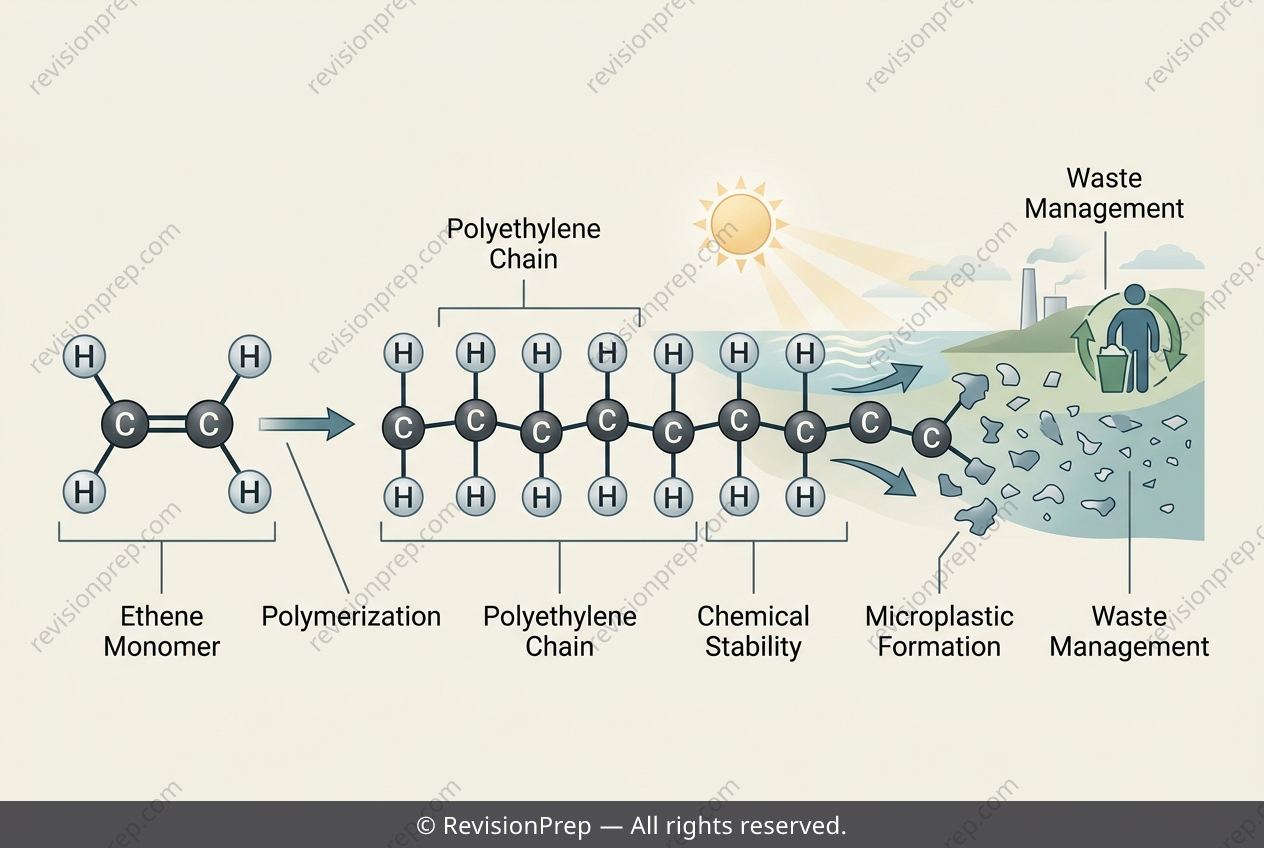
Plastics like polyethylene are built from a single, remarkably simple repeating unit — the ethene molecule, C₂H₄ — yet their properties and environmental fate hinge entirely on the structure of the carbon–carbon backbone. At the heart of this lies carbon’s tetravalency: each carbon atom shares its four valence electrons to form four covalent bonds, allowing it to link two neighbouring carbons while also bonding to hydrogen atoms. This, combined with catenation — carbon’s ability to bond repeatedly with itself — transforms the double bond of ethene into a long, single-bonded chain containing thousands of atoms. That same backbone, however, explains why polyethylene is so persistent. Its C–C and C–H bonds are non-polar and chemically stable, so microorganisms lack enzymes to break them down; the polymer resists biodegradation for centuries. Instead, physical weathering — UV radiation, abrasion, freeze–thaw cycles — fragments the material into microplastics smaller than 5 mm, which spread through soils and water, enter food chains, and bioaccumulate. Understanding this structure–property link is essential for evaluating real-world waste management, such as mechanical recycling, where each melt cycle shortens polymer chains and degrades tensile strength — a trade-off between reuse and material integrity.
Start practising IB questions today
150,000+ IB-styled questions, criteria-mapped and instantly accessible.