
Chemistry: Why Symmetry Cancels Molecular Polarity
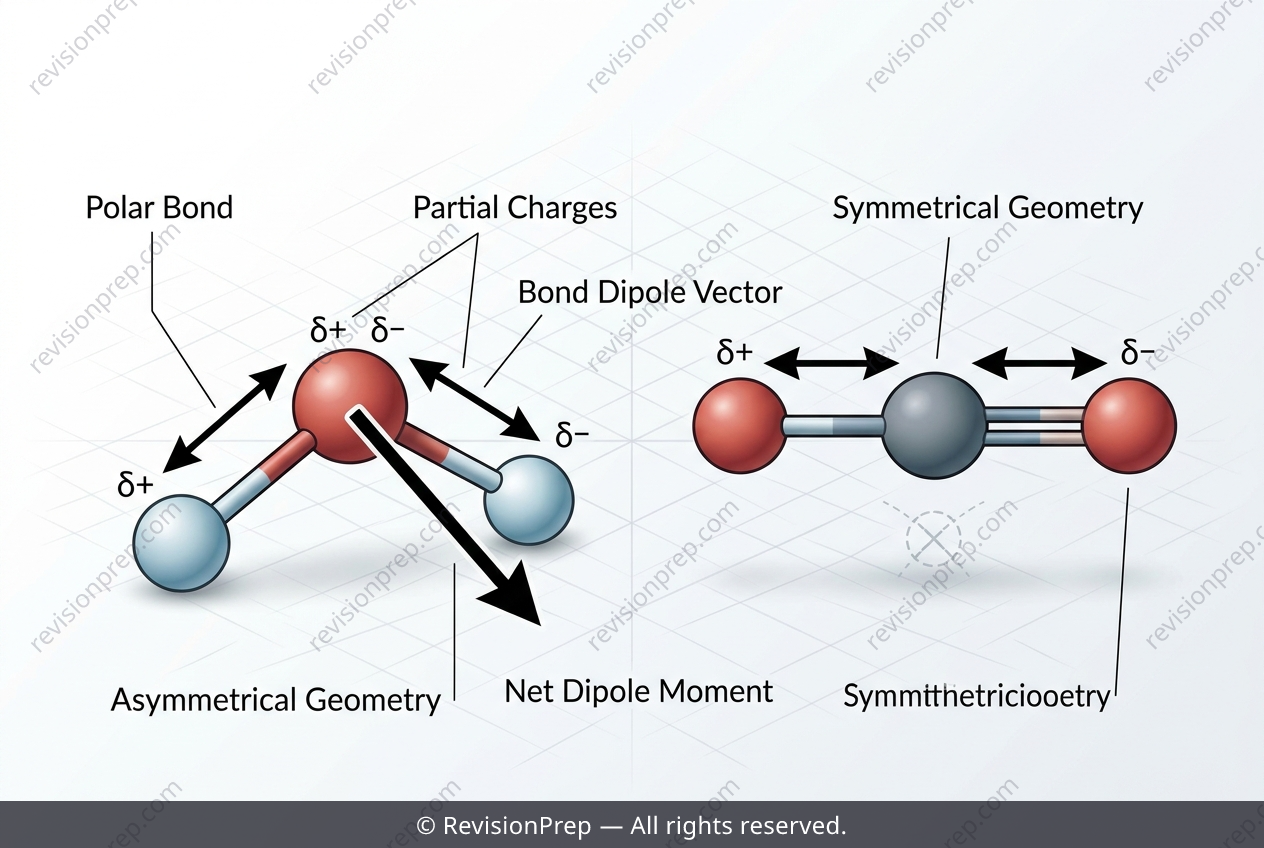
When two atoms in a covalent bond differ in electronegativity, the shared electron pair is pulled unevenly, creating a polar bond with a partial positive charge on the less electronegative atom and a partial negative charge on the more electronegative one. In a C–Cl bond, chlorine’s higher electronegativity draws electron density away from carbon, producing a bond dipole moment that points from carbon toward chlorine. However, a molecule’s overall polarity is not simply the sum of its individual bond polarities—it depends on how those bond dipoles are arranged in three-dimensional space. This is where molecular geometry and vector addition become essential. In 1,4-dichlorobenzene, the two C–Cl bonds lie directly opposite each other (180° apart). Because their magnitudes are equal and their directions are exactly opposed, the vectors cancel, giving a net dipole moment of zero. In 1,2-dichlorobenzene, the two bonds are on adjacent carbons (about 60° apart), so their dipoles do not point in opposite directions; vector addition leaves a non-zero resultant. Thus, identical atoms can yield completely different molecular polarities purely due to geometry—a key idea linking structure, symmetry, and physical properties like solubility or boiling point.
Start practising IB questions today
150,000+ IB-styled questions, criteria-mapped and instantly accessible.